

Questions and answers on trigeneration
In brief. All questions and answers from the pages of this site, grouped by section: 65 questions. The list is at the top; each answer links to the page it comes from.
Trigeneration in brief
Will trigeneration pay back if the site has enough electrical capacity for now?
It may not: the benefit comes from replacing grid kilowatt-hours and avoiding the fee for new capacity. If the connected capacity will not be enough in the future and you need the power anyway, the calculation changes. That is why we calculate both cases.
↑ Back to the list of questions
How does payback change if surplus electricity cannot be sold to the grid?
The plant is sized for your own consumption. If your own load is small and there is no large cooling demand, the project is not justified: one of our customers turned it down for exactly this reason.
↑ Back to the list of questions
Can we see your equipment on an operating site and talk to the operators?
Yes. We will show a reference list of similar projects, arrange a site visit and, on request, give you customer contacts for a phone conversation.
↑ Back to the list of questions
Trigeneration
How much heat for an absorption chiller will gas engines give?
The Jenbacher JMC 320 gives about 1.15 kW per 1 kW of output, the JMC 420 about 1.01. Ask for a table for the 100, 75 and 50% points, separately for exhaust and water. Cooling is free only while the unit runs at rated output for the whole season.
From the page: Trigeneration: electricity, heat and cooling from one gas supply
↑ Back to the list of questions
What type of absorption chiller is best with gas engines?
The classic: the jacket and the exhaust heat exchanger heat water for a single-effect machine. More cooling comes from ordering the gas engine without a heat recovery module and feeding the exhaust at about 400 °C directly. This takes experience: sometimes there is a lot of exhaust gas and little demand, and the excess goes past the machine.
From the page: Trigeneration: electricity, heat and cooling from one gas supply
↑ Back to the list of questions
Can surplus heat from polymer extruders be turned into cooling?
Yes, if the heat transfer fluid is hotter than 80 °C. The hotter it is, the cheaper the machine for the same cooling. The second lever is on the consumer side: if the line can work with water at 9–10 °C instead of 7, the machine often drops one frame size. Allow for changeovers: when the extruder stops, there is no heat, and during those hours someone else has to supply the cooling.
From the page: How a Trigeneration Plant Works
↑ Back to the list of questions
What failures are typical for absorption machines, and why is solution crystallization dangerous?
Besides crystallization, there is freezing of water in the evaporator with tube rupture (usually after a power outage), loss of vacuum and solution spills. Machines with spray nozzles and a small margin to the crystallization line are at greater risk: when power is lost, the solution stays at the top. Ask the supplier what exactly is installed in the machine. A crystallization prevention system and a decrystallization system, which only warms the machine back up after a failure, are different things.
From the page: How a Trigeneration Plant Works
↑ Back to the list of questions
In summer the emergency dry coolers of the gas engine cannot cope and output has to be reduced. How do we solve the overheating?
First, the gas engine datasheet and the actual parameters of the installed dry coolers are requested, and the missing cooling is calculated. Then the risks of running on the emergency circuit are described, and dry coolers of the required capacity, or air coolers without an intermediate heat exchanger, are selected. If the site has a cooling consumer of 300 kW or more, it is worth calculating an absorption machine as well: it will take part of the heat that is now dumped to the air.
From the page: Cogeneration: What It Is and How It Differs from Trigeneration
↑ Back to the list of questions
Can the hot water that goes to the cooling towers at a combined heat and power plant be used for other needs?
It all depends on its temperature. Water at 75–120 °C is suitable as a drive for the machine. If it is colder, it will not work for cooling, but an absorption heat pump can take low-grade heat from the cooling water and deliver it to the district heating network as water at up to 90 °C. The assessment is made from a questionnaire: water temperature, flow rate, and how many hours a year the discharge runs.
From the page: Cogeneration: What It Is and How It Differs from Trigeneration
↑ Back to the list of questions
What does the pre-design of an energy center with an absorption chiller include, and how long does it take?
The pre-design (PP stage) includes a hydraulic schematic, a functional control diagram, a descriptive section and a specification of the main equipment. It takes about 40–45 working days. The pre-design is not enough to hand over the site: commissioning into operation requires detailed design documentation with piping, sections, controls and steel structures. For a gas-fired chiller, gas supply and flue gas sections are added; for a steam chiller, steam and condensate piping.
From the page: Trigeneration complex. What an energy center consists of
↑ Back to the list of questions
What size of expansion and buffer tanks is needed in the chilled and hot water circuits?
The exact volume is calculated from the system volume and the maximum and minimum hot water temperatures, and there may be several tanks in different sections. As a guide, in heating systems the tanks are up to 10 % of the system volume, and in cooling systems much less. Do not confuse an expansion tank with a chilled water storage tank: the storage tank is needed to support the consumer while the chiller reaches its operating mode, and it is sized by how many minutes the site can do without cooling.
From the page: Trigeneration complex. What an energy center consists of
↑ Back to the list of questions
Where does the heat of an absorption heat pump go in summer, when space heating is off?
You need a backup heat sink: a cooling tower or a dry cooler for the remaining capacity. Without it the unit hits its upper temperature limit and goes into dilution, and the steam is wasted. The heat pump takes heat from the cooling water and delivers it to the district heating network, so for summer, when the network takes less, the heat sink question is settled at the design stage, not during commissioning. Equipment details are in the "Absorption heat pump" section.
From the page: Distributed energy and on-site generation at an industrial plant
↑ Back to the list of questions
What flue resistance is allowable for a gas-fired absorption chiller?
Less than 5 mm H2O at the machine outlet. The stack is designed so that it removes the gases on its own: velocity 3.6–4.6 m/s, design temperature at least 360 °C with flue gas leaving at 190 °C, condensate only through a water seal. For every 300 mm of horizontal run, 180 mm is added to the stack height, and for every 90° bend another 1.2 m. A long flue with such bends leaves the burner short of full output.
From the page: Trigeneration Mistakes: Why It Fails to Pay Back
↑ Back to the list of questions
How do you back up exhaust-fired absorption chillers when the gas generator stops?
A built-in burner makes up the shortfall; just include its consumption in the allocation request from the start. A standalone gas-fired absorption chiller covers the remainder and in winter heats water to 95 °C on its own.
From the page: Trigeneration Mistakes: Why It Fails to Pay Back
↑ Back to the list of questions
Types
Does it make sense to install an absorption chiller on flue gas at about 160–170 °C to cool a large data center?
For a Thermax exhaust-fired chiller, the standard inlet temperature is 350–600 °C, or 270 °C in a special design, and the gas leaves at 170 °C (130 °C in the special design). Gas at 160–170 °C is already a residue; it will not drive the chiller. It is a different matter if this temperature is measured after an existing heat recovery steam generator: then the chiller can be installed upstream of it, on the hot gas. To answer, we need the temperature and flow before and after the heat recovery unit.
From the page: Types of trigeneration. Comparison of prime movers and absorption chillers
↑ Back to the list of questions
Can an absorption chiller deliver propylene glycol at −6 °C if the heat source is a gas engine with a 97/70 °C circuit?
Not on 97/70 °C water. Sub-zero outlet temperatures are produced only by double-effect lithium bromide chillers, which need a hotter source, and their limit is −5 °C in a special design.
From the page: Types of trigeneration. Comparison of prime movers and absorption chillers
↑ Back to the list of questions
What pressure drop is acceptable on the heat exchanger of an exhaust-fired absorption chiller? Will the engine get back pressure?
Engine heat exchangers allow about 500 mm H2O. If the chiller is designed for 500, the limit will be exceeded together with the bends, up to the point of damaging the pistons. That is why Thermax allows 250 mm for the chiller, and the rest is left for the duct run.
From the page: Trigeneration with a gas engine
↑ Back to the list of questions
Why does a gas engine data sheet show several exhaust gas temperatures, and which one should be used to size the absorption chiller?
Because at lower load, less combustion energy goes into mechanical work and more into heat. The bmep 13.5 mark corresponds to 75 % load, and bmep 9 to 50 %. The calculation should be based on the real operating profile, not on a single line.
From the page: Trigeneration with a gas engine
↑ Back to the list of questions
Can an old absorption chiller be replaced with a new exhaust-fired one with a backup burner?
Yes, the factory selects such a machine from the site data. A burner is needed if the turbine may be down while cooling is still required. The old flue duct is rechecked, since it was designed for a different machine. The gas consumption and electrical power of the burner (0.75–15 kW depending on the model) are written into the specification from the start; otherwise you may be refused the allocation after the design is already done.
From the page: Trigeneration on a Gas Turbine
↑ Back to the list of questions
How much can we cool the air at the turbocompressor intake if we have surplus steam?
First the cooling is calculated: a double-effect machine takes dry saturated steam at about 1.08 kg/h per 1 kW, so one ton per hour gives roughly 0.9 MW (calculated). With steam up to 3.5 bar you get half as much. How many degrees this cooling removes depends on the air flow. You need the initial and target temperatures, and the steam pressure and flow. Superheat must not exceed 10 °C.
From the page: Trigeneration on a Gas Turbine
↑ Back to the list of questions
Can the heat of diesel generator sets be used in an absorption chiller to cool computing equipment?
Yes, but computing loads come with a condition: the chiller takes about 30 minutes to reach its operating mode, and the racks cannot wait that long. You need a chilled water storage tank or a backup chiller for 5–20 % of the load nearby. If the racks can take warmer water than usual, the chiller can be smaller: every degree above 7 °C adds capacity.
From the page: Diesel power plant with heat recovery and cooling
↑ Back to the list of questions
Feasibility
What is the payback period of an absorption chiller?
Published cases range from less than a year on waste steam to 5–10 years. A standalone direct-fired absorption chiller without on-site generation, compared with a modern chiller with free cooling, comes out at about 11 years, and with a grid connection fee at about 6.8 years: it gets no gain from your own electricity.
From the page: Trigeneration feasibility study: six calculations for different sites
↑ Back to the list of questions
When is an absorption chiller more cost-effective than an electric chiller?
With a high or rising tariff, capacity charges, cheap gas or waste heat, and also with frequent grid outages. A high chiller COP does not mean lower costs. The limits beyond which the scheme needs to be rechecked: a tariff below RUB 5/kWh or gas more expensive than RUB 11/m³.
From the page: Trigeneration feasibility study: six calculations for different sites
↑ Back to the list of questions
Will trigeneration pay off if the site still has enough electrical capacity?
If the new load does not need additional electricity and the cooling demand is small, the project may not be justified. If the connected capacity will not be enough in the future, the scheme can pay off. A grid connection costs from RUB 20,000 to 100,000 per kilowatt, so look at the margin in the grid connection specifications three to five years ahead. And check the limits: at a tariff below RUB 5 or gas above RUB 11, the calculation must be rechecked separately.
From the page: How to calculate trigeneration payback: formulas and pitfalls
↑ Back to the list of questions
Does the payback calculation include the cost of the cooling tower, pumps and piping?
In our model, yes: RUB 65,000 per kilowatt of cooling covers the machine, cooling tower, pumps and controls. What is more often missed is operation. For the machine alone, the specification gives 5–10 kW per MW; with all the auxiliaries, 46–130. Make-up water for the cooling tower of a 5 MW double-effect absorption chiller is about 12.5 m³/h; for a single-effect hot water machine, evaporation alone is about 18 m³/h, plus blowdown. Ask for these lines separately in the commercial proposal and check that the water and pump electricity are included too.
From the page: How to calculate trigeneration payback: formulas and pitfalls
↑ Back to the list of questions
How do we compare the costs of an absorption chiller and an electric chiller at our tariffs, connection fee and gas price?
Start with the grid connection specifications: the connection rate charged by the grid company. In the model it is RUB 47,000 per kilowatt; in different regions it ranges from RUB 20,000 to 100,000, and at a site with a capacity shortage it decides the outcome. Then compare the full cost of a kilowatt-hour of cooling, not the datasheet COPs: it includes make-up water (a 5 MW double-effect lithium bromide absorption chiller takes about 12.5 m³/h of water, a single-effect one more), machine service, and the cooling tower, which is noticeably larger for absorption.
From the page: Trigeneration calculator: payback in a minute
↑ Back to the list of questions
How much electricity does an absorption chiller consume?
The machine itself uses 5–10 kW per megawatt of cooling, less than 10% of an electric chiller of the same capacity. The whole plant with pumps and cooling tower fans takes 46–130 kW per megawatt, a compressor chiller 180–350. The calculator uses the lower bound, 46, so for long pipelines and high pump heads you need to add a margin manually.
From the page: Trigeneration calculator: payback in a minute
↑ Back to the list of questions
Can a data center get cooling from gas engine heat, and what will the payback be?
Yes, using hot water from the gas engines. The calculation needs the inlet and outlet temperatures and the heat transfer fluid flow rate; the heating medium must be at least 80 °C. If exhaust heat is used directly, a double-effect machine with a coefficient of 1.40–1.45 gives roughly twice as much cooling per kilowatt of heat as a single-effect hot-water machine with 0.65–0.72, but the engine has to withstand the machine's gas path resistance of 200–250 mm H2O. The payback depends on the tariff and the capacity charge; in our model it is 1.5 to 4.1 years.
From the page: Trigeneration Feasibility Study for a Data Center
↑ Back to the list of questions
Can cooling be produced on gas if there is not enough electrical capacity?
Yes: gas-fired absorption chillers are used where electrical capacity is short, including for data centers. For 5,000 kW of cooling such a machine uses 380–700 m³/h of gas. The hourly consumption limit and the pressure at the connection point must be agreed in advance: sometimes they become an obstacle sooner than the price does.
From the page: Trigeneration Feasibility Study for a Data Center
↑ Back to the list of questions
Will a hot-water absorption chiller after a gas engine pay back if cooling now comes from conventional chillers?
Payback is calculated from a questionnaire with the electricity price at the site and the cooling load (process plus air conditioning). It matters whether your chillers are already installed. In our model, the baseline chillers are bought new, and their cost (RUB 60.0 million) is deducted from the difference in investment. If they were bought long ago, there is no offset: the difference in investment grows by RUB 60 million, and the period by about half a year. On the other hand, the old chillers can be kept for peak and backup.
From the page: Trigeneration feasibility study for a dairy plant
↑ Back to the list of questions
Will an absorption chiller pay back?
An absorption chiller costs more than an electric chiller, but heat is usually cheaper than electricity or free, and connecting an extra electrical kilowatt is expensive in itself: for example, 1,000 kW of capacity costs RUB 20 to 100 million at rates of RUB 20,000 to 100,000 per kilowatt. If the calculated payback is over five years, choosing an absorption chiller is questionable. Large facilities with their own gas-fired absorption chillers, which work for heating in winter instead of a boiler house, sometimes turn out cheaper than electric ones. The decision is made only on the basis of a feasibility study.
From the page: Trigeneration Feasibility Study for a Pharmaceutical Plant
↑ Back to the list of questions
What to choose: an absorption chiller or a compressor chiller, for example for a business center or a shopping mall?
It depends on whether there is a steady source of cheap heat or waste heat. If there is, the lithium bromide absorption chiller covers the base load, an electric chiller covers the peaks, and the scheme is called a hybrid. N+1 redundancy is provided for separately in the design. If there is no heat or it is unstable, a compressor chiller is installed. An absorption chiller always works together with a cooling tower, and its cooling tower is almost twice as large. You need to compare the cost of a kilowatt-hour of cooling, not the COP.
From the page: Trigeneration feasibility study for a shopping mall
↑ Back to the list of questions
How does the payback of a gas engine with an absorption chiller change if surplus electricity cannot be sold to the grid?
Without selling the surplus, and without your own need for additional electricity and a large volume of cooling, the project is not justified. That is why the gas engine capacity should be chosen for your own load and heat, not for the output you would like to have. In our model there is no surplus by design: all output is consumed, and that is exactly what keeps the payback at 2.0 years. A 2014 UK survey named sizing for electricity rather than for the heat load as the reason for the weak finances of older schemes.
From the page: Trigeneration feasibility study for a greenhouse complex
↑ Back to the list of questions
Does it make sense to install an absorption chiller on the heat of a small 100–350 kW gas engine?
As a rule, no. Hot water of about 300 kW at 85 °C is usually not enough for an absorption chiller, especially if cooling is not critical, and such a project loses to vapor-compression cooling. At a coefficient of 0.75, that is about 225 kW of cooling, below the 300 kW threshold. Small absorption chillers are expensive per kilowatt, and gas engine suppliers confirm that there is no point at these capacities. In any case, the calculation needs the inlet and outlet temperatures and the heating medium flow.
From the page: When trigeneration does not pay back: a business center
↑ Back to the list of questions
Equipment
A hot-water absorption chiller fed by a gas engine at 90/70, or a conventional chiller, if you need 6 MW of cooling at 7/12 °C?
Count not 6 but 8–8.6 MW of input heat; with this temperature schedule, that is about 345–370 m³/h. Heat rejection through the cooling towers will be twice as large: 14–14.6 MW versus 7.1–7.2 MW for a vapor-compression unit, but the latter draws 1–1.2 MW from the grid. The rated capacity is given at a higher inlet temperature, so a correction is applied for 90 °C.
From the page: Gas engines for trigeneration
↑ Back to the list of questions
How much cooling can you get from 1 MW of heat?
Roughly 0.65–1.45 MW, depending on the chiller type. After that, the temperature difference of the source decides: at a COP of 0.7, 1,000 kW of cooling takes 1,430 kW of heat, and with a 10 K temperature difference you need 123 m³/h of heating water, while with 5.6 K it is already 220 m³/h. On the engine side, everything is more modest: 1 MW of gas leaves about 450 kW of heat, which is roughly 360 kW of cooling.
From the page: Thermax absorption chillers, series, COP and capacity
↑ Back to the list of questions
Can a gas-fired absorption chiller supply hot water along with cooling?
Yes, as a chiller-heater: up to 60 °C through the evaporator circuit and up to 95 °C through an additional heat exchanger. There are "both heating and cooling" and "either heating or cooling" modes; in one of the selections, heating was at 55/60 °C. For winter heating, the cooling tower circuit is isolated and drained, the absorber insulation is chosen to withstand up to 80 °C, and the position of every valve is posted in a table next to the unit. That is why the heating mode is specified right away in the order.
From the page: Thermax absorption chillers, series, COP and capacity
↑ Back to the list of questions
What is the minimum hot water temperature an absorption chiller needs?
The LT series works from 70 °C, but its capacity is then well below nominal. It makes economic sense from 80 °C. The nominal conditions are 90.6/85 °C for LT and 90/80 °C for 5G. The factory selects the chiller for your mode based on supply temperature, return temperature and flow, so send the temperature schedule right away, not a single figure.
From the page: Thermax absorption chillers, series, COP and capacity
↑ Back to the list of questions
What is the coefficient of performance of an absorption chiller, if a Chinese unit is claimed at 1.4?
The figure 1.4 by itself proves nothing: for gas-fired and high-pressure steam chillers, it is about the same for all manufacturers. On hot water from an engine you get about 0.8, half as much, and that is a different design, with one stage instead of two. Ask the supplier at what heating medium, temperatures and flows the coefficient was obtained, and compare only identical conditions.
From the page: Thermax absorption chillers, series, COP and capacity
↑ Back to the list of questions
Is lithium bromide dangerous if the solution leaks?
Lithium bromide is a salt solution: it does not burn or explode. The pressure inside the chiller is below atmospheric, so if the unit loses tightness, air gets in rather than solution being forced out. The refrigerant in the chiller is water, with zero ozone depletion and global warming potential. A leak is dangerous above all for the chiller itself: air spoils the vacuum, and poor vacuum leads to solution crystallization. That is why the purge of non-condensable gases is checked daily.
From the page: Thermax absorption chillers, series, COP and capacity
↑ Back to the list of questions
The chiller is much larger than an electric chiller. Will it fit into our plant room?
An absorption chiller is usually one and a half to two times larger than a compressor chiller of the same capacity and noticeably heavier, so the floor slab may need strengthening. For new gas-fired chillers, the room is kept within +8…+45 °C, with humidity up to 90 % without condensation. Clearances: 500 mm on each side, 200 mm above, 1,200 mm on the control panel side, plus space at one end for tube cleaning, which is 4,300 mm for a 700 kW chiller. Send us the room layout: the arrangement and the rigging route are checked before ordering.
From the page: Thermax absorption chillers, series, COP and capacity
↑ Back to the list of questions
Can the flues of two or more absorption chillers be connected to one stack?
It is not recommended. While one machine is stopped, flue gas condensate from neighboring equipment can get into the common stack and header, and corrosion starts. If a common stack cannot be avoided, the connections are made at least 1 m apart vertically, with a condensate collector and an automatic damper on the branch from the stopped machine.
From the page: Exhaust-fired absorption chillers and Trigenie: cooling from engine exhaust and jacket water
↑ Back to the list of questions
What heat can an absorption chiller run on: steam, hot water, exhaust, gas?
Any of them, plus diesel and process heat: in one Thermax case, it is steam from frying potato chips. Each medium has its own condition. Steam needs a dryness fraction of 0.99, while boilers usually give 0.95–0.97, so a separator is installed. A burner needs gas at 60–100 mbar; above that, a pressure reducing station is installed. Hot water is economically justified from 80 °C.
From the page: Exhaust-fired absorption chillers and Trigenie: cooling from engine exhaust and jacket water
↑ Back to the list of questions
What does an absorption chiller plant with wet cooling towers look like for a large data center?
Three circuits: the heating circuit (for example, 95/80 °C hot water, steam or exhaust), the chilled water circuit to the consumer and the cooling tower circuit with a three-way valve. In the Thermax catalog a single 2B series chiller gives up to 8.8 MW, so for tens of megawatts several units are installed with N+1 redundancy. For example, a plant room for two 5,000 kW chillers takes 120–150 m² with a height of 5.5 m or more: each unit needs clear space for tube pulling. The area for cooling towers for a 5 MW data center is 2.3–2.5 times larger than with chillers.
From the page: NCT cooling towers for absorption chillers: which one you need and why it is larger than for a chiller
↑ Back to the list of questions
How does a gas engine + absorption chiller + cooling tower combination work in winter, in severe frost?
In winter the engine heat goes to space heating, hot water and process needs, and if no cooling is needed, the absorption chiller stands idle. The cooling tower needs a winter package (electric heater, heating cable, dry coil section), and the VR centrifugal fan does not ice up. A chiller with water inside must stand in a heated room above +5 °C. If cooling is needed in winter too, as in a data center or for a process, the same bypass works: the water at the chiller inlet must not drop below 10 °C for a double-effect unit and 20 °C for a single-effect unit. On a direct-fired chiller in heating mode, the cooling water circuit is isolated and drained.
From the page: NCT cooling towers for absorption chillers: which one you need and why it is larger than for a chiller
↑ Back to the list of questions
Applications
What can hot water from production be used for after it has cooled the equipment?
Look at the temperature and the hours. Water from 75 °C is suitable as a drive for an absorption machine; from 80 °C it makes economic sense. Colder water goes to space heating or to an absorption heat pump, which raises its heat to 90 °C. Before selecting anything, build an hourly profile: how many hours a year the water is actually available and when cooling is needed.
From the page: Who Trigeneration Suits
↑ Back to the list of questions
Is gas engine heat enough for all the cooling of a 30 MW data center?
No. With water at 95/75 °C, the plant delivers about 30.2 MW, and single-effect chillers will make 22–24 MW of cooling from it. For 30 MW you need 38–43 MW of heat, or a 6–8 MW vapor-compression chiller. The 12/7 °C circulation flow will be about 5,200 m³/h. Water from the cooling towers at a 22 °C wet-bulb temperature will be 26–27 °C, and the towers have to be sized for 52–55 MW.
From the page: Data center cooling with trigeneration
↑ Back to the list of questions
How do you provide N+1 redundancy for a gas engine and absorption chiller combination?
After a failure, the standby unit takes about 5 minutes to reach rated output, and all that time the chiller gets less heat. The dip is covered by a 10–15% margin on the engines and a gas-fired hot water boiler house. Selection requires the exhaust temperature and flow, the jacket water schedule (for example, 93/78 °C) and the capacity of each circuit.
From the page: Data center cooling with trigeneration
↑ Back to the list of questions
What happens to an absorption chiller if the power goes out?
The chiller survives an outage of up to 3 minutes. If it lasts longer, a dilution cycle is needed; without it, the solution may crystallize. That is why an uninterruptible power supply or a backup feed is provided specifically for the chiller, not only for the racks.
From the page: Data center cooling with trigeneration
↑ Back to the list of questions
Can a hot water absorption chiller produce water at about +3 °C?
Yes. A low-temperature hot water chiller with a +3 °C outlet is selected by the factory as a non-standard unit. It cannot be supplied from stock. A non-standard tube material may be required, and this affects cost and weight. That is why it is better to state the outlet temperature in the first inquiry, not after the series has been chosen.
From the page: Trigeneration for dairy plants and food production
↑ Back to the list of questions
What if there is no hot water?
The concept includes a backup vapor-compression chiller for the period without hot water. If the cooling is transmitted over hundreds of meters, a 5/14 °C schedule is used, and modular open cooling towers are installed with the absorption chiller. The choice between chillers and absorption chillers is made at the feasibility study stage.
From the page: Trigeneration for dairy plants and food production
↑ Back to the list of questions
What happens to an absorption chiller if power is lost, and what should be done with the engine exhaust?
Without backup power, there is a high risk of solution crystallization, especially in double-effect chillers and at a high heating medium temperature. In a short outage, a fast restart and built-in dilution algorithms help. There is an option of uninterruptible power for a normal shutdown, which is calculated individually. On an exhaust-fired chiller, the damper is powered from the engine: if the chiller stops or the power is lost, the exhaust goes around it.
From the page: Trigeneration for pharmaceutical production
↑ Back to the list of questions
Will an absorption chiller work if the heat transfer fluid is only about 75 °C in summer?
Low-temperature chillers are considered for a 7/12 °C schedule, but the capacity with such water is noticeably below nominal. The LT series works from 70 °C and is economically reasonable from 80 °C. In one project, the customer compared the options, chose direct gas firing and requested a calculation for 1 and 2 MW.
From the page: Trigeneration for shopping malls
↑ Back to the list of questions
Is there a hot water absorption chiller with a gas burner? Which chiller should I choose for trigeneration?
No, these are different machines: hot water chillers have no burner; a burner exists only on direct-fired chillers and on exhaust-fired chillers with a burner option. For trigeneration, the type is chosen by the main heat source: exhaust, jacket water or direct firing. Dimensions and weight are tied to a specific model and confirmed with the factory.
From the page: Trigeneration for business centers, hotels and hospitals
↑ Back to the list of questions
Can we install an absorption chiller if all we have is 45 °C hot air from an extrusion line?
No, that is too little to drive it. Usually trigeneration with a gas engine generator set is considered, where the engine becomes the heat source. For selection we need the inlet and outlet temperatures of the chilled water, the makeup water source and the reserve of electrical capacity.
From the page: Trigeneration for factories, electronics and power generation
↑ Back to the list of questions
Can we get cooling for distillation column condensers from the heat of process vapors through an absorption chiller?
Technically this is justified if there is surplus heat. 1 MW of heat will give roughly 0.8–1.4 MW of cooling, depending on the heat transfer medium. The equipment is a self-contained unit that fits into the existing scheme.
From the page: Trigeneration for factories, electronics and power generation
↑ Back to the list of questions
We want to recover secondary heat from a process unit (hot water) through an absorption chiller. What data is needed?
Supply and return temperatures, available flow rate, hourly profile and whether it is available year-round. On the cooling side: the load profile, temperatures and medium. Then the electricity tariff, gas and water prices, a laboratory analysis of the makeup water, the plant room dimensions and the rigging route, and space for the cooling tower. While even one item is blank, it is too early to send a selection request.
From the page: Trigeneration for factories, electronics and power generation
↑ Back to the list of questions
Testimonials
Can we see the equipment in operation and talk to the operating staff?
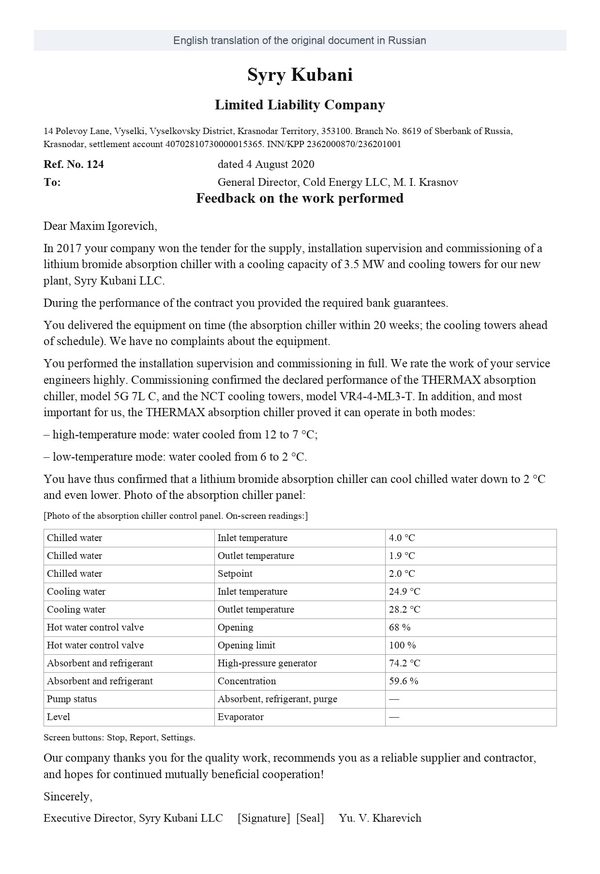
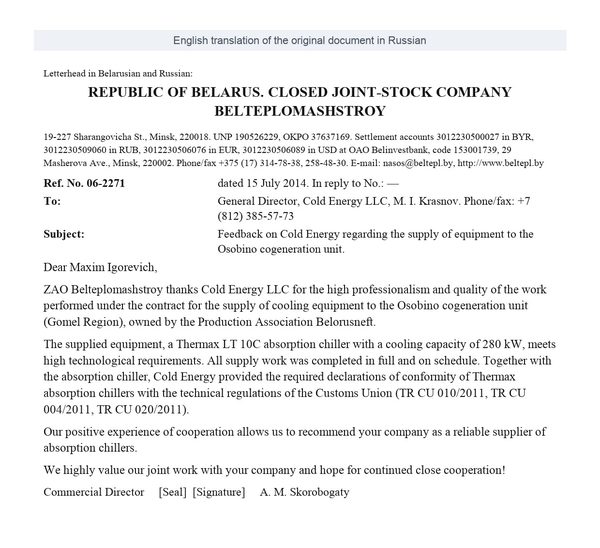
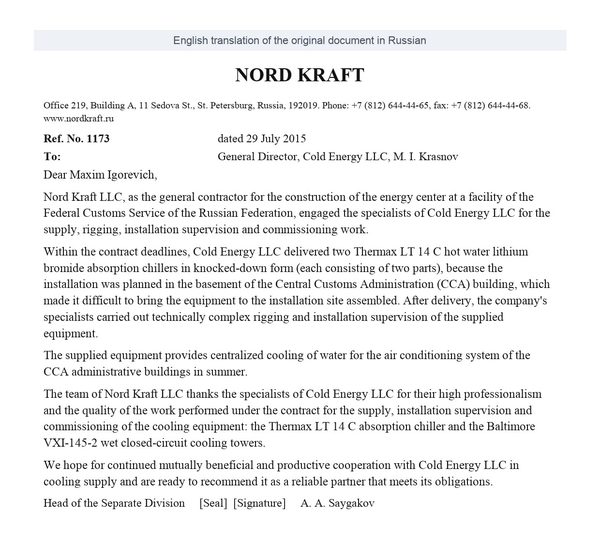
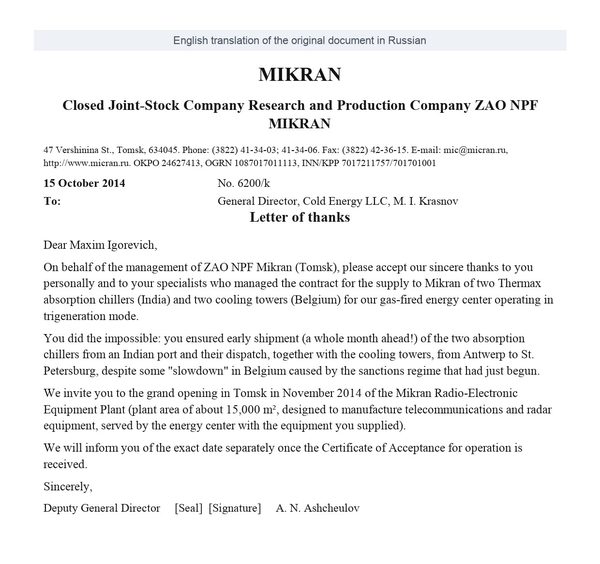
Yes. Besides the letters, we offer reference lists of similar projects and visits to operating sites, for example an absorption chiller at a gas turbine power plant. On request, we give customer contacts so that you can get a review by phone, not just from a scan.
From the page: Customer Reviews of Trigeneration and Thermax Absorption Chillers
↑ Back to the list of questions
Company
Are storage tanks needed in the chilled and hot water circuits with an absorption chiller?
In the 7/12 °C chilled water circuit, in most cases no: the absorption chiller modulates smoothly from 10 to 100%, the system has a large water volume and the load is stable. Storage tanks are usually not used in the hot water circuit (not to be confused with expansion tanks). For year-round operation, an intermediate cooling water tank is installed after the cooling tower if there is no central cooling water system. The exception is a continuous load, where a chilled water tank is needed to cover the time the machine takes to reach its operating point, about 30 minutes.
From the page: Trigeneration and absorption chiller design: stages, input data, typical mistakes
↑ Back to the list of questions
Can you calculate gas engine emissions for the environmental section?
We do not: designers do this by the approved method in the environmental section. Take the NOx and CO limits from the engine datasheet, and add the noise limit in the installation zone (industrial or residential), the design (containerized or open) and the altitude above sea level.
From the page: Trigeneration and absorption chiller design: stages, input data, typical mistakes
↑ Back to the list of questions
What are the requirements for the installation contractor?
The Thermax documentation sets no numerical requirements for the contractor's years of experience. The requirements are different: installation according to the manual, the design and the P&ID diagrams of the specific chiller and to local codes; the first start-up only under the supervision of a Thermax service representative, which in Russia means our engineers. Work by uncertified personnel and design changes void the chiller warranty, which is why we offer installation supervision as a separate service.
From the page: Trigeneration installation and commissioning, what is done on site and in what order
↑ Back to the list of questions
What must be ready when the commissioning engineers arrive?
The piping is flushed, pressure gauges and air vents are installed, pump interlocks are connected, and the power supply is checked. The vacuum pump needs oil at start-up, at least 5 liters. The customer's mechanic attends the first start-up and is trained there: warranty work relies on this.
From the page: Trigeneration installation and commissioning, what is done on site and in what order
↑ Back to the list of questions
How do you restart an absorption chiller after a power interruption?
The burner and pumps stop, and the solution drains from the trays under gravity. When power is restored, the chiller goes into dilution and shows a "Power failure" alarm. Then, according to the manual for new gas-fired chillers: an interruption of less than 5 minutes means dilution can be skipped and the chiller restarted; more than 5 minutes means it starts only after dilution; more than half an hour means a start and stop for the sake of the dilution cycle, then a check for crystallization. For 2V series chillers in heating modes, the limit is 3 minutes rather than 5, so the procedure is taken from the manual of your specific chiller.
From the page: Service for trigeneration equipment, scheduled maintenance, diagnostics, monitoring
↑ Back to the list of questions
Does the site need a permanent trained operator?
Our service engineers train the customer's staff during commissioning. It takes 2–3 days and is recorded in a certificate, which the factory may request in a warranty case. The customer's mechanic must be present at the first start-up. With a service contract, a permanent specialist on site is not required, but someone still has to do the daily log checks.
From the page: Service for trigeneration equipment, scheduled maintenance, diagnostics, monitoring
↑ Back to the list of questions
When should the bearings of the solution and refrigerant pumps be replaced?
The pumps are serviced once a year. Bearing replacement under our service regulations is a guideline of 50,000 operating hours: about 5.7 years of round-the-clock operation, or about 11 years at 12 hours a day. The actual condition is shown by the bearing wear indicator, if one is fitted on the chiller; a pump in the red zone must not be operated.
From the page: Service for trigeneration equipment, scheduled maintenance, diagnostics, monitoring
What our customers say
150 letters of thanks · 350+ major projects · 1,000+ customers · in business since 2011. These are real letters from customers; many others are on the testimonials page.
Let us calculate trigeneration for your site
An engineer will put together the scheme and select the equipment, and you get a feasibility study. Free of charge, no obligation.