

Trigeneration Feasibility Study for a Data Center
In brief. For a data center with 5 MW of cooling and a year-round load, the model gives savings of RUB 260.0 million a year and a payback of 2.1 years. This is a model calculation and a reference point based on typical prices.
For a data center with a peak cooling load of 5,000 kW and an electrical load of 3,850 kW, the model gives a payback of 2.1 years with the grid connection in place and 1.1 years if the electrical capacity had to be connected. Here cooling and electricity are needed all year round, and nearly all of the engine heat finds a use.
The calculation is a model and a reference point: typical prices and investments, not a commercial proposal. The main savings come from own-generated electricity. The general rules of the model are described on the page how to calculate payback.
What site did we calculate?
Cooling of 5,000 kW at 6,130 full-load hours a year, electrical load excluding cooling of 3,850 kW all year round. The baseline is a modern chiller with free cooling and a seasonal COP of 5.5: we deliberately took a strong comparison option. With an old chiller the result would look better, but that comparison would not be fair.
What did we get?
| Item | Value |
|---|---|
| Peak cooling | 5,000 kW |
| Full-load cooling hours | 6,130 h/year |
| Electrical load excluding cooling | 3,850 kW, 8,760 h/year |
| Reference chiller, seasonal COP | 5.5 |
| Gas engine output | 35.3 million kWh/year |
| Required generating capacity | about 4,700 kW |
| Gas | 9.5 million m³/year |
| Own electricity | RUB 3.72/kWh vs RUB 10 from the grid |
| Cooling from waste heat | 97% of annual demand |
| Costs: grid and chiller | RUB 399.5 million/year |
| Costs: trigeneration | RUB 139.5 million/year |
| Savings | RUB 260.0 million/year |
| Capex: trigeneration | about RUB 694.3 million |
| Capex: chillers | about RUB 150.0 million |
| Payback of the difference, grid capacity available | 2.1 years |
| Payback if a grid connection is needed | 1.1 years (connection fee RUB 259.3 million) |
Heat from the gas engines covers 97 % of the annual cooling demand; the rest is covered by a chiller powered by the same gas engines. Own-generated energy costs RUB 3.72/kWh versus RUB 10 from the grid. Most of the savings come from this electricity. Cooling gives the engine heat a job all year round and takes the chiller load off the grid.
What happens at a different tariff and gas price?
| Gas, RUB/m³ | Power RUB 7.5 | Power RUB 10 | Power RUB 12 |
|---|---|---|---|
| 7 | 3.0 years | 2.0 years | 1.5 years |
| 9 | 3.4 years | 2.1 years | 1.6 years |
| 12 | 4.1 years | 2.4 years | 1.8 years |
The payback ranges from 1.5 to 4.1 years. The most conservative cell of the table, a tariff of RUB 7.5 and gas at RUB 12, gives 4.1 years: that is the one to rely on when making a decision.
What assumptions are in the calculation?
Tariff RUB 10/kWh, gas RUB 9/m³, water RUB 50/m³, gas engine efficiency 40 % electrical and 45 % thermal, gas engine service RUB 1.3/kWh. Investments are based on the company's 2026 model benchmarks: RUB 78,000 per kW of generation, RUB 65,000 per kW of cooling, RUB 30,000 per kW for the baseline chiller. These are benchmarks, not a price list, and in a real project they are replaced by the price from the commercial proposal. Simple payback, no discounting.
What does the calculation not take into account?
- Redundancy. A data center requires N+1 or more, and the model does not include standby engines or a second line. They will be added in the commercial proposal, and the payback will get longer.
- Start-up time. An absorption chiller needs about 30 minutes to reach operating mode; it survives a power loss of up to 3 minutes, and a longer one requires a dilution cycle. During the transition, cooling has to be carried by a chiller or cold storage.
- Rack density. Air cannot remove more than 50 kW per rack. With denser cooling schemes, temperatures and flow rates are different, which means a different machine.
- Hourly profiles. The equivalent 6,130 hours hide daily and seasonal dips.
Which of our sites is similar?
Our example of server room cooling from generation heat is the Central Customs Administration building in Moscow. Overall it is an administrative building rather than a data center, but part of the cooling there goes to server rooms. The second similarity is the shortage of electrical capacity: in the historic center there are five Capstone C200 microturbines and two LT-14 C machines of 500 kW each, which were delivered in parts and assembled in the basement. This is one of many sites; the rest are in the projects section. How the cooling circuit interfaces with the engine is described on the page about gas engines, and the sector's tasks are covered on the data center page.
What next?
If you have a site and technical conditions for grid capacity, send them through the feasibility study request or rough out the figures in the calculator. About the machine: Thermax absorption chiller.
Frequently asked questions
Can a data center get cooling from gas engine heat, and what will the payback be?
Yes, using hot water from the gas engines. The calculation needs the inlet and outlet temperatures and the heat transfer fluid flow rate; the heating medium must be at least 80 °C. If exhaust heat is used directly, a double-effect machine with a coefficient of 1.40–1.45 gives roughly twice as much cooling per kilowatt of heat as a single-effect hot-water machine with 0.65–0.72, but the engine has to withstand the machine's gas path resistance of 200–250 mm H2O. The payback depends on the tariff and the capacity charge; in our model it is 1.5 to 4.1 years.
Can cooling be produced on gas if there is not enough electrical capacity?
Yes: gas-fired absorption chillers are used where electrical capacity is short, including for data centers. For 5,000 kW of cooling such a machine uses 380–700 m³/h of gas. The hourly consumption limit and the pressure at the connection point must be agreed in advance: sometimes they become an obstacle sooner than the price does.
What our customers say
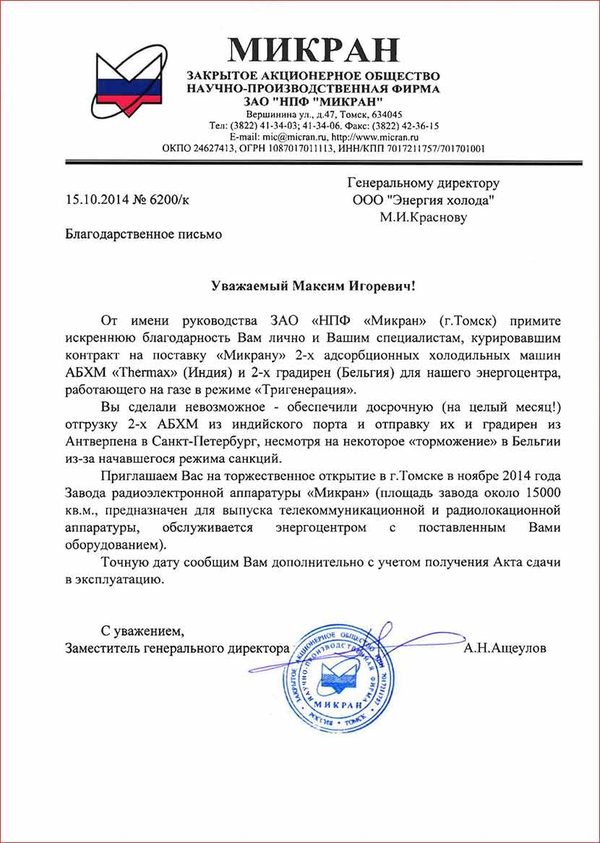
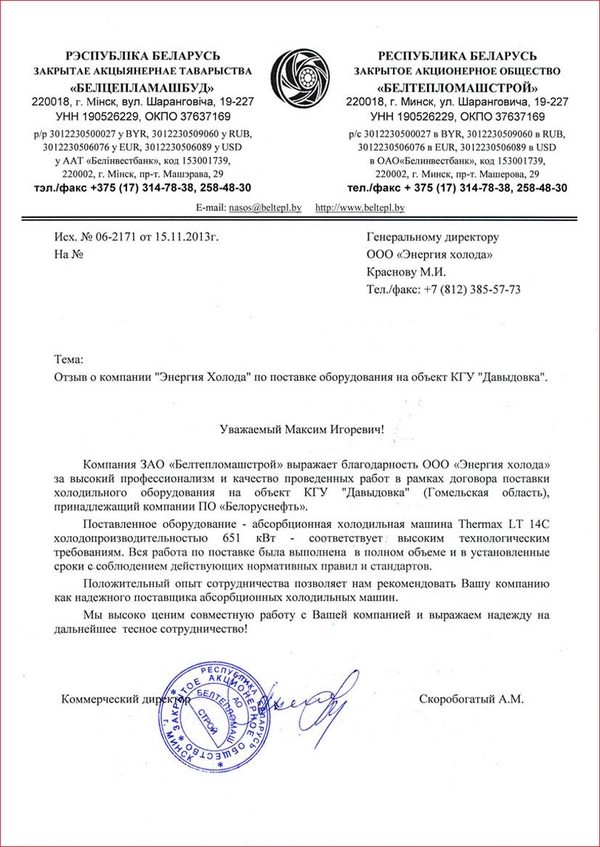
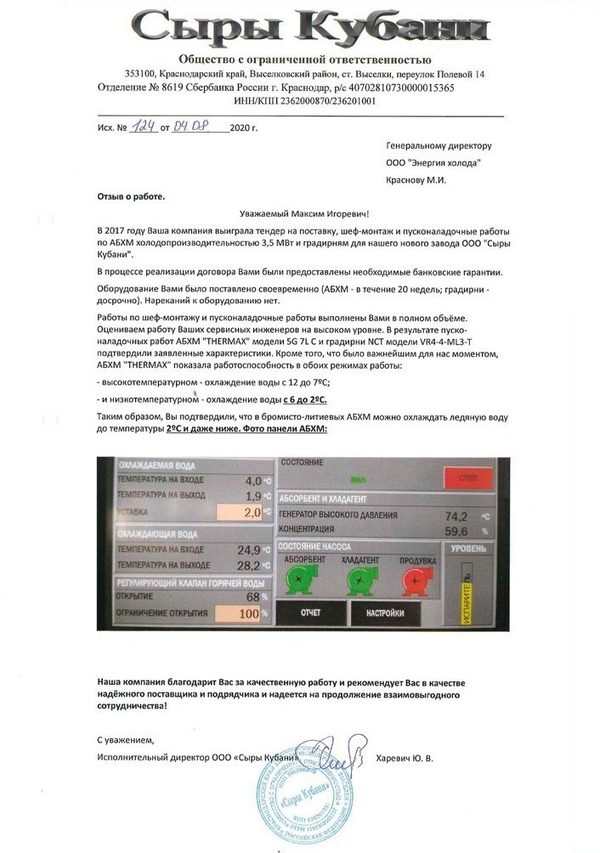
150 letters of thanks · 350+ major projects · 1,000+ customers · in business since 2011. These are real letters from customers; many others are on the references page.

Let us calculate trigeneration for your site
An engineer will put together the scheme and select the equipment, and you get a feasibility study. Free of charge, no obligation.