

History of cogeneration and trigeneration
In brief. Trigeneration is built from two old ideas. Absorption cooling was invented in the 1850s, the first district heating system in the US appeared in 1877, and mass growth of cogeneration in the US came after a 1978 law.
Trigeneration (CCHP) was not invented by one person in one year. It grew out of two lines: absorption cooling, known since the 1850s, and combined generation of electricity and heat, which became widespread after the 1978 US law. In Russia, Thermax machines running on engine heat have been working since at least 2006: this is the Moscow Region Government House, a project carried out without the participation of Cold Energy (NCT); our company has been working since 2011. Below are the events in order, with notes where historians and sources disagree.
When did absorption cooling appear?
The first machines ran on sulfuric acid and on ammonia, made ice and carried frozen meat across the ocean. The lithium bromide machines on which trigeneration is built today came later.
| Year | Event | What is known for certain |
|---|---|---|
| 1850–1858 | Carré creates the first absorption refrigerator | Historians disagree: 1850 or 1858, Edmond or Ferdinand |
| 1859–1860 | Ferdinand Carré's patent in France and the US | Only per Wikipedia; we did not open the patent records |
| 1862 | An ice machine is shown at the International Exhibition in London | 200 kg of ice per hour |
| 1876 | The ship "Paraguay" carries frozen meat across the ocean | An absorption plant on board |
| 1922–1923 | Platen and Munters create a compressorless absorption refrigerator | Household units, not LiBr chillers |
We do not give a date for the first lithium bromide chillers: it was not confirmed in open sources.
How did cogeneration and district heating appear?
In 1877, a district steam heating system was built in Lockport (New York State), which the American Society of Mechanical Engineers (ASME) calls the first district steam heating system in the US. In Russia, the start of district heating in Leningrad is considered to be 24 November 1924: heat from the station on the Fontanka was supplied to house 96 on the Fontanka Embankment. Sources disagree on the station's address and on the date, so we do not use the phrase "the first combined heat and power plant in Russia".
It is often written that Edison launched the first cogeneration in New York in 1882. We found no confirmation, so it should not be treated as fact.
What did the 1978 law change?
In the US, the PURPA law of 9 November 1978 introduced "qualifying facilities": cogeneration that is more efficient than separate generation. Utilities were required to buy its electricity. According to the US Department of Energy, cogeneration capacity in the US grew from about 12,000 MW in 1980 to more than 66,000 MW in 2000. In the 2000s the market slowed down because of the restructuring of electricity markets.
| Year | Event | What is known for certain |
|---|---|---|
| 1978 | PURPA signed on 9 November | Half of the heat is counted in the efficiency calculation |
| 1998 | Capstone starts series production of microturbines | 2,035 units shipped by the end of 2001 |
| 2001 | The US DOE selects teams for the BCHP program | Goal: make combined generation of heat, cooling and electricity the preferred way to use energy in buildings by 2020 |
| 2012 | EU Directive 2012/27/EU adopted | Heat used to drive an absorption chiller counts as useful |
| 2019 | Federal Law No. 471-FZ on microgeneration | Up to 15 kW, not relevant to industrial trigeneration |
When did trigeneration become common practice?
In the 2000s, large showcase projects appeared. In 2004, a system on a 4.5 MW gas turbine was started in Austin (Texas) with a 2,500-ton absorption chiller running directly on the exhaust without a steam generator. In 2005, the Verizon communications hub in Garden City (New York) got seven 200 kW fuel cells with absorption chillers. In 2009, the US Department of Energy published the first detailed report on cogeneration in data centers, and Syracuse University built a data center with trigeneration on microturbines.
In 2017, two reference documents came out: DOE/EE-1608 on absorption chillers for cogeneration and a revision of the EPA technology catalog. We did not find a newer edition of the catalog. According to the International Energy Agency (IEA), data center demand grew from 415 TWh in 2024 to an estimated 485 TWh or so in 2025, and gas turbine orders in 2025 grew by 70%. On-site gas generation at data centers produces heat, and an absorption chiller turns it into cooling.
How did it go in Russia and for us?
| Year | Event | What is known for certain |
|---|---|---|
| 2006 | Start-up of 3 LT 42 T machines at the Moscow Region Government House | Four Jenbacher JMS 620 gas engines, 12 MW. Shown as an example; carried out without the participation of Cold Energy |
| 2014 | Mikran, Tomsk | 1.7 MW gas engine, two 5G 4L C machines of 1,100 kW each |
| around 2015 | Central Customs Directorate, Moscow | Five Capstone C200 microturbines and two LT-14 C machines |
| 2018 | Teplichnoye, Sverdlovsk Region | The first trigeneration in Russia for a greenhouse complex, 5-year payback |
These are examples, not the full list: there are many facilities, and they are collected in the "Projects" section, while Thermax projects worldwide are in the "World projects" section. More about how such a plant works is on the "Trigeneration" page.
What does this history teach?
Cogeneration and absorption cooling developed separately for a long time, and each line is well proven on its own. The difficulty lies between them: the engine and the machine are made by different factories, but they work in one circuit. So someone has to be responsible for this interface. Which interfaces fail is covered on the "Trigeneration mistakes" page, and how we take responsibility for them is on the about us page.
If you want to see how this looks for your facility, order a feasibility study or use the calculator.
Sources
- Wikipedia, Ferdinand Carré: https://en.wikipedia.org/wiki/Ferdinand_Carr%C3%A9
- Wikipedia, Absorption refrigerator: https://en.wikipedia.org/wiki/Absorption_refrigerator
- ASME Landmark 122, Holly District Heating System: https://www.asme.org/about-asme/engineering-history/landmarks/122-holly-district-heating-system
- Encyclopedia of Saint Petersburg, district heating in Leningrad: https://www.encspb.ru/object/2804001551?lc=en
- Wikipedia, PURPA: https://en.wikipedia.org/wiki/Public_Utility_Regulatory_Policies_Act
- DOE/EPA, Combined Heat and Power: A Clean Energy Solution, August 2012: https://www.energy.gov/sites/prod/files/2013/11/f4/chp_clean_energy_solution.pdf
- Capstone Turbine, Form 10-K for 2001: https://www.sec.gov/Archives/edgar/data/1009759/000093639202000355/a80071e10-k.htm
- Power Engineering, 31 August 2001, BCHP program: https://www.power-eng.com/environmental-emissions/doe-selects-burns-mcdonnell-to-participate-in-heating-and-cooling-generation-project/
- ORNL, Advanced absorption chiller converts turbine exhaust to air conditioning, 2005: https://webarchive.library.unt.edu/web/20080920092112id_/http://www.ornl.gov/sci/engineering_science_technology/cooling_heating_power/pdf/ISHPC-095-2005.pdf
- ICF for ORNL, Opportunities for CHP in Data Centers, March 2009: https://www.energy.gov/sites/prod/files/2013/11/f4/chp_data_centers.pdf
- Campus Technology, 3 December 2009, Syracuse data center: https://campustechnology.com/Articles/2009/12/03/Syracuse-U-Constructs-Green-Data-Center.aspx
- Directive 2012/27/EU, Annex II and Article 2: https://legislation.gov.uk/eudr/2012/27/annex/II/2020-01-31
- DOE, Absorption Chillers for CHP Systems, DOE/EE-1608, May 2017: https://www.energy.gov/sites/prod/files/2017/06/f35/CHP-Absorption%20Chiller-compliant.pdf
- EPA, Catalog of CHP Technologies, September 2017: https://www.epa.gov/sites/default/files/2015-07/documents/catalog_of_chp_technologies.pdf
- Rossiyskaya Gazeta, 30 December 2019, Federal Law No. 471-FZ: https://rg.ru/2019/12/30/energetika-dok.html
- IEA, Energy and AI, electricity demand: https://www.iea.org/reports/energy-and-ai/energy-demand-from-ai
- IEA, Key Questions on Energy and AI, 2026: https://www.iea.org/reports/key-questions-on-energy-and-ai/executive-summary
What our customers say
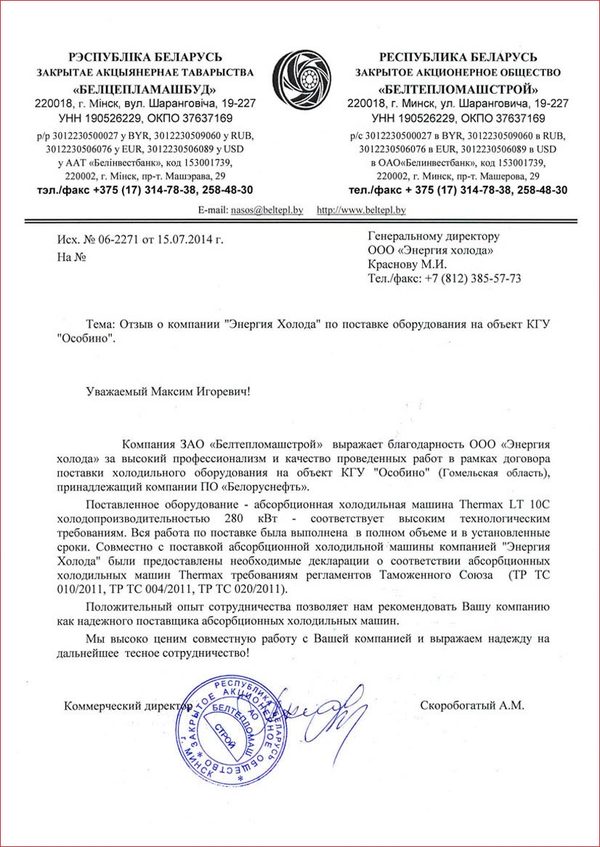
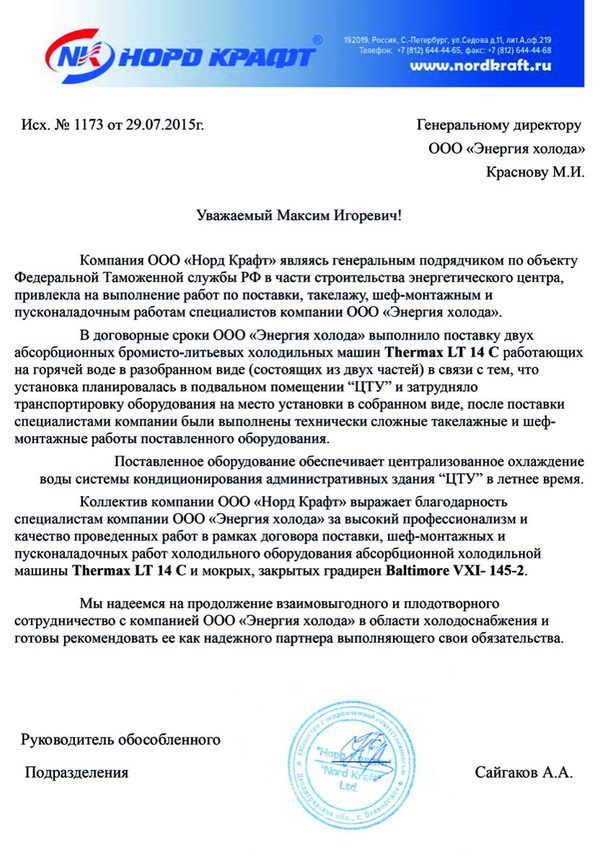
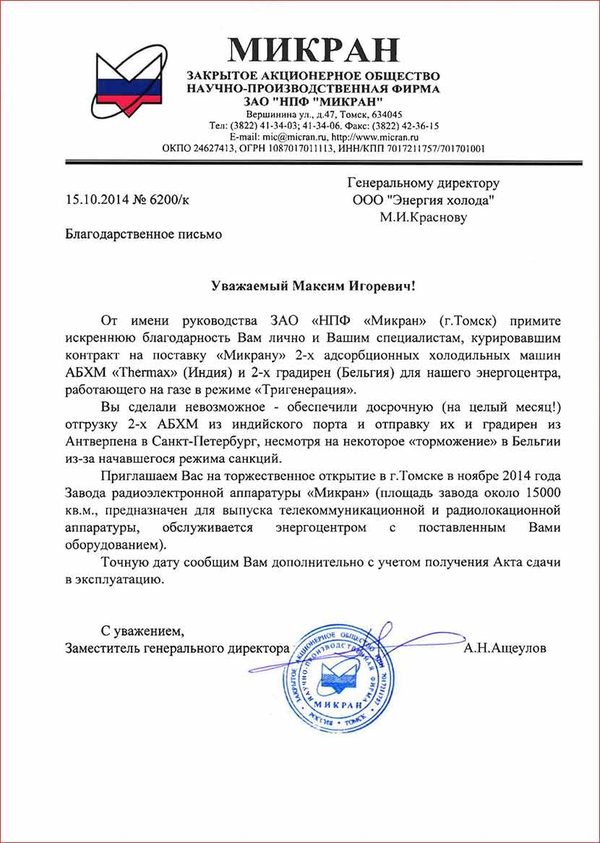
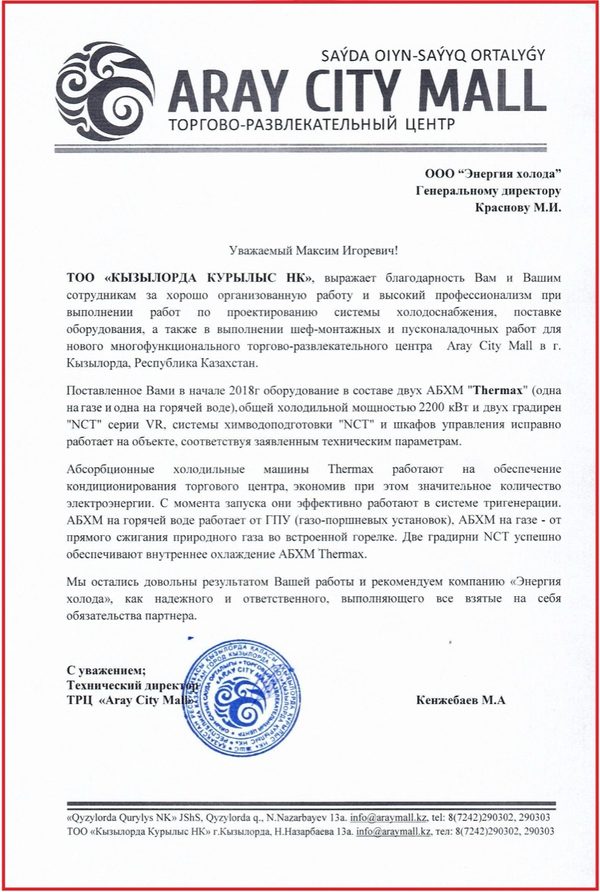
150 letters of thanks · 350+ major projects · 1,000+ customers · in business since 2011. These are real letters from customers; many others are on the references page.
Let us calculate trigeneration for your site
An engineer will put together the scheme and select the equipment, and you get a feasibility study. Free of charge, no obligation.