

NCT dry coolers for gas engines and absorption chillers, when a dry cooler beats a cooling tower
In brief. An NCT dry cooler cools without water, from 300 kW, from RUB 500,000, warranty up to 5 years. With an absorption chiller, summer needs adiabatic cooling or a cooling tower: a dry cooler gets no colder than air plus 10–15 K.
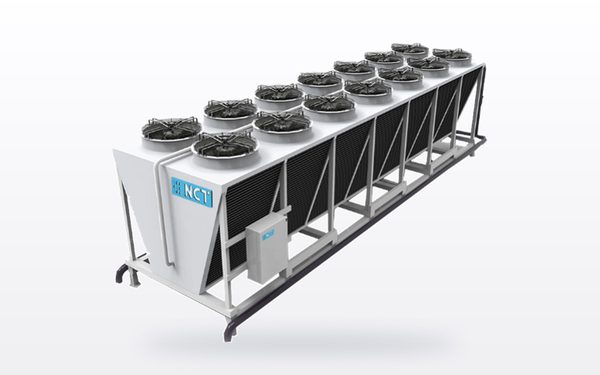
A dry cooler is a cooler without water: the fluid flows through finned tubes, fans blow air over them, and no makeup water is needed. In trigeneration (CCHP) it stands on a par with the cooling tower and the chiller. NCT dry coolers are rated for cooling from 300 kW, prices start at RUB 500,000, and the warranty is up to 5 years. They reject engine heat, keep the circuit closed and clean, and work where a water circulation system is not possible.
How to reject heat: cooling tower or dry cooler
On the right of the diagram is an NCT dry cooler: no water, but the fluid temperature is higher and the surface area is larger. On the left is a cooling tower: the water is colder, but treatment and makeup are required.
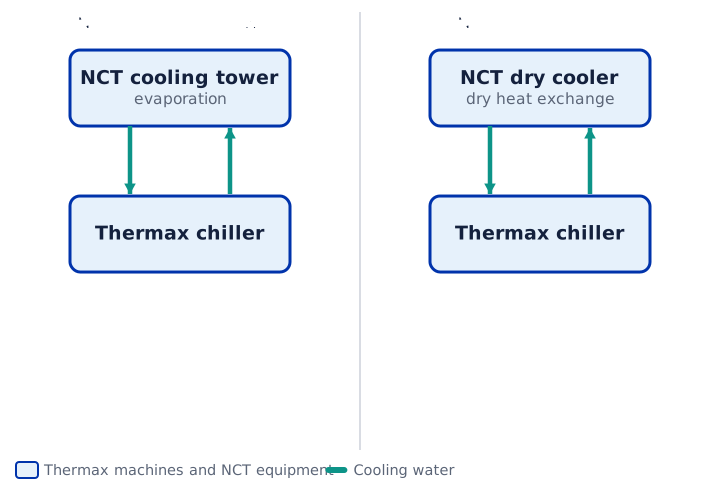
How does a dry cooler differ from a cooling tower?
| Criterion | Dry cooler | Cooling tower |
|---|---|---|
| What limits cooling | air temperature plus 10–15 K | wet-bulb temperature plus an approach of at least 2.8 K |
| Cooling below air temperature | not possible | possible |
| Water | not needed | evaporation of about 1.5 l/h per kW of heat rejected, about 2.1 with blowdown |
| Electricity | higher: at 35 °C air, a chiller condenses at about 51.7 °C versus 37.8–40.6 °C with a cooling tower | fans use 2–8.5 W per kW of heat rejected |
| Circuit | closed, the fluid stays clean | an open cooling tower contaminates the fluid |
| Winter | runs as a dry circuit and as free cooling, glycol protects against freezing | needs a winterization package |
| Maintenance | fin cleaning, glycol check once a year | chemicals, blowdown, Legionella risk |
| Price | higher per kW | cheaper in upfront cost where water is available |
Is a dry cooler suitable for an absorption chiller?
Not everywhere and not always. A lithium bromide absorption chiller rejects 1.72–2.45 kW per kW of cooling and prefers cooling water at 22–32 °C, with an optimum of 27 °C. A dry cooler delivers fluid 10–15 K above air temperature, so at +20 °C air it is already 30–35 °C. In hot weather the scheme goes outside the chiller's operating range, and adiabatic cooling or a wet cooling tower is needed. In the Russian climate, without adiabatic cooling, the outlet fluid is no colder than about 45 °C. That is why an absorption chiller with a dry cooler costs more than with a cooling tower, and such a scheme is calculated separately.
For the engine, conditions are simpler. Emergency rejection of jacket water heat, when the chiller is not taking it, is done with dry coolers: a temperature below air temperature is not needed there. On the jacket water circuit diagram, these are the emergency radiators.
When is a dry cooler a must?
When there is no treated water or a water circulation system is prohibited: the south, remote sites. When the closed circuit must stay clean. When the cooled fluid is above 60 °C. In a data center with a warm-water loop (water at the rack inlet up to 45 °C), a dry cooler can replace the compressor entirely.
If, on the other hand, you need a temperature below air temperature, or a large continuous load where electricity is the main cost item, the cooling tower wins: see NCT cooling towers.
What does an adiabatic dry cooler give?
It runs dry most of the time. In summer, when the air is above +20…+25 °C, nozzles humidify the incoming air, which becomes 5–15 °C colder. Water consumption is up to 95% lower than in a wet scheme. The downside: water treatment is still mandatory.
What about winter?
The fans operate from −35 to +55 °C, the heat exchanger from −35 to +80 °C. The heat transfer fluid can be water, ethylene glycol or propylene glycol. Glycol protects the circuit from freezing, and in winter the dry cooler works as free cooling (natural cooling).
Where is it cheaper?
It depends on the price of water. In a 2017 model example for a flow of 196 m³/h, the break-even water price between the dry and the evaporative scheme was about RUB 51/m³ without chemicals and RUB 63/m³ with chemicals. Water tariffs including wastewater are now RUB 50–60/m³, so the question is close to break-even, and the calculation has to be done with your tariff. This is a model calculation, not an offer.
Peak and standby cooling are covered by an NCT chiller. For the full set of cooling equipment for trigeneration, see the trigeneration plant page.
How much heat has to be rejected
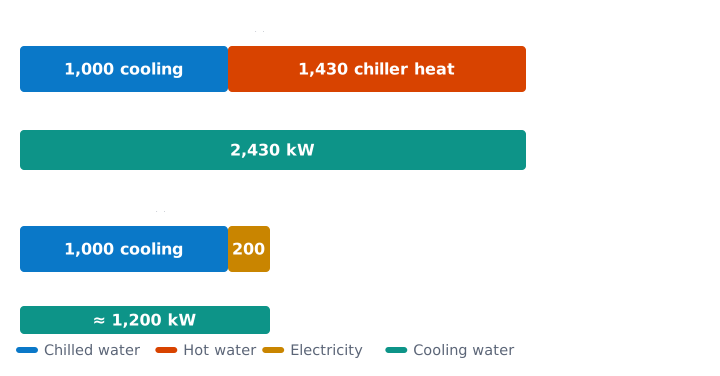
For 1,000 kW of cooling, a single-effect chiller takes 1,430 kW of heat and rejects 2,430 kW. A chiller with a COP of 5 rejects about 1,200 kW. That is why the cooler for an absorption chiller is roughly twice the size of one for an electric chiller.
Details on the dry cooler range are on nc-t.ru. If you want to know what suits your site, submit a request for a feasibility study or try the calculator.
What our customers say
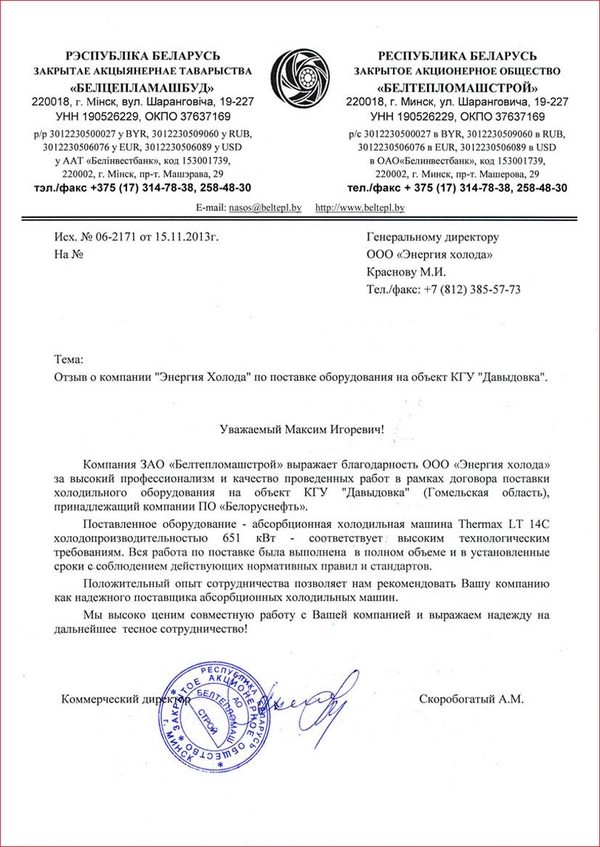
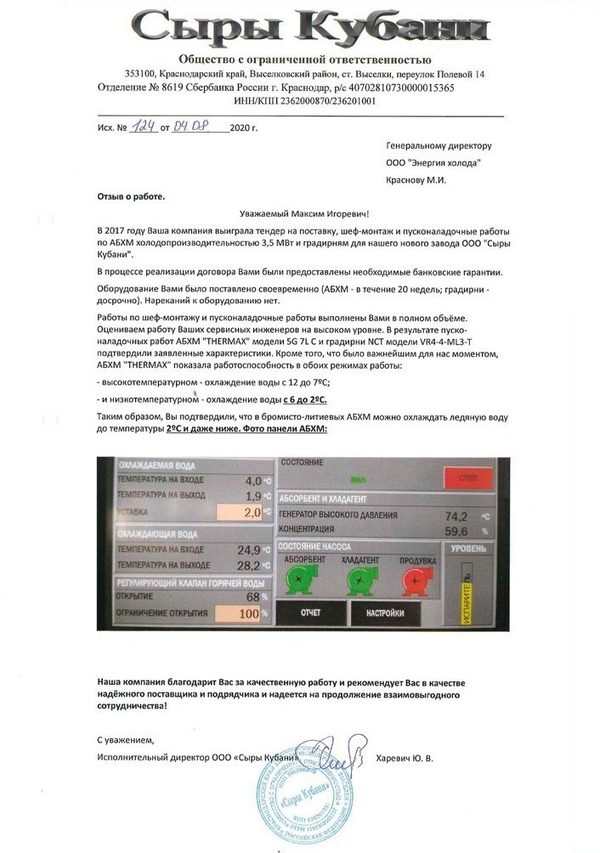
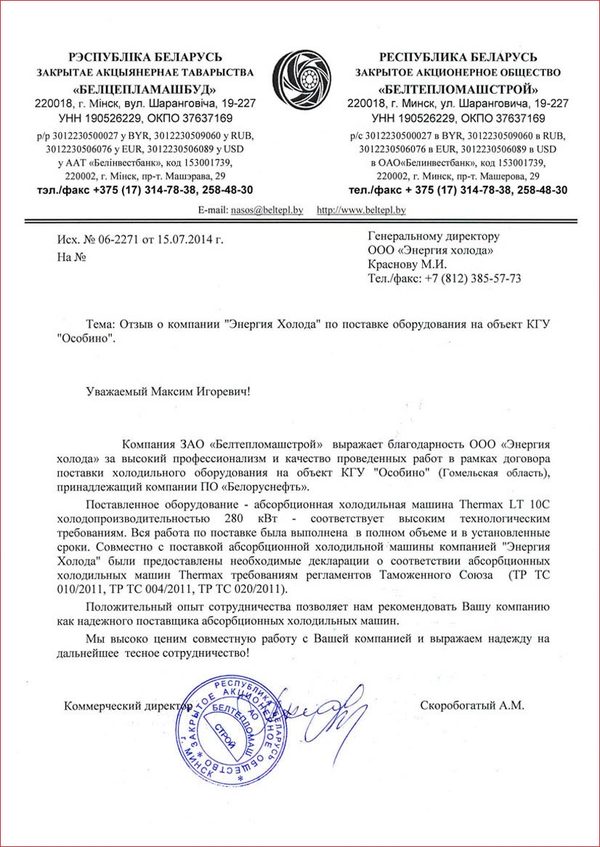
150 letters of thanks · 350+ major projects · 1,000+ customers · in business since 2011. These are real letters from customers; many others are on the references page.

Let us calculate trigeneration for your site
An engineer will put together the scheme and select the equipment, and you get a feasibility study. Free of charge, no obligation.