

Exhaust-fired absorption chillers and Trigenie: cooling from engine exhaust and jacket water
In brief. 2D and Trigenie machines take engine exhaust directly, with a COP of about 1.4 versus 0.8 on hot water. The price is a back pressure of 200–250 mm H2O, which is calculated together with the engine.
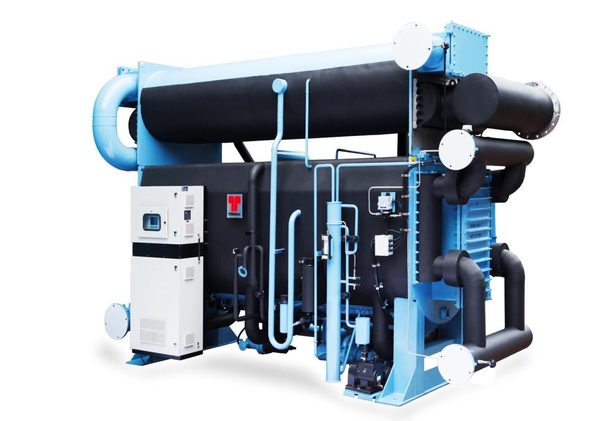
An exhaust-fired lithium bromide absorption chiller takes the exhaust heat of an engine or turbine directly, without intermediate water. From the same heat it gives twice as much cooling as a hot water machine: such a machine has a COP of 1.40–1.45, a hot water machine 0.65–0.80. The Trigenie series goes further: one machine takes both the exhaust and the engine jacket hot water, so no separate exhaust heat exchanger is needed. These are Thermax machines. In Russia and the CIS, Thermax machines are supplied only by Cold Energy (NCT). We are the official representative of Thermax.
How does an exhaust-fired machine differ from a hot water machine?
With hot water, the exhaust first gives its heat to water in an exhaust heat exchanger, then the water heats the machine, and the COP is below one. An exhaust-fired machine is double-effect and uses a hotter source, so it gives twice as much cooling.
There are downsides too. The machine requires more expertise in design and commissioning. Part of the gas has to be diverted past the machine when cooling is not needed. And the machine sits in the exhaust path, while the engine does not tolerate extra resistance.
Exhaust directly into the machine
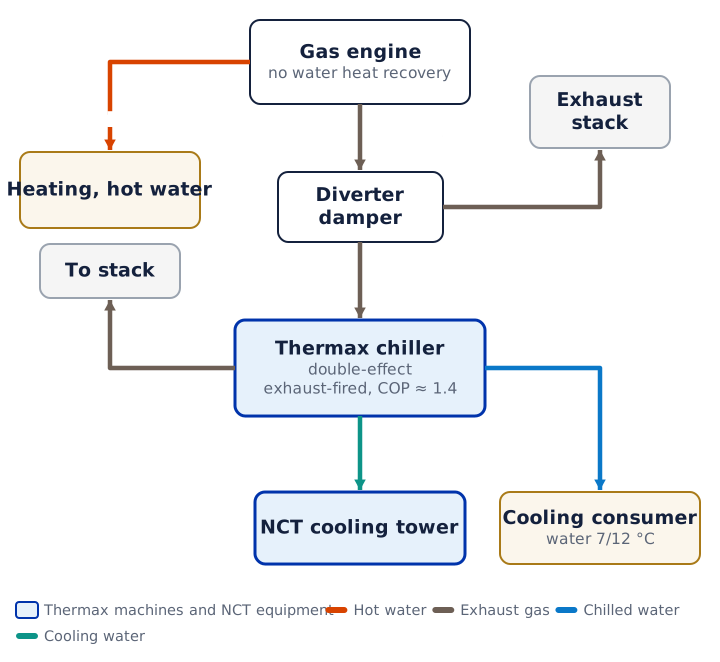
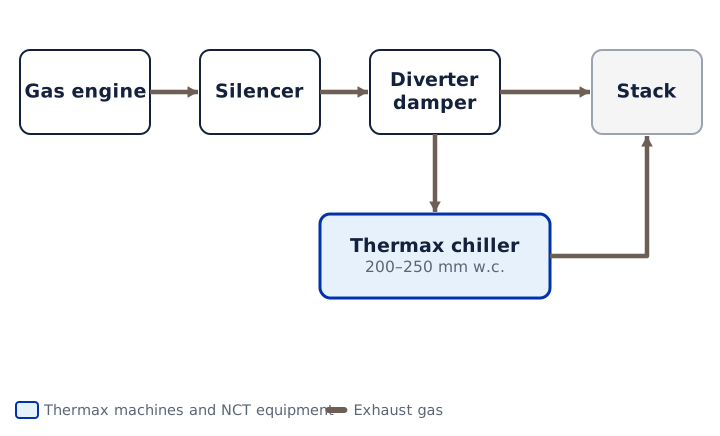
Exhaust gases pass through a diverter damper straight into a double-effect machine with a COP of about 1.4. If cooling is not needed, the damper sends the gas to the bypass. The jacket hot water goes to heating.
Trigenie: exhaust and jacket water in one machine
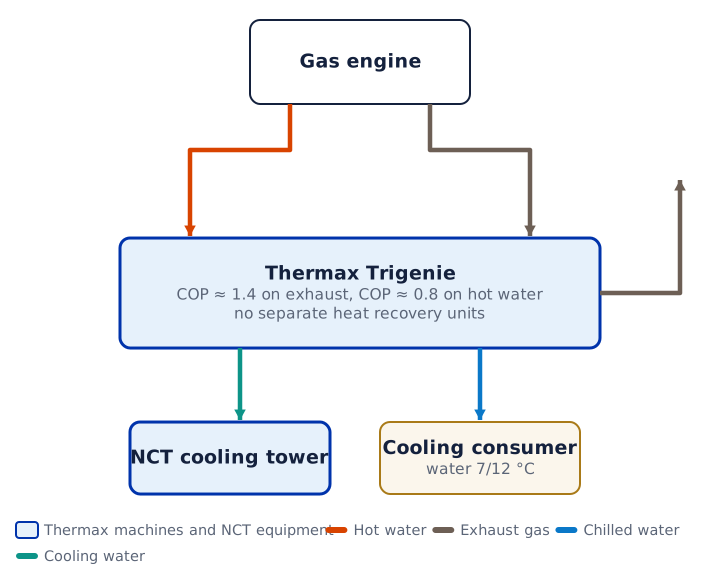
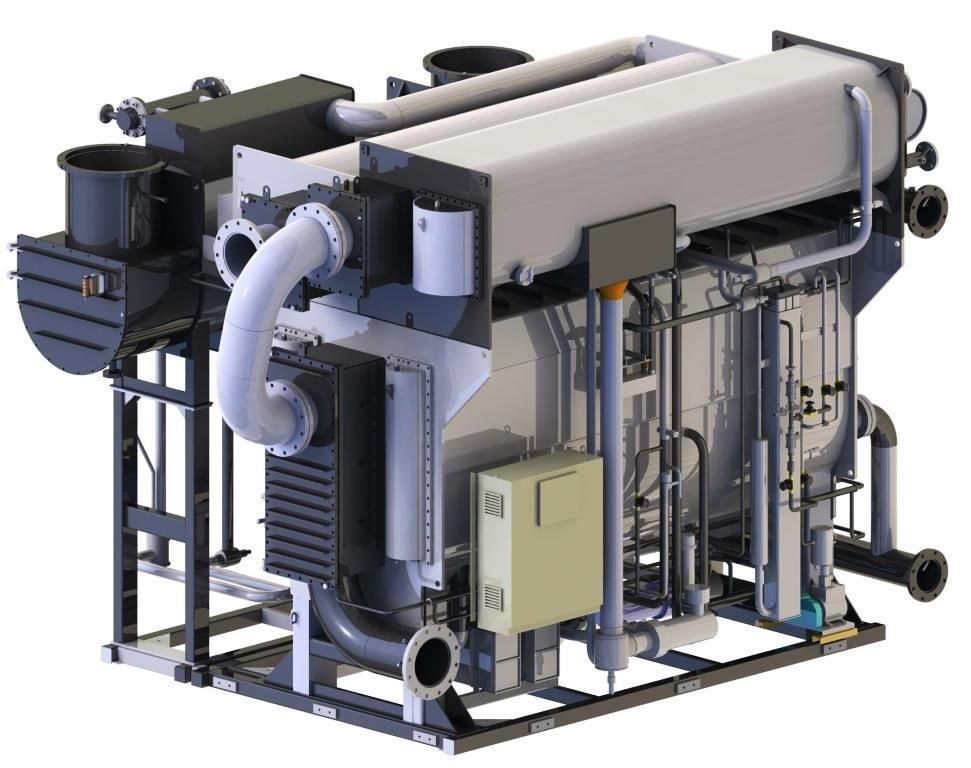
Trigenie takes two sources at once: the exhaust with a COP of about 1.4 and the jacket hot water with a COP of about 0.8. The output is 7/12 °C chilled water.
What does the machine need from the engine?
| Parameter | Value | Why it matters |
|---|---|---|
| Exhaust inlet temperature | 350–600 °C, special design 270 °C | determines how much cooling you get |
| Outlet temperature | 170 °C, special design 130 °C | further recovery down to 135–140 °C only on request |
| Gas-side resistance of the machine | 200–250 mm H2O | adds up with the exhaust duct, bends, damper and silencer |
| Damper | switches to bypass when the machine stops or power is lost | exhaust goes past a stopped machine |
| Jacket water outlet | down to 70–75 °C for Trigenie | a separate generator can use water at this temperature too |
| Number of engines per machine | up to three, gases do not mix | each engine has its own generator in the machine |
The total resistance must not exceed the allowable engine back pressure from its datasheet. If it does, the engine loses power, and the engine always has priority over the machine.
Where back pressure is calculated
The machine resistance is added to the exhaust ducts, damper and silencer. The exhaust duct design is done together with Thermax based on the engine datasheet.
How is the machine sized if the engine is not always at full load?
On the actual load profile, at three points: 100, 75 and 50% load. From the engine datasheet you take the exhaust flow and temperature at each point and the allowable back pressure. Exhaust temperature rises as load falls, and a design "for 100%" gives a machine that does not hold its operating point at 75 and 50.
Cooling is calculated by the formula: exhaust heat times the exhaust COP, plus hot water heat times the hot water COP. Trigenie is adapted to part load: a separate generator for hot water gives better heat recovery when the engine is not fully loaded, a solution pump with a variable frequency drive raises the COP, and smooth control works from 10 to 100%.
Cooling comes almost free only while the engine is loaded. If the engine's load profile is erratic, the cooling reserve is covered by an electric chiller or a direct-fired machine.
What about crystallization on shutdown?
Lithium bromide solution crystallizes if the machine stops without dilution or if the cooling tower water is too cold. Trigenie has a dump condenser for protection on shutdown, and the control system calculates the crystallization margin in real time. The manufacturer states stable operation with cooling water down to 10 °C.
The machine survives a power interruption of up to 3 minutes without harm. If it is longer, a dilution cycle is needed, and for that a backup power feed or an uninterruptible power supply.
Where this works
Gas turbine exhaust goes to a 2D machine at the ZhGTES power plant: about 3.2 MW of cooling, 15/8 °C water, cooling of turbine inlet air at a 110 MW station. This makes power output less dependent on hot weather. More about such schemes: trigeneration (CCHP) on gas turbines and on gas engines. Exhaust-fired installations worldwide are collected in the world projects section.
For other Thermax series and a COP comparison, see the Thermax absorption chillers page.
If you want to know whether your engine can handle an exhaust-fired machine, start with a feasibility study or the calculator.
Frequently asked questions
Can the flues of two or more absorption chillers be connected to one stack?
It is not recommended. While one machine is stopped, flue gas condensate from neighboring equipment can get into the common stack and header, and corrosion starts. If a common stack cannot be avoided, the connections are made at least 1 m apart vertically, with a condensate collector and an automatic damper on the branch from the stopped machine.
What heat can an absorption chiller run on: steam, hot water, exhaust, gas?
Any of them, plus diesel and process heat: in one Thermax case, it is steam from frying potato chips. Each medium has its own condition. Steam needs a dryness fraction of 0.99, while boilers usually give 0.95–0.97, so a separator is installed. A burner needs gas at 60–100 mbar; above that, a pressure reducing station is installed. Hot water is economically justified from 80 °C.
What our customers say
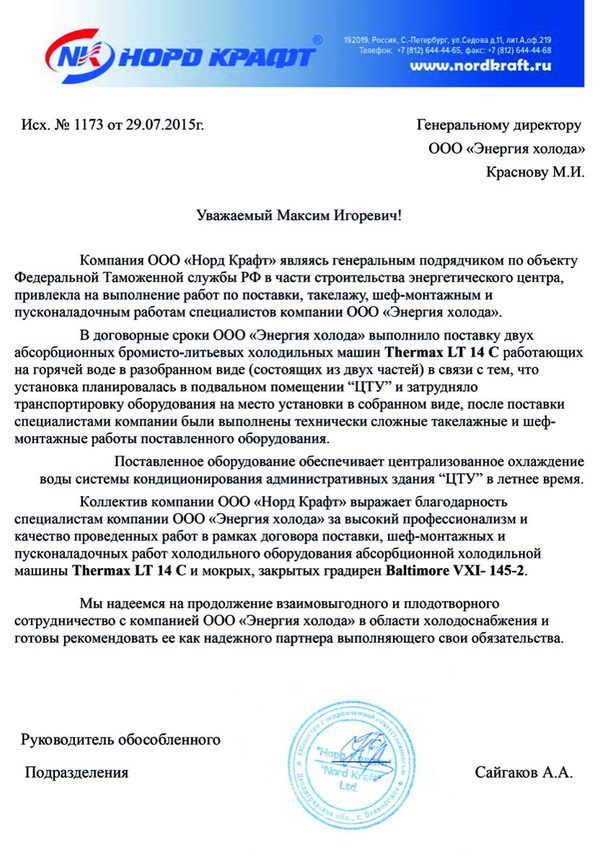
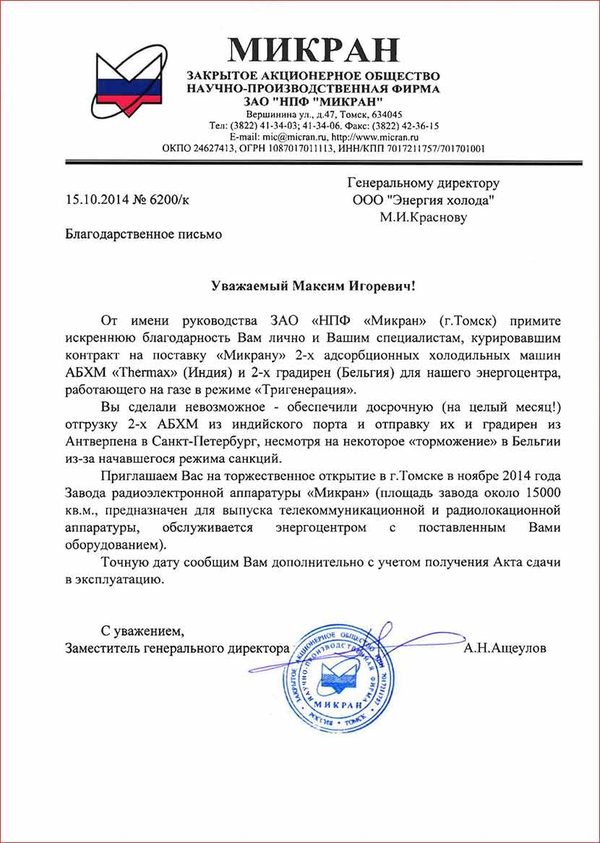
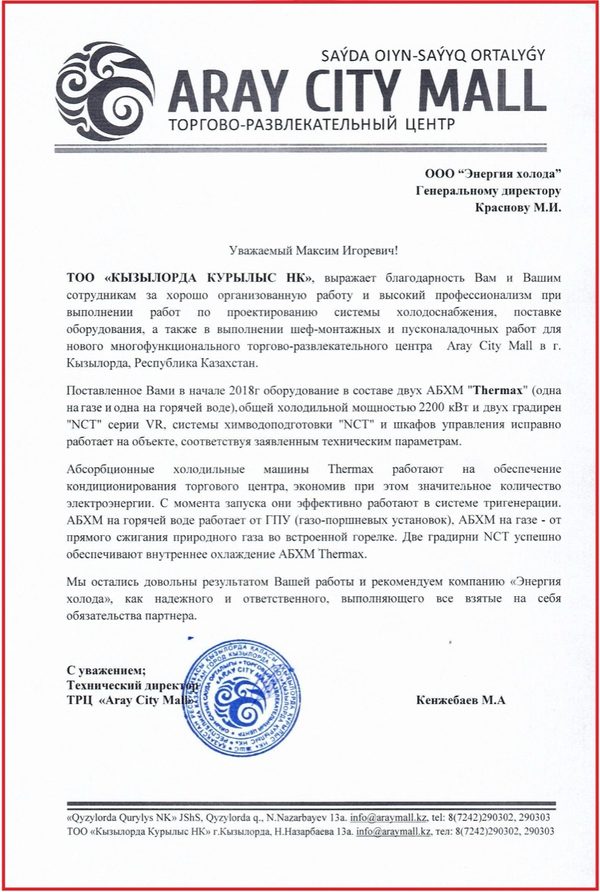
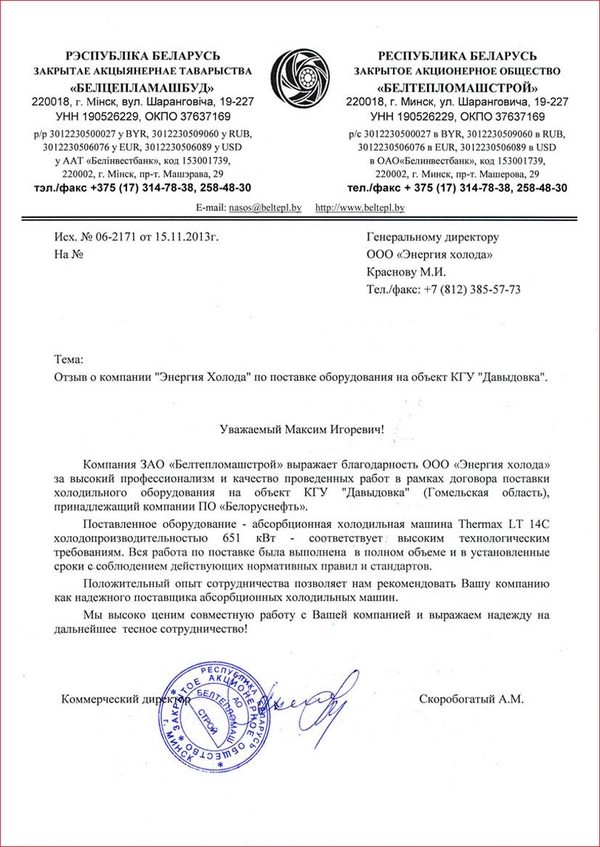
150 letters of thanks · 350+ major projects · 1,000+ customers · in business since 2011. These are real letters from customers; many others are on the references page.
Let us calculate trigeneration for your site
An engineer will put together the scheme and select the equipment, and you get a feasibility study. Free of charge, no obligation.