

NCT Chillers in Trigeneration: Peak and Backup Cooling Next to an Absorption Chiller
In brief. An NCT chiller takes the peak and provides backup while the absorption machine carries the base load. An absorption chiller needs about 30 minutes to reach operating mode, so a continuous load needs a chiller or cold storage next to it.
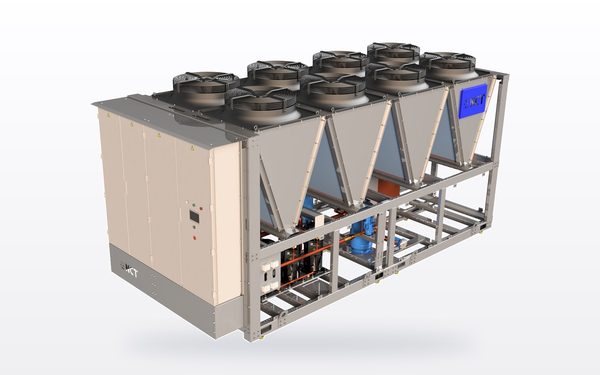
In trigeneration (CCHP), an NCT chiller works next to the absorption machine. The lithium bromide absorption chiller carries the base load on engine heat. The electric chiller takes the peak and stays as backup: when the engine is down, when the machine is coming up to operating mode, or when more cooling is needed than the heat can provide. A site with a continuous load almost always needs this pair.
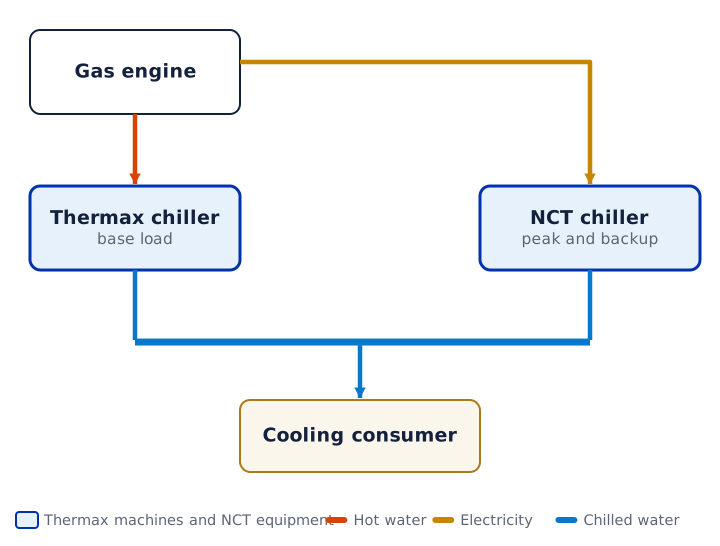
Absorption chiller on base load, electric chiller on peak
The Thermax machine runs continuously on the base load using engine heat. The NCT chiller comes on for the peak and as backup. Both machines feed a common chilled water header.
Why do you need a chiller if you have an absorption chiller?
An absorption machine needs about 30 minutes to reach operating mode. For an office this does not matter; for a data center or a continuous process it means half an hour without cooling. Engine heat is sometimes short: the engine is down, part-loaded, or under repair. And the peak can be brief: in a data center it falls on 5–7 days a year, there is no point installing absorption capacity for it, and a chiller covers it.
That is why, in a data center scheme, the NCT cooling circuit includes the absorption chiller, cooling towers, water treatment, pumps, controls and a backup chiller for 5–20 % of the load, and if an engine fails you need a grid connection, a second heat source or chillers for the full load.
How are the absorption chiller and the electric chiller connected: in series or in parallel?
| Layout | How it works | When it is used |
|---|---|---|
| Parallel | The absorption chiller takes the base load at constant flow, the electric chiller takes the peak and backup | typical trigeneration |
| Series | The absorption chiller, first along the water flow, removes the "warm" part, 12 → 9 °C, and the electric chiller brings it down to 7 °C | when you need to use as much engine heat as possible |
Flow through the absorption chiller evaporator is constant; variable flow control is done in the secondary circuit. Keep this rule in mind during design: the machine trips on its flow switch if the water flow drops below 50 % of rated.
What do you do while the machine is coming up to operating mode?
For this, a cold storage tank is installed.
Cold storage for the transition period
The tank carries the consumer while the machine starts up or switches to another source. It is needed only for a continuous load.
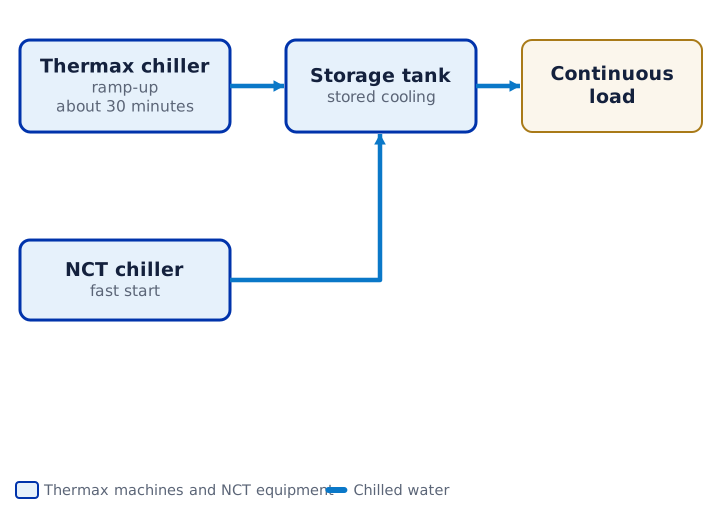
For sites with a normal load profile and smooth absorption chiller turndown from 10 to 100 %, storage tanks are in most cases not needed.
Electric chiller or absorption chiller: which pays off better?
A chiller is cheaper when operating hours are low: below 2,000 hours per year an absorption machine does not pay back. A chiller consumes 180–350 kW of electricity per MW of cooling depending on seasonal COP; an absorption chiller together with pumps and a cooling tower consumes 46–130 kW per MW. If electricity is expensive or the grid cannot supply the capacity, absorption wins; if electricity is cheap and the hours are few, the chiller wins.
For comparison in a 5,000 kW model we take three chillers: a conventional one with COP 3.0, a packaged unit with free cooling for about 4,500 hours a year with a seasonal COP of 5.5, and a centrifugal one with a wet cooling tower with a seasonal COP of 6.5. The calculations are model-based and are not an offer.
What chillers does NCT make?
Chillers with air-cooled and water-cooled condensers, screw chillers, and oil-free centrifugal chillers on gas bearings. Manufactured in Saint Petersburg, with an extended warranty of up to 5 years when installation supervision, commissioning and service are included. See product lines and capacities at nc-t.ru.
Heat from a water-cooled chiller is rejected by a cooling tower or a dry cooler. For the absorption machine itself, see the Thermax absorption chiller page.
If you want to find out whether you need a chiller next to the absorption chiller and for what share of the load, request a feasibility study or make a rough estimate in the calculator.
What our customers say
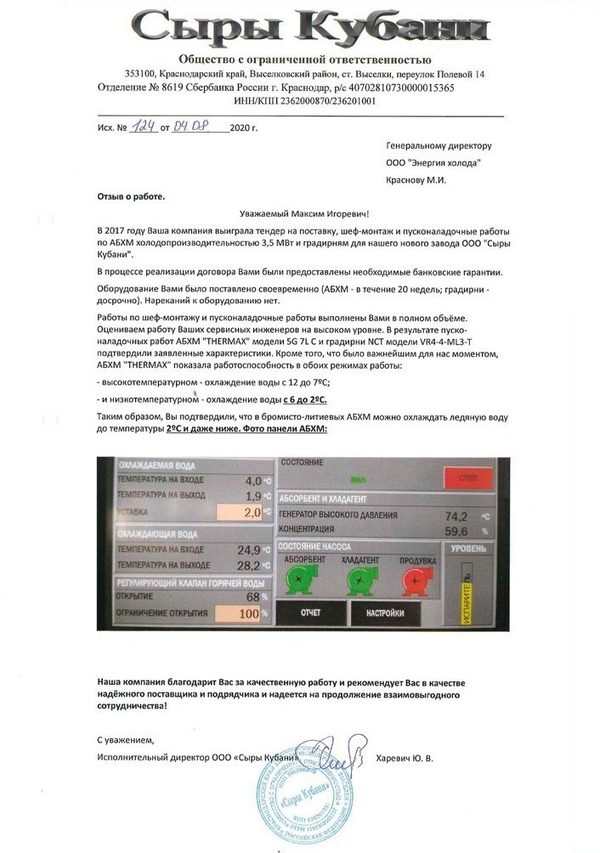
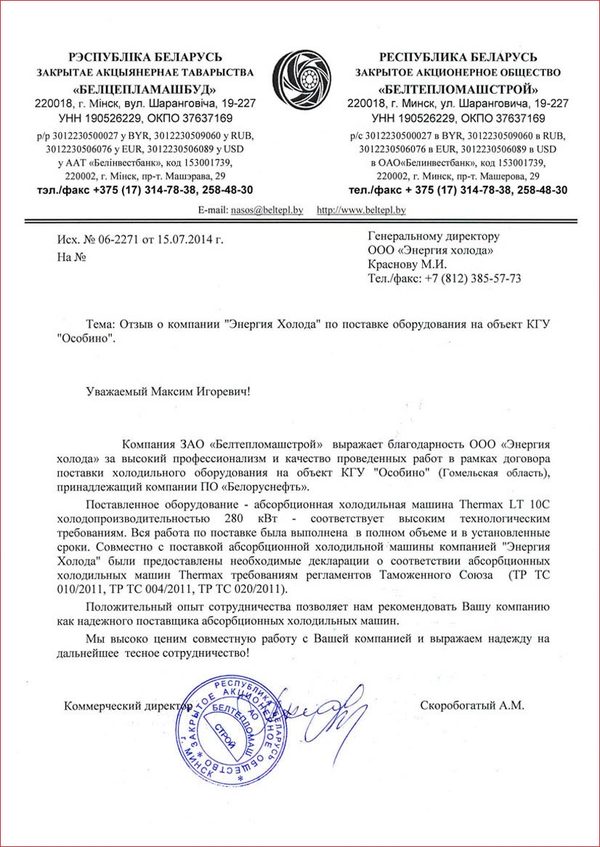
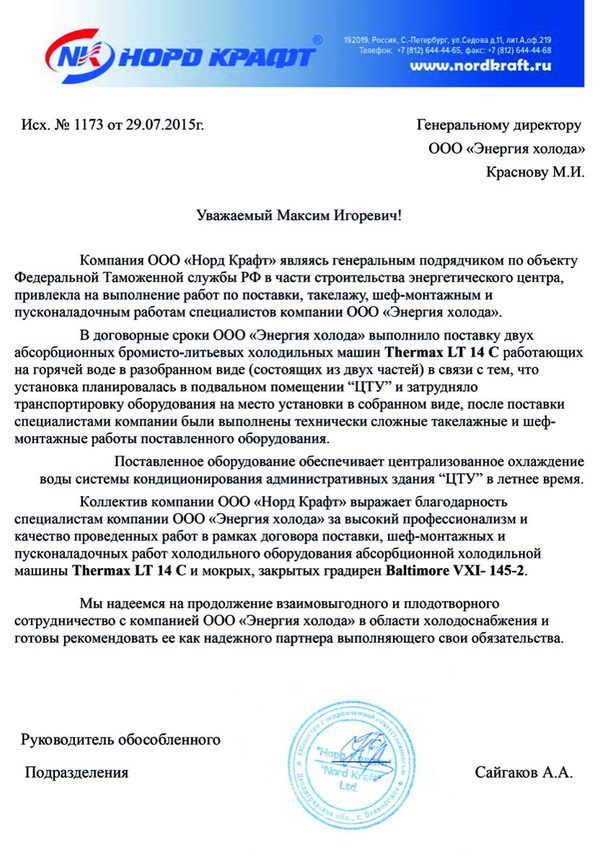
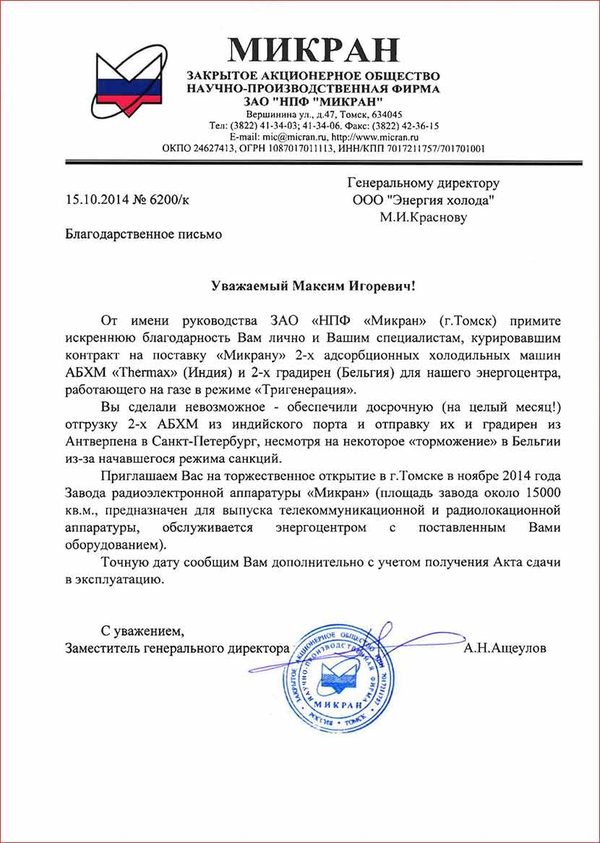
150 letters of thanks · 350+ major projects · 1,000+ customers · in business since 2011. These are real letters from customers; many others are on the references page.
Let us calculate trigeneration for your site
An engineer will put together the scheme and select the equipment, and you get a feasibility study. Free of charge, no obligation.