

Trigeneration complex. What an energy center consists of
In brief. A trigeneration complex is built from gas engines, an absorption chiller, a cooling tower or dry cooler, pump skids and controls. At a typical plant with two 1,500 kW gas engines, the chiller gives 2,250 kW of cooling.
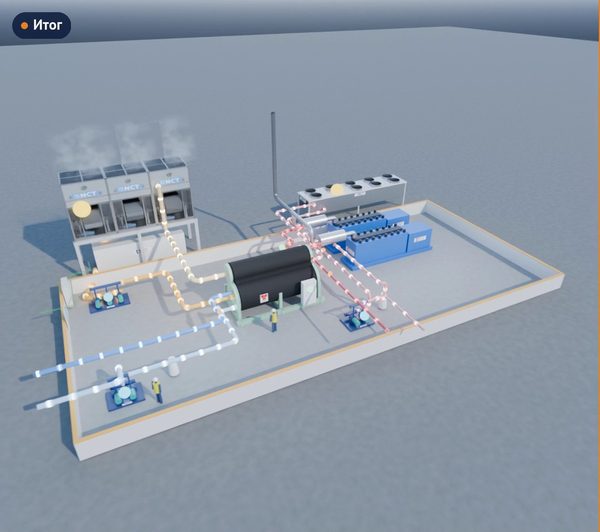
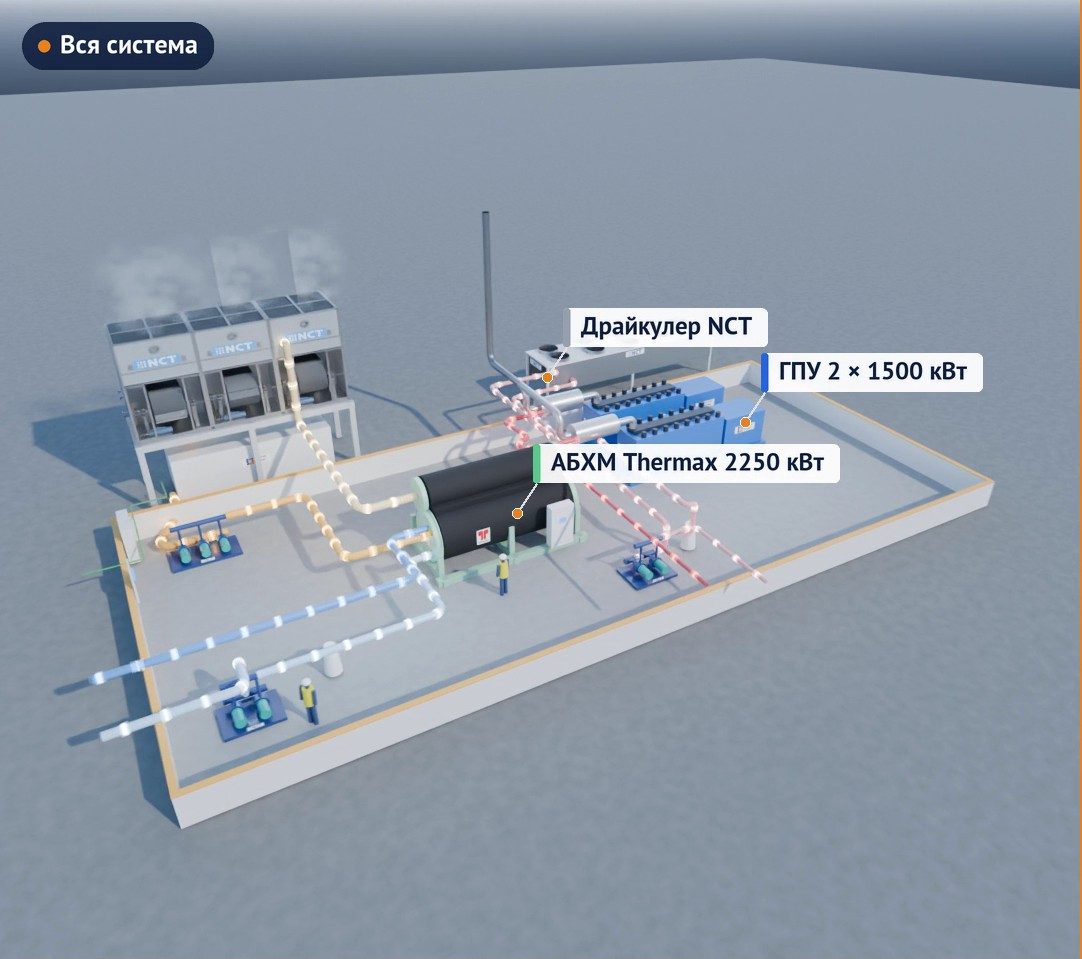
A trigeneration (CCHP) complex, or energy center, consists of five parts: gas engine generator sets, a lithium bromide absorption chiller, a heat rejection unit (cooling tower or dry cooler), pump skids and controls. Below is a typical plant shown in frames of a 3D model: two 1,500 kW gas engines, a 2,250 kW Thermax chiller and an NCT cooling tower. This is a typical scheme for explanation, not a specific site: the figures show the order of magnitude and how they relate to each other.
What does a typical complex consist of?
| Component | What it does | Typical scheme parameters |
|---|---|---|
| Gas engines | Electricity and heat | 2 units of 1,500 kW each |
| Thermax absorption chiller | Heat into cooling | 2,250 kW of cooling |
| NCT cooling tower | Heat rejection | 5,250 kW, water 35 → 28 °C |
| Pumps | Three circuits | chilled water 386 m³/h (1+1), hot water 129 m³/h (1+1), cooling tower 2+1 |
The controls tie everything together: the chiller controller, the pump panel and the cooling tower panel.
What do the engines do?
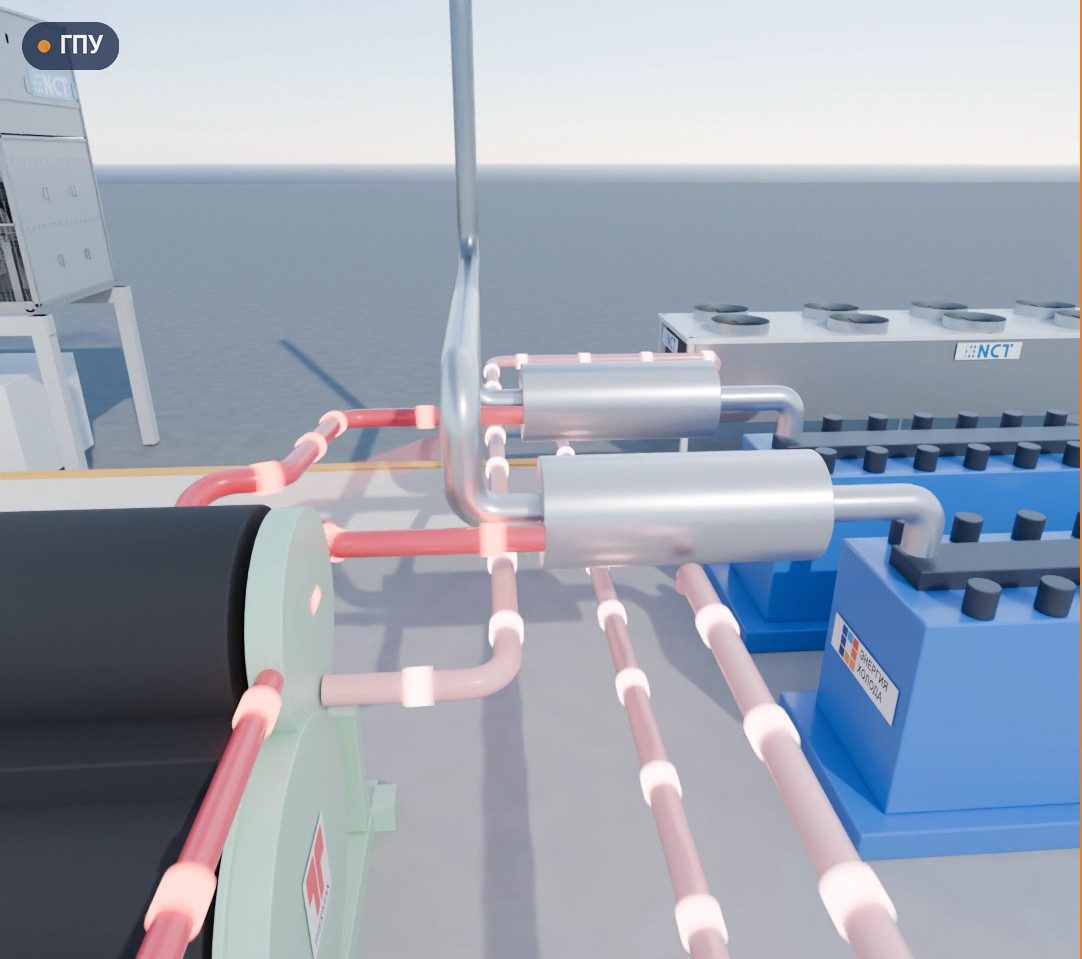
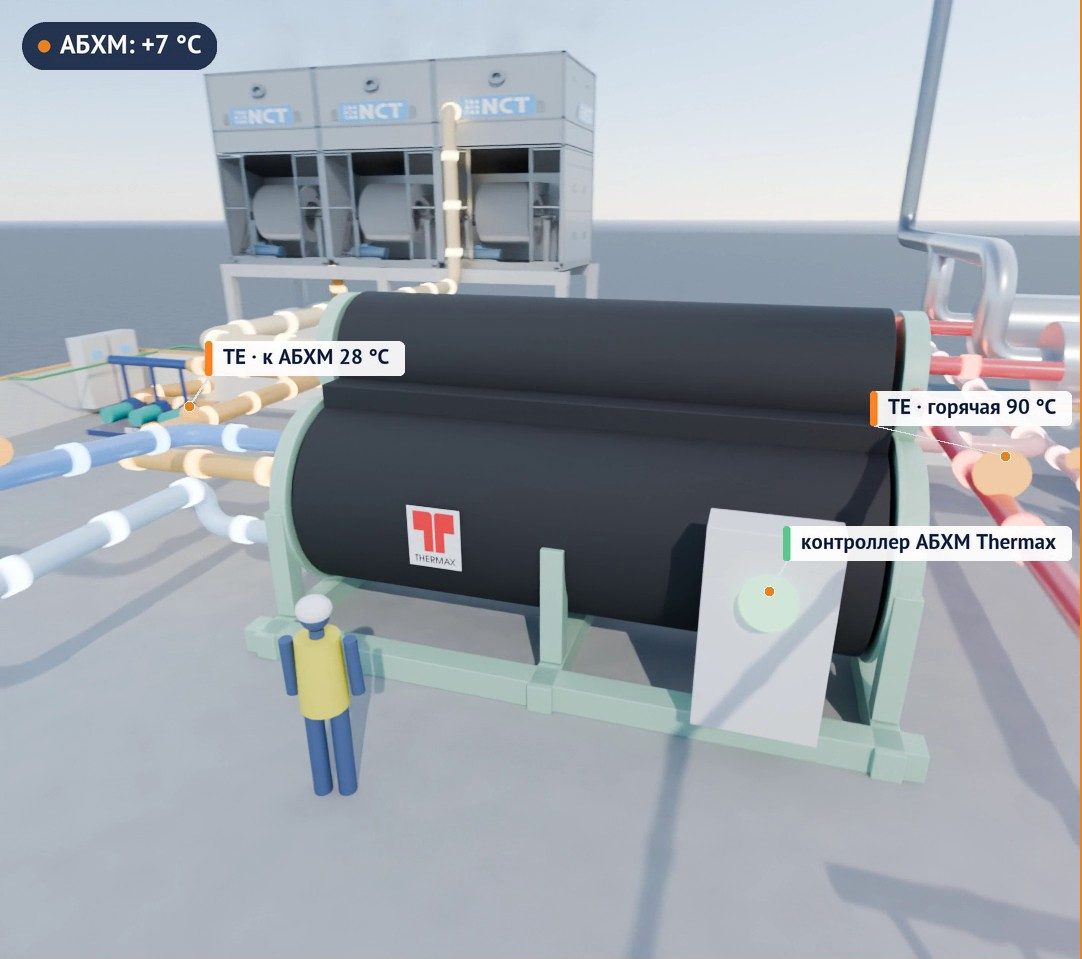
The two gas engines generate electricity for the site. Their heat is collected in two places: the engine jacket water and the exhaust. The exhaust passes through an exhaust heat exchanger and goes up the stack, and the heated water goes to the chiller. The engine circuit is separated from the chiller circuit by a heat exchanger, because the engine has its own requirements for the return temperature.
How does the hot circuit work?
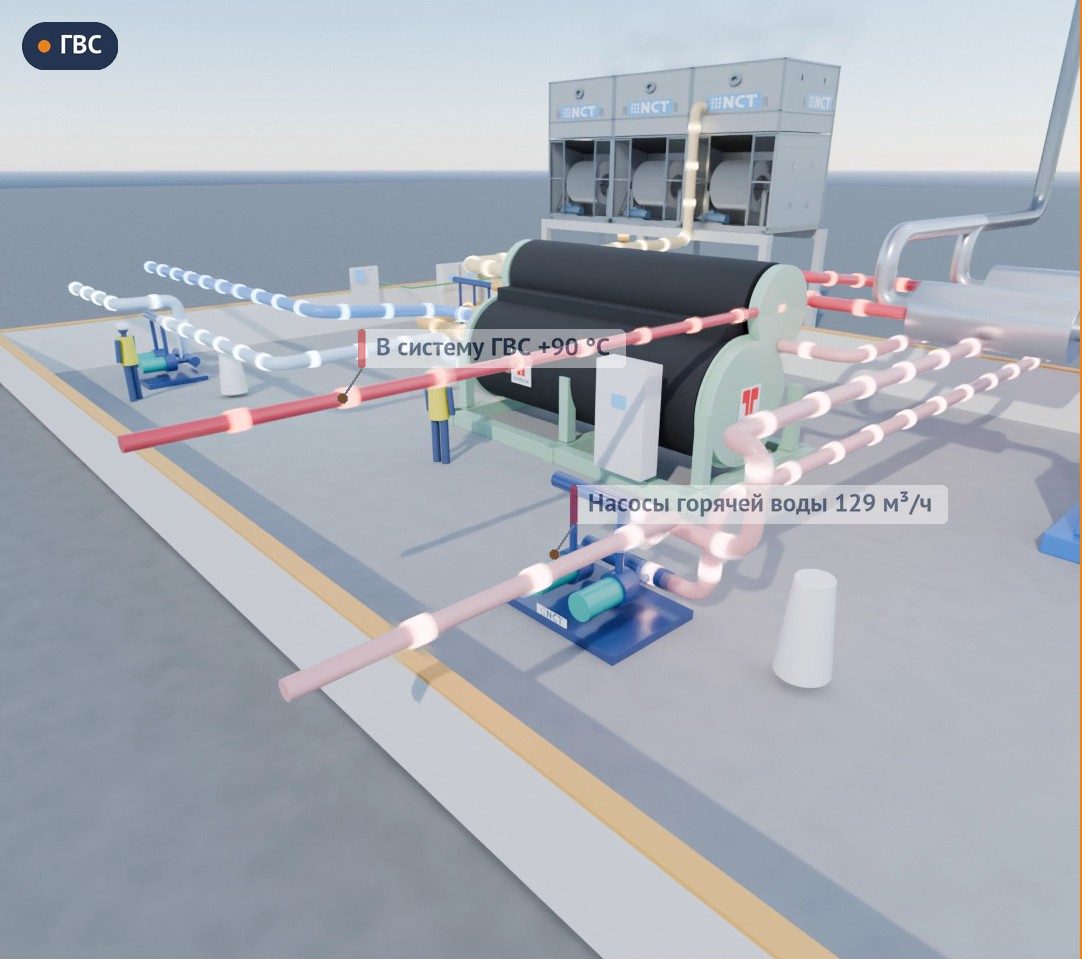
Hot water from the engines reaches the chiller at 90 °C and returns to them cooled to 70 °C. It is driven by hot water pumps in a 1+1 arrangement: one duty, one standby. The flow is 129 m³/h. In the frame, this circuit is labeled GVS (the Russian abbreviation for hot water supply).
What does the absorption chiller do?
The chiller takes heat from the hot water and cools the consumer's water from 12 to 7 °C. It needs cooling water at 28 °C from the cooling tower side, and this water heats up to 35 °C at the chiller outlet. The Thermax controller monitors the chilled water temperature and adjusts the heat input. How the cycle works inside the chiller is described on the page "Operating principle".
How does the cooling reach the consumer?
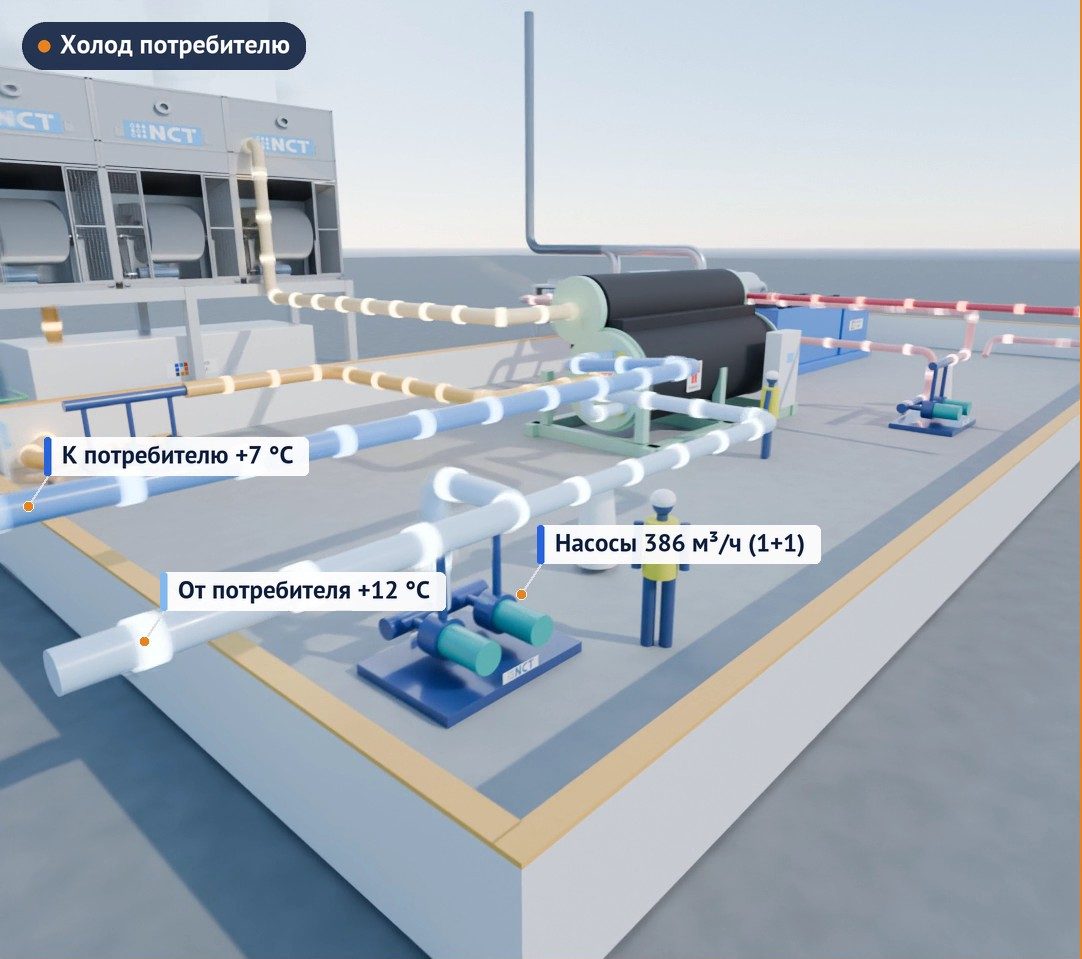
Water at 12 °C comes from the consumer, cools down to 7 °C in the chiller and goes back. Two pumps of 386 m³/h, one duty and one standby, keep a constant flow through the evaporator: the chiller trips if the flow drops below 50 % of nominal.
Why the cooling tower, and why is it so large?
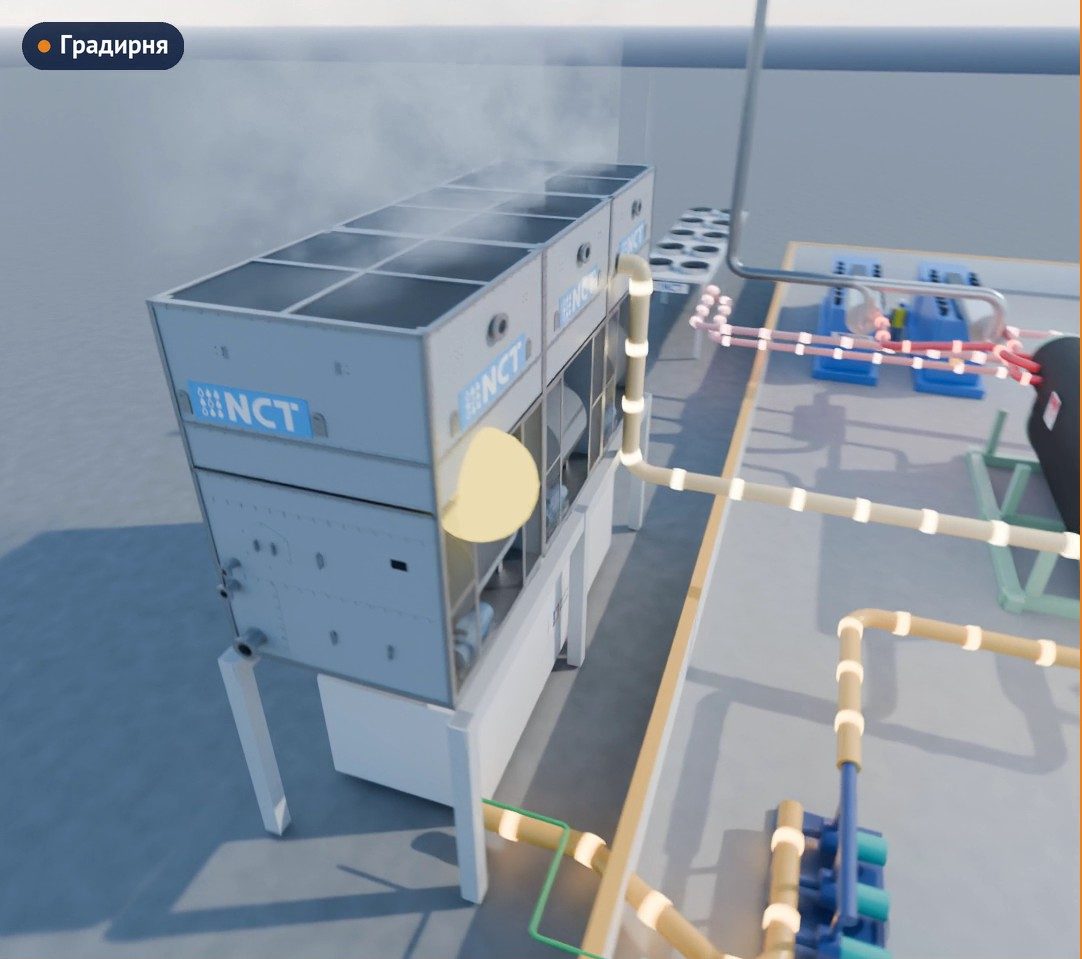
The cooling water takes both the heat the chiller received from the engines and the heat it removed from the consumer. At the typical plant, the chiller gives 2,250 kW of cooling at a coefficient of about 0.75 and takes 3,000 kW of heat, so the cooling tower has to handle 2,250 + 3,000 = 5,250 kW. A 5,250 kW NCT cooling tower is roughly twice the size of the one an electric chiller of the same cooling capacity needs.
Let us check that the figures add up. Cooling: 386 m³/h with a 5 °C difference is about 2,250 kW. Hot water: 129 m³/h with a 20 °C difference is about 3,000 kW. By estimate, the heat of two 1,500 kW gas engines is enough for the hot circuit with a small margin: a gas engine gives about 1.1 kW of heat per 1 kW of electricity.
Instead of a cooling tower, you can install an NCT dry cooler. It uses no water, but cools only to the air temperature plus 10–15 °C. With air at +20 °C, the water will be 30–35 °C, while the chiller's operating range is 22–32 °C. That is why a cooling tower is chosen more often for an absorption chiller, and a dry cooler is installed where there is no water.
What is added to such a complex?
In real projects, the basic scope is supplemented with whatever the site requires. A chilled water storage tank supports the consumer while the chiller reaches its operating mode, which takes about 30 minutes. An NCT chiller takes the peak and serves as backup while the absorption chiller carries the base load. A boiler covers the heat peak, and emergency radiators remove excess engine heat. Water treatment protects the chiller from scale: 1 mm of scale eats about 14 % of capacity. More about controls and pumps in the section "Controls, water treatment and pumps".
Where are the weak points of the complex?
Each component on its own is well known. The difficulties start at the interfaces between the engine and the cooling: exhaust back pressure, jacket overheating when the chiller stops, return temperature, different load profiles of the engine and the cooling, power loss, untreated water. They are covered on the page "Trigeneration mistakes". If the engine and the cooling are split between different contractors, nobody owns these interfaces. Cold Energy (NCT) supplies the whole complex: gas engines, Thermax chillers and NCT equipment. For the cooling circuit, we handle the design, supply of Thermax chillers and NCT equipment, installation supervision, commissioning and service.
If you want to see what such a complex looks like at your site, order a feasibility study or try the calculator. Real sites are collected in the "Projects" section.
Frequently asked questions
What does the pre-design of an energy center with an absorption chiller include, and how long does it take?
The pre-design (PP stage) includes a hydraulic schematic, a functional control diagram, a descriptive section and a specification of the main equipment. It takes about 40–45 working days. The pre-design is not enough to hand over the site: commissioning into operation requires detailed design documentation with piping, sections, controls and steel structures. For a gas-fired chiller, gas supply and flue gas sections are added; for a steam chiller, steam and condensate piping.
What size of expansion and buffer tanks is needed in the chilled and hot water circuits?
The exact volume is calculated from the system volume and the maximum and minimum hot water temperatures, and there may be several tanks in different sections. As a guide, in heating systems the tanks are up to 10 % of the system volume, and in cooling systems much less. Do not confuse an expansion tank with a chilled water storage tank: the storage tank is needed to support the consumer while the chiller reaches its operating mode, and it is sized by how many minutes the site can do without cooling.
What our customers say
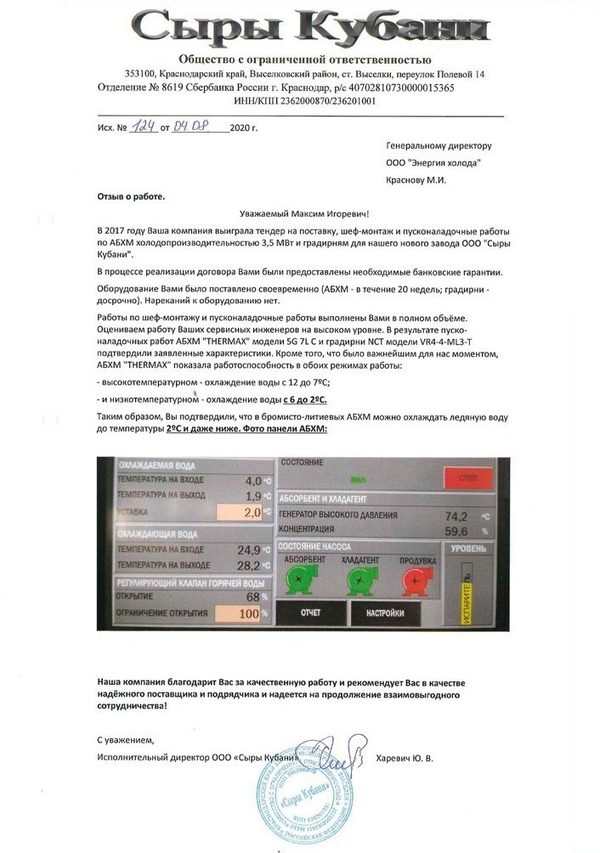
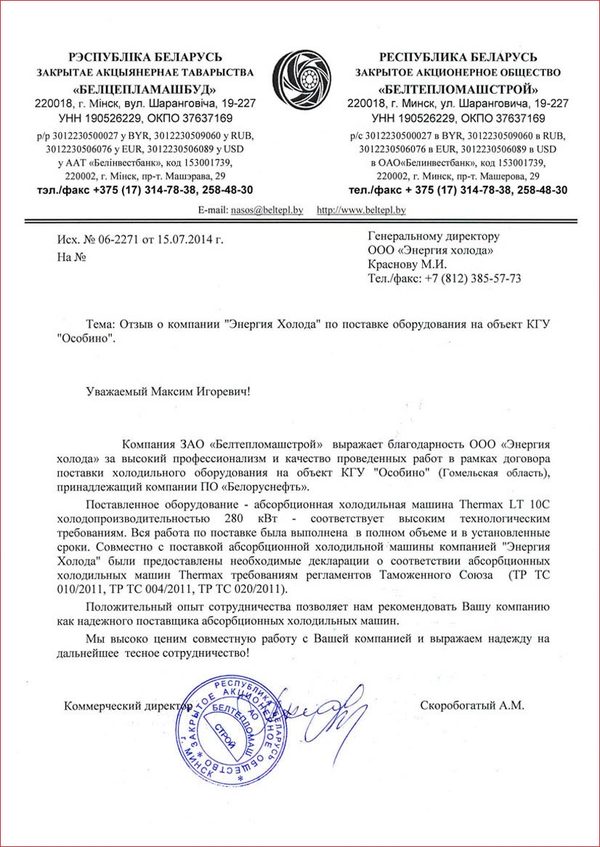
150 letters of thanks · 350+ major projects · 1,000+ customers · in business since 2011. These are real letters from customers; many others are on the references page.


Let us calculate trigeneration for your site
An engineer will put together the scheme and select the equipment, and you get a feasibility study. Free of charge, no obligation.