

NCT cooling towers for absorption chillers: which one you need and why it is larger than for a chiller
In brief. A cooling tower for an absorption chiller is sized for 2.45 kW of heat rejection per 1 kW of cooling for a single-effect unit and 1.72 for a double-effect unit, so it is 1.5–2 times larger than for a chiller. A bypass is mandatory.
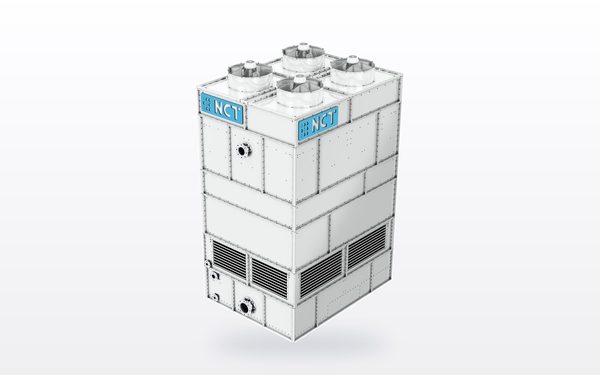
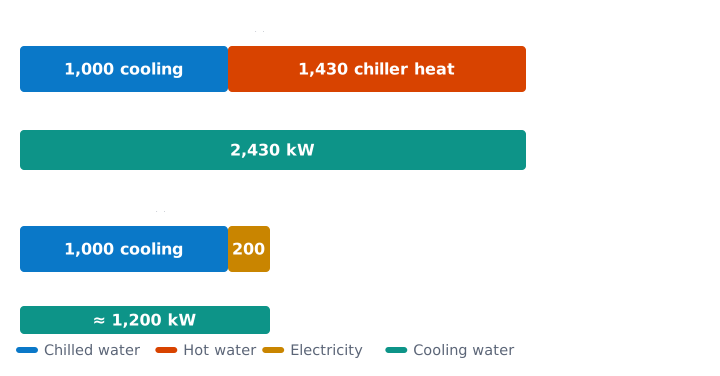
A cooling tower for an absorption chiller is 1.5–2 times larger than one for an electric chiller of the same capacity. The reason is heat. A chiller with a COP of 5 rejects about 1.20 kW of heat per 1 kW of cooling, a double-effect lithium bromide absorption chiller 1.72 kW, and a single-effect unit 2.45 kW. An NCT cooling tower rejects this heat to the atmosphere, and it has to be selected for the chiller's heat rejection, otherwise the capacity will not hold in the first hot summer.
How much heat has to be rejected
At 1,000 kW of cooling, a single-effect chiller takes 1,430 kW of heat and rejects 2,430 kW to the cooling tower. An electric chiller with a COP of 5 at the same capacity rejects about 1,200 kW.
Which cooling tower suits an absorption chiller: open or closed-circuit?
The choice depends on what matters more to you: price and water temperature, or a clean circuit.
| Parameter | Open (VR, SVA) | Closed-circuit (VRC, SVAC) |
|---|---|---|
| Water in the chiller tubes | in contact with air, needs treatment | closed loop, stays clean |
| Water temperature | colder, down to +23…+25 °C under typical conditions | 2–3 °C warmer than open |
| Price and size | cheaper and more compact | more expensive |
| Cools glycol | no | yes |
Cleanliness matters: 1 mm of scale cuts absorber capacity by about 14 %, and energy consumption rises by up to 20 %. If there is no water treatment and there will not be any, choose a closed-circuit tower. If there is water and NCT water treatment, an open tower is more often chosen: it is cheaper. The centrifugal fan in the VR series does not ice up in winter.
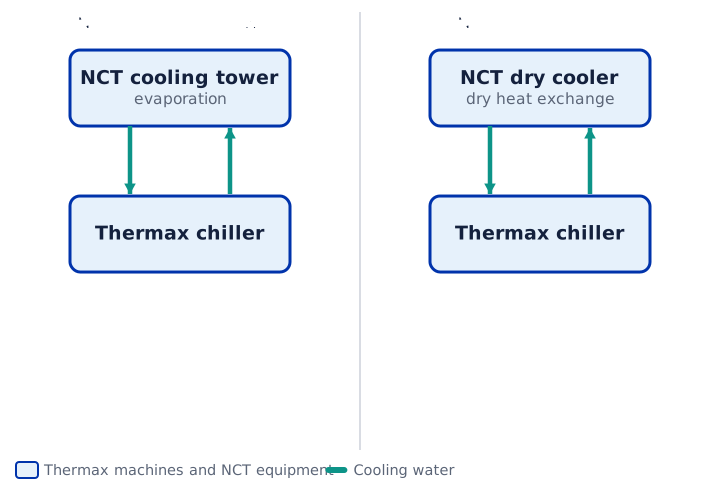
If there is no water at all, look at NCT dry coolers. A comparison of the two options:
How to reject heat: cooling tower or dry cooler
On the left, an open or closed-circuit NCT cooling tower: the water is colder and the chiller delivers more cooling, but water treatment and makeup water are needed. On the right, an NCT dry cooler: no water, but the temperature is higher and the footprint is larger.
What must be included in the design?
A bypass. On a spring night the water from the cooling tower can be 5 °C, while a double-effect chiller needs at least 10 °C and a single-effect chiller at least 20 °C. Without a bypass the solution crystallizes in the shoulder season. The rules are simple:
-
A three-way valve on the cooling water line, with the bypass discharging into the cooling tower basin, not into the pipe to the pumps.
-
Valve stroke time no more than 120 seconds, control in cascade with the fans, preferably with variable frequency drives.
-
At start-up the fan is off and the cooling tower is in bypass until the water at the chiller inlet rises to 20 °C. The fan is switched off at 25 °C with a 3 °C hysteresis.
-
The design temperature is taken from the site's wet-bulb temperature (SP 131.13330, Russian building code), not "for the region."
The absorption chiller itself does not control the bypass or the cooling tower: it gives signals to start the pumps and an enable-to-run signal, while the bypass and fan logic is handled by the plant controls.
How much water and electricity does a cooling tower use?
Per 1,000 kW of cooling, evaporation is 2.5 m³/h for a double-effect chiller, 3.6 m³/h for a single-effect chiller and 1.8 m³/h for an electric chiller. Blowdown and drift are added based on the cycles of concentration. The fans take 2–8.5 W per kW of heat rejection. Example for 1,000 kW of cooling at 12 → 7 °C: about 282 m³/h of cooling water, 3.6 m³/h of evaporation.
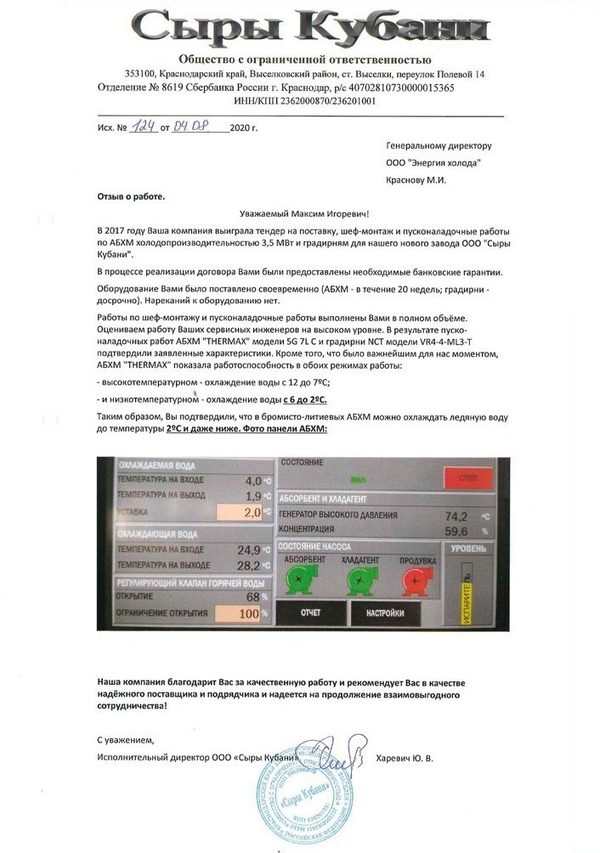
The warranty against through-corrosion on NCT cooling towers is 10 years. The service life of open and closed-circuit cooling towers is more than 15–20 years. We manufacture NCT cooling towers in Saint Petersburg. At the Syry Kubani cheese plant, the Teplichnoye greenhouse complex and many other sites, NCT cooling towers work together with Thermax chillers: see the Projects section. Cooling towers, chillers and dry coolers are described in detail at nc-t.ru.
If you want to check which cooling tower your chiller needs, start with a feasibility study or the calculator.
Frequently asked questions
What does an absorption chiller plant with wet cooling towers look like for a large data center?
Three circuits: the heating circuit (for example, 95/80 °C hot water, steam or exhaust), the chilled water circuit to the consumer and the cooling tower circuit with a three-way valve. In the Thermax catalog a single 2B series chiller gives up to 8.8 MW, so for tens of megawatts several units are installed with N+1 redundancy. For example, a plant room for two 5,000 kW chillers takes 120–150 m² with a height of 5.5 m or more: each unit needs clear space for tube pulling. The area for cooling towers for a 5 MW data center is 2.3–2.5 times larger than with chillers.
How does a gas engine + absorption chiller + cooling tower combination work in winter, in severe frost?
In winter the engine heat goes to space heating, hot water and process needs, and if no cooling is needed, the absorption chiller stands idle. The cooling tower needs a winter package (electric heater, heating cable, dry coil section), and the VR centrifugal fan does not ice up. A chiller with water inside must stand in a heated room above +5 °C. If cooling is needed in winter too, as in a data center or for a process, the same bypass works: the water at the chiller inlet must not drop below 10 °C for a double-effect unit and 20 °C for a single-effect unit. On a direct-fired chiller in heating mode, the cooling water circuit is isolated and drained.
What our customers say
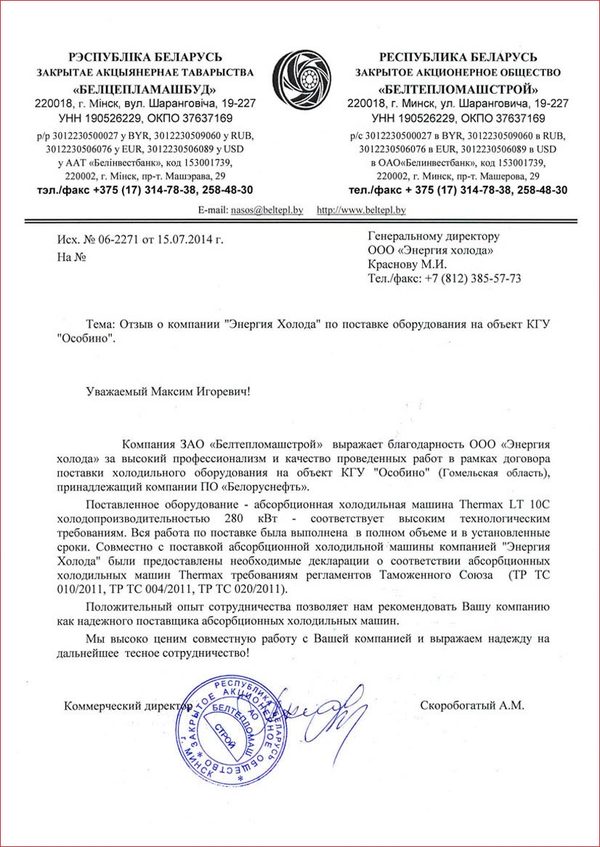
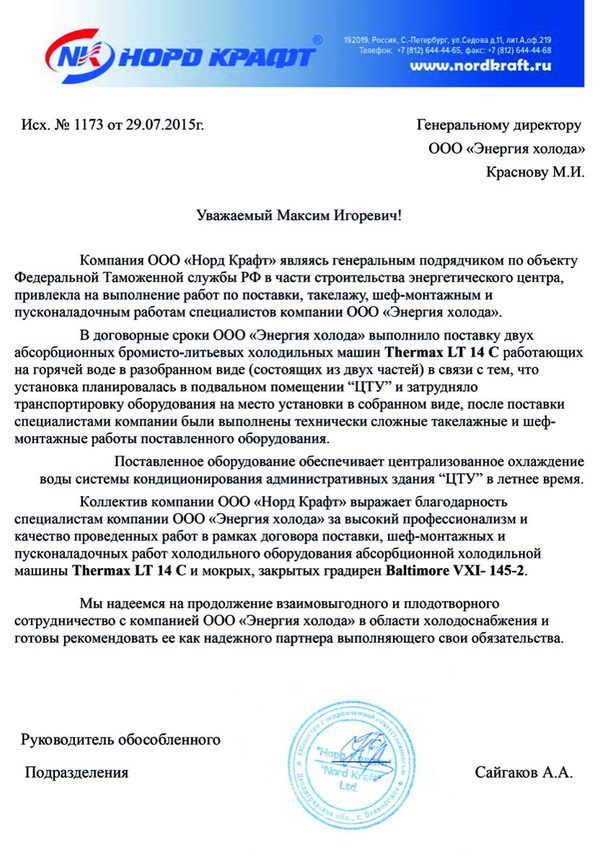
150 letters of thanks · 350+ major projects · 1,000+ customers · in business since 2011. These are real letters from customers; many others are on the references page.

Let us calculate trigeneration for your site
An engineer will put together the scheme and select the equipment, and you get a feasibility study. Free of charge, no obligation.