

Types of trigeneration. Comparison of prime movers and absorption chillers
In brief. The type of trigeneration is set by the prime mover. It determines electrical efficiency, heat temperature and which absorption chiller will fit. Below is a comparison based on data from the US EPA.
Types of trigeneration (CCHP) are distinguished by the prime mover that generates electricity: a gas engine generator set, a gas turbine, a microturbine, a diesel engine, a steam turbine or a fuel cell. The prime mover determines how much electricity is obtained from the gas, what heat remains (hot water, exhaust or steam), and which lithium bromide absorption chiller will turn it into cooling. Below is a comparison based on the technology catalog of the US Environmental Protection Agency (EPA) and the selection of a Thermax chiller for each type.
If you need the basics, start with the article on the operating principle and the "Cogeneration" page.
How do prime movers differ in efficiency and capacity?
EPA data (Catalog of CHP Technologies, September 2017 edition, efficiency based on higher heating value). These are typical US values from industry publications, not an official EPA position.
| Prime mover | Electrical efficiency | Total efficiency with heat recovery | Typical capacity |
|---|---|---|---|
| Reciprocating gas engine (including diesel) | 27–41% | 77–80% | from 5 kW to 10 MW; high-speed diesel up to 4 MW, low-speed up to 80 MW |
| Gas turbine | 24–36% | 66–71% | 0.5–300 MW, economical for cogeneration from 5 MW |
| Microturbine | 22–28% | 63–70% | 30 kW – 1 MW (modules of 30–250 kW) |
| Steam turbine | from 5 to 40% and higher | about 80% | from 0.5 MW to several hundred MW |
| Fuel cell | 30–63% | 55–80% | 0.2–2.8 MW |
Total efficiency does not distinguish the quality of energy: electricity and heat are simply added together, as if they were the same thing. So a gas turbine with a total efficiency of 66–71% is not necessarily worse than a gas engine with 77–80%: it gives heat at a higher temperature, and steam can be obtained from it. This difference is what matters in the choice.
How do prime movers behave in operation?
| Prime mover | Start-up time | Part-load operation | Operating hours before overhaul |
|---|---|---|---|
| Reciprocating gas engine | about 10 s | acceptable | 30,000–60,000 |
| Gas turbine | 10 min – 1 h | poor | 25,000–50,000 |
| Microturbine | about 60 s | acceptable | 40,000–80,000 |
| Steam turbine | 1 h – 1 day | acceptable | more than 50,000 |
| Fuel cell | 3 h – 2 days | good | 32,000–64,000 |
For trigeneration, part-load operation matters most. Trigeneration pays off when the engine runs and the heat is used as many hours a year as possible. A gas turbine loses efficiency at part load, so it is chosen where the load is steady. Gas engines and microturbines handle variable loads better.
What heat is produced and which absorption chiller fits it?
The chiller is chosen by the temperature and type of heat, not by the name of the prime mover.
| Prime mover | What heat | Thermax chiller | COP |
|---|---|---|---|
| Gas engine | jacket water at about 90–110 °C and exhaust at about 380–540 °C | hot water (LT, 5G), exhaust-fired (2D), Trigenie for both sources at once | 0.65–0.80 on water, 1.40–1.45 on exhaust |
| Gas turbine | exhaust at about 430–480 °C for small units, up to 590 °C for large ones; steam via a heat recovery steam generator | exhaust-fired (2D) or double-effect steam-fired (2B) | 1.40–1.45 and 1.30–1.45 |
| Microturbine | exhaust at about 260–315 °C | exhaust-fired in a special design, or hot water via a heat exchanger | depends on the chiller |
| Diesel | jacket water, exhaust, heat recovery steam generator | hot water, steam-fired | 0.65–0.80 and 1.30–1.45 |
| Steam turbine | back-pressure and extraction steam | steam-fired: single-effect SS, double-effect SD and 2B | up to 0.75 and 1.30–1.45 |
| Fuel cell | hot water or low-pressure steam; exhaust for high-temperature types | hot water, steam-fired or exhaust-fired | depends on the cell type |
COP (coefficient of performance) shows how many kW of cooling 1 kW of heat produces. For single-effect hot water chillers it is 0.65–0.80, for double-effect chillers on steam, gas or exhaust 1.30–1.45. A triple-effect chiller (steam at 10–25 bar) reaches 1.8.
Typical pairings according to DOE: a single-effect chiller works with a reciprocating engine (lower-temperature heat), a double-effect chiller with a gas turbine (hot heat). For low-temperature fuel cells (PEMFC), the heat is not enough even for a single-effect chiller. If the fuel cell is a high-temperature type (SOFC, MCFC), the heat is suitable.
There is also a general limitation: any absorption chiller rejects more heat to the cooling tower than an electric chiller. For a single-effect chiller it is about 2.45 kW per 1 kW of cooling, for a double-effect one about 1.72, for an electric chiller with a COP of 5 about 1.20. An NCT cooling tower is sized for the absorption chiller's heat rejection, not "as for a chiller".
How do you choose the type by the ratio of heat to electricity?
The choice starts with T/P, the ratio of heat consumption to electricity consumption. According to the guide by DOE and the Midwest CHP Application Center:
| Site T/P | Which prime mover to consider |
|---|---|
| 0.5–1.5 | reciprocating engines |
| 1–10 | gas turbines |
| 3–20 | steam turbines |
T/P is calculated from 12 months of bills: heat derived from gas consumption, taking equipment efficiency into account, is divided by electricity in kWh. For trigeneration this rule has to be applied with care: cooling also consumes heat, so the "heat" load grows in summer.
In the US, gas turbines provide about 64% of all cogeneration capacity, steam turbines 32.1%, reciprocating engines 2.7% (but 51.9% of all sites), and microturbines and fuel cells 0.1% each. ICF database, 2014.
Which types of trigeneration are covered in detail?
- Gas engines: the most detailed page, with schemes and real projects.
- Gas turbine plant: exhaust, heat recovery steam generator, turbine inlet air cooling.
- Microturbines: buildings and data centers.
- Diesel power plant: when there is no gas.
- Steam: heat recovery steam generator and steam-fired chiller.
- Biogas, coal mine gas and associated petroleum gas.
- Fuel cells.
- Atlas of schemes: all schemes on one page.
All Thermax chillers in one place: Thermax absorption chillers. Heat from the chillers is rejected by NCT equipment: cooling towers, dry coolers, and chillers for the peak, see colden.ru.
Which type does not pay off?
Any type where there is no year-round heat load. The reason is the load, not the technology: projects fail when capacity is chosen by electricity, when there is no heat demand in summer, or when operating hours are few. These mistakes are covered on the "Why trigeneration does not pay off" page. The benchmark for the absorption part: from 300 kW of cooling and 3,000–4,000 hours a year or more; below 2,000 hours it does not pay off.
Whatever prime mover you choose, the interface with cooling remains, and if the engine and the cooling are split between different contractors, it belongs to no one. Cold Energy (NCT) supplies gas engines, Thermax chillers and NCT equipment. With turbines and other prime movers, we handle the cooling circuit and its interface with the heat source.
Want to know which type suits your site? Order a feasibility study or calculate it with the calculator.
Sources
- EPA, Catalog of CHP Technologies, September 2017: https://www.epa.gov/sites/default/files/2015-07/documents/catalog_of_chp_technologies.pdf
- DOE, Absorption Chillers for CHP Systems, DOE/EE-1608, May 2017: https://www.energy.gov/sites/prod/files/2017/06/f35/CHP-Absorption%20Chiller-compliant.pdf
- DOE / Midwest CHP Application Center, CHP Resource Guide for Hospital Applications, 2007: https://www.energy.gov/sites/prod/files/2013/11/f4/chp_hospital_guidebook_2007.pdf
- ICF for ORNL, Opportunities for CHP in Data Centers, March 2009: https://www.energy.gov/sites/prod/files/2013/11/f4/chp_data_centers.pdf
- Thermax absorption chiller catalog (manufacturer data on series and COP).
Frequently asked questions
Does it make sense to install an absorption chiller on flue gas at about 160–170 °C to cool a large data center?
For a Thermax exhaust-fired chiller, the standard inlet temperature is 350–600 °C, or 270 °C in a special design, and the gas leaves at 170 °C (130 °C in the special design). Gas at 160–170 °C is already a residue; it will not drive the chiller. It is a different matter if this temperature is measured after an existing heat recovery steam generator: then the chiller can be installed upstream of it, on the hot gas. To answer, we need the temperature and flow before and after the heat recovery unit.
Can an absorption chiller deliver propylene glycol at −6 °C if the heat source is a gas engine with a 97/70 °C circuit?
Not on 97/70 °C water. Sub-zero outlet temperatures are produced only by double-effect lithium bromide chillers, which need a hotter source, and their limit is −5 °C in a special design.
Sections
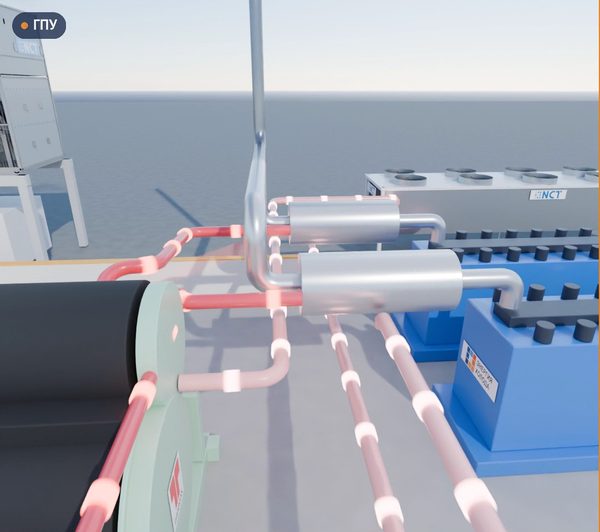
How trigeneration with a gas engine is built: where the heat comes from, which absorption chiller schemes exist, where they…
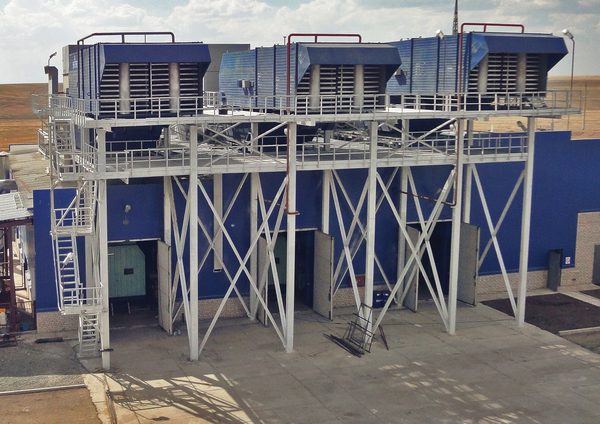
Trigeneration on a gas turbine: exhaust into an absorption chiller, a heat recovery steam generator, turbine inlet cooling…
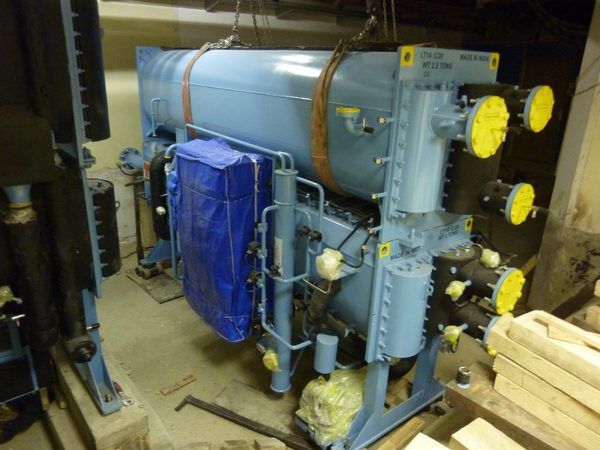
Microturbines with an absorption chiller: exhaust at 260–315 °C, up to 1 MW, schemes for buildings and data centers, our project…
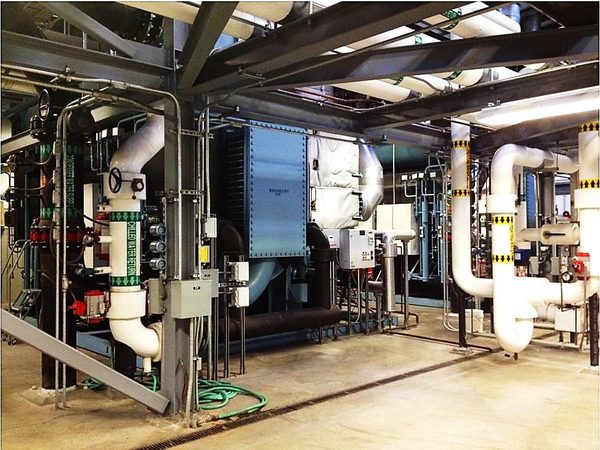
Heat recovery from diesel power plants and cooling from that heat: a scheme with a heat recovery boiler, examples from India and…
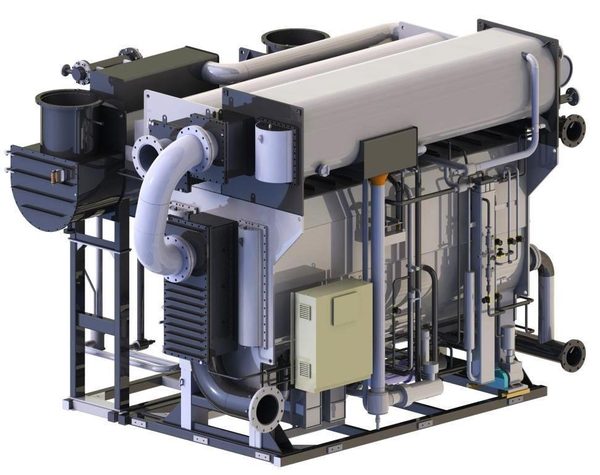
Steam trigeneration: a heat recovery steam generator after an engine or turbine, a steam absorption chiller with COP up to 1.45…
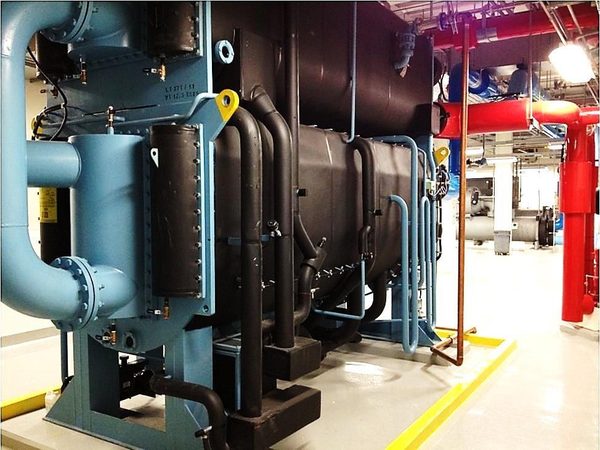
Trigeneration on biogas, coal mine methane and associated gas. How the fuel differs from natural gas, three digester schemes…
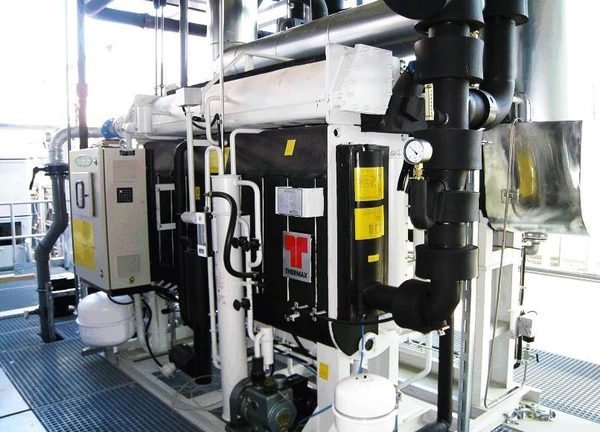
Fuel cells with an absorption chiller: 30–63% efficiency, which types give heat hot enough, and international examples with data…
What our customers say
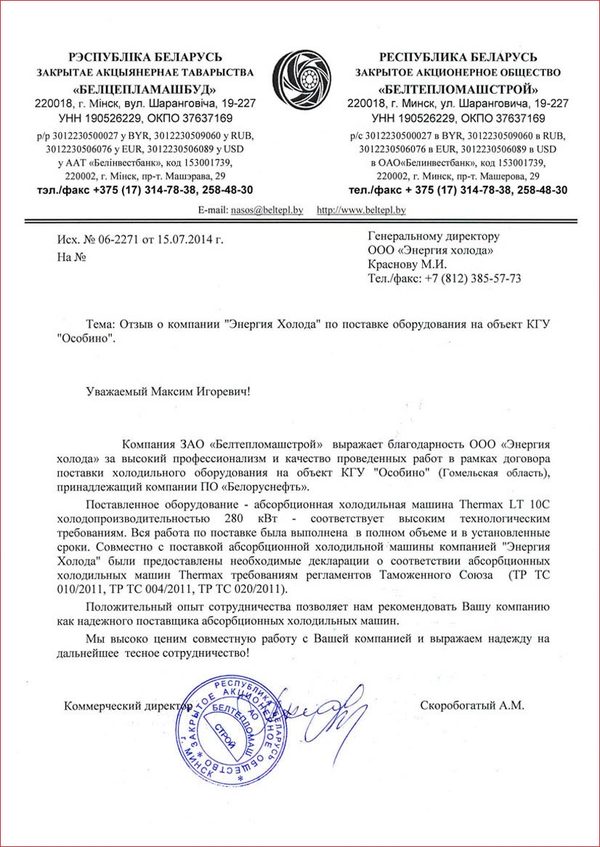
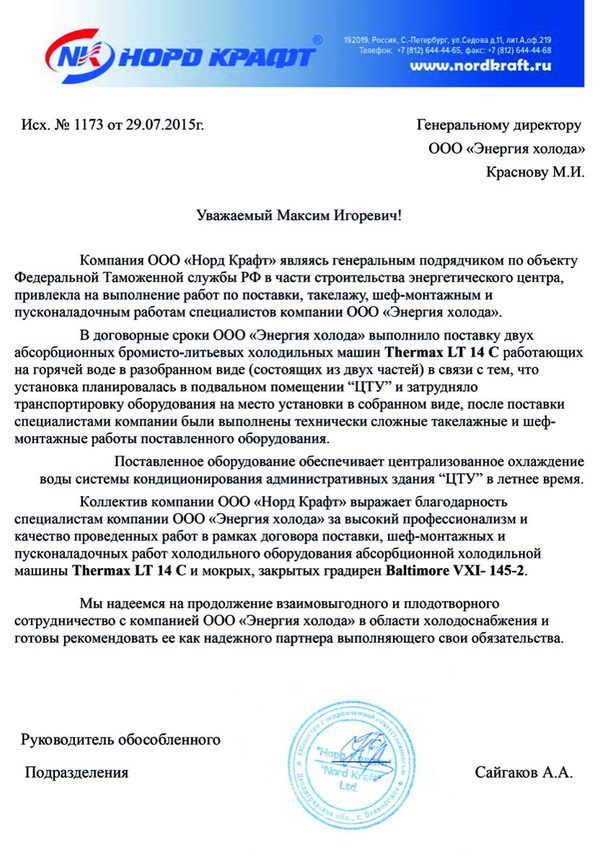
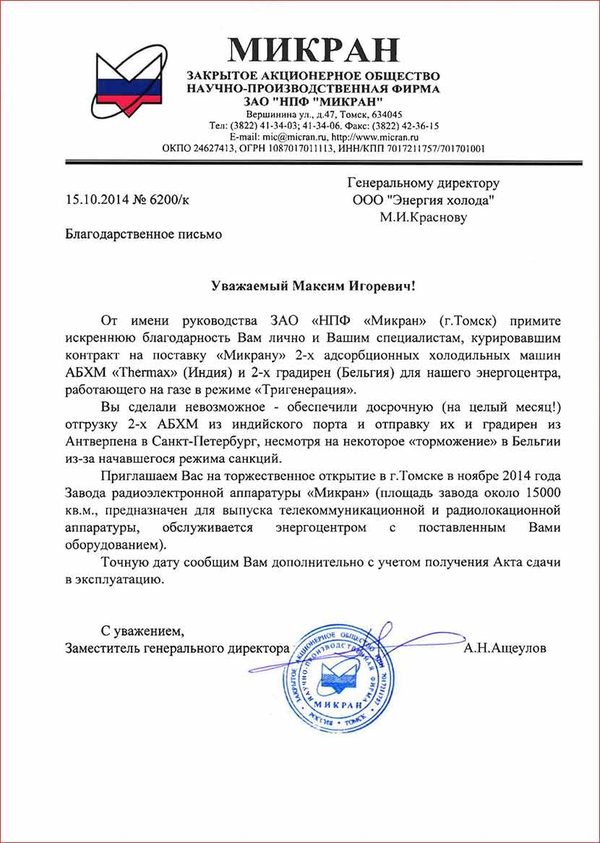
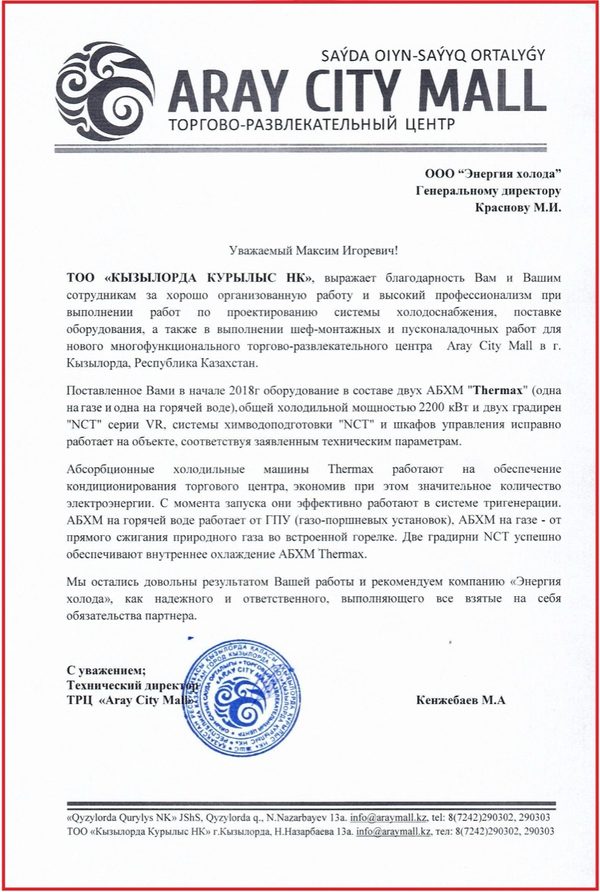
150 letters of thanks · 350+ major projects · 1,000+ customers · in business since 2011. These are real letters from customers; many others are on the references page.
Let us calculate trigeneration for your site
An engineer will put together the scheme and select the equipment, and you get a feasibility study. Free of charge, no obligation.