

Trigeneration with microturbines
In brief. A microturbine gives 30 kW to 1 MW of electricity and exhaust at 260–315 °C, which goes to an absorption chiller. It suits buildings and data centers that need compactness and fast start-up.
A microturbine is a small gas turbine with an output of 30 kW to 1 MW. For trigeneration (CCHP), its exhaust (about 260–315 °C) is sent to an absorption chiller, which produces cooling for a building or a server room. Microturbines have a modest electrical efficiency of 22–28%, and a total efficiency with heat recovery of 63–70% (EPA catalog data, 2017). On the other hand, start-up takes about a minute, availability is 98–99%, the service life is 40,000–80,000 operating hours before overhaul, and part-load operation is acceptable.
The overall picture for engines is on the "Types of trigeneration" page, and for larger turbines there is a page on gas turbines.
How does a microturbine scheme work?
Several microturbines produce electricity, and the exhaust from each is collected in a common header and goes to a Thermax exhaust-fired chiller. The scheme is used in buildings and data centers. Capacity is increased by adding modules: the EPA catalog lists modules of 30–250 kW and packages up to 1,000 kW.
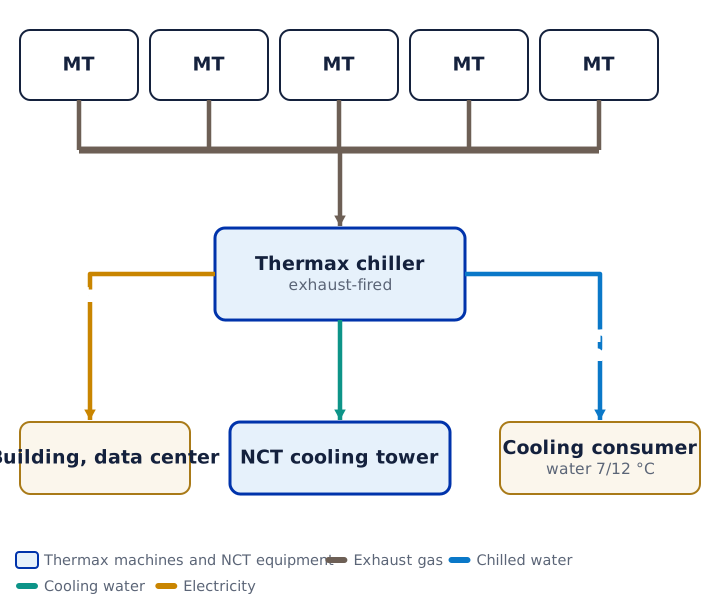
Microturbine exhaust is cooler than that of gas engines and gas turbines: 260–315 °C. The standard exhaust inlet temperature of a Thermax exhaust-fired chiller is 350–600 °C, and 270 °C in a special design, so the microturbine version is confirmed with the manufacturer at the selection stage. An alternative is to recover the exhaust heat with a heat exchanger and feed hot water to a hot water chiller. This was done, for example, at an office in Los Angeles (four 250 kW microturbines, hot water 90.5 → 73.2 °C, one chiller of about 800 kW of cooling, savings of about 550,000 kWh a year).
Our project: Central Customs Administration, Moscow
In a historic building on Komsomolskaya Square, a mini power plant of five Capstone C200 microturbines of 200 kW each, that is 1 MW of electricity, is in operation. Two Thermax LT-14 C chillers of 500 kW of cooling each run on heat from the plant and from the building's own boiler house. Start-up was around 2015.
The historic center lacks electrical capacity, and the building needs cooling, so the cooling was produced from heat. Part of this cooling goes to the server rooms. The chillers had to go into a basement with narrow passages: they were delivered in sections and assembled on site.
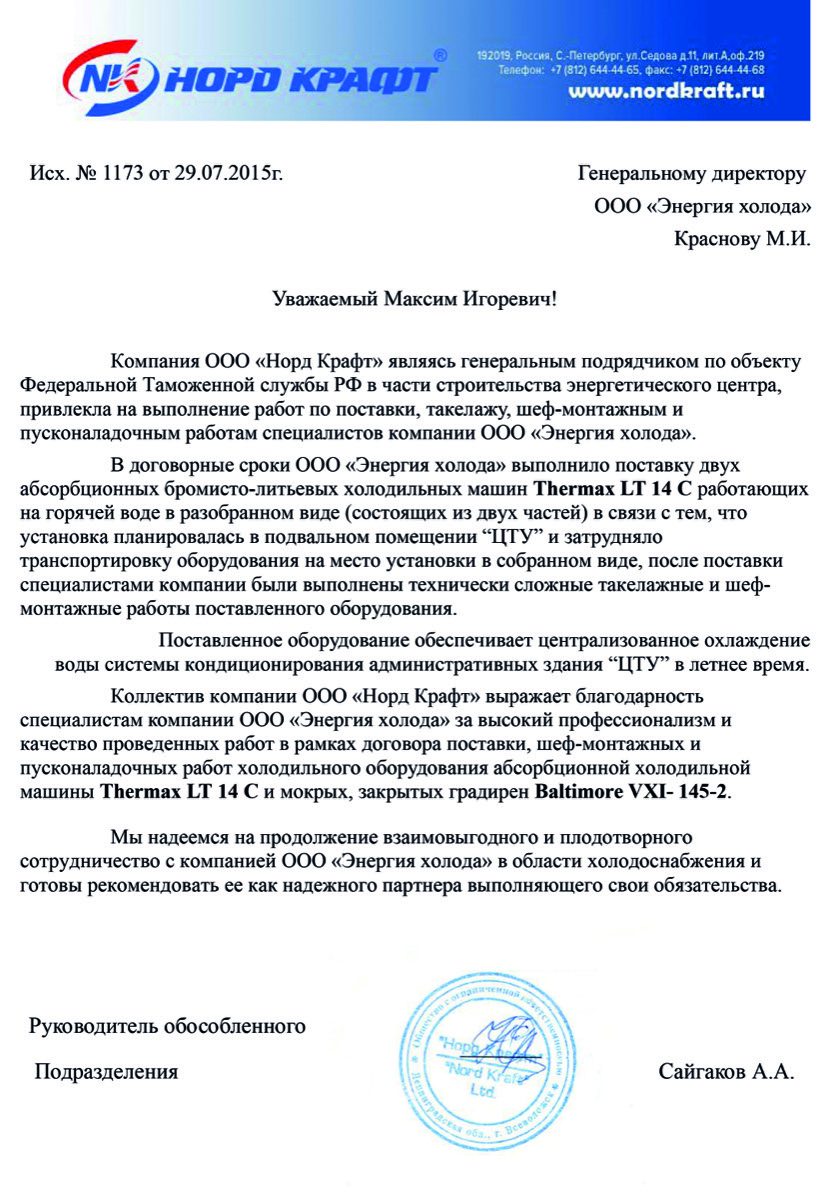
A letter from the energy center's general contractor confirms the on-time delivery of two LT-14 C chillers in knocked-down form, rigging, installation supervision and commissioning. Project page: Central Customs Administration.
What international examples are there?
| Site | Microturbines | Heat and chiller | Result |
|---|---|---|---|
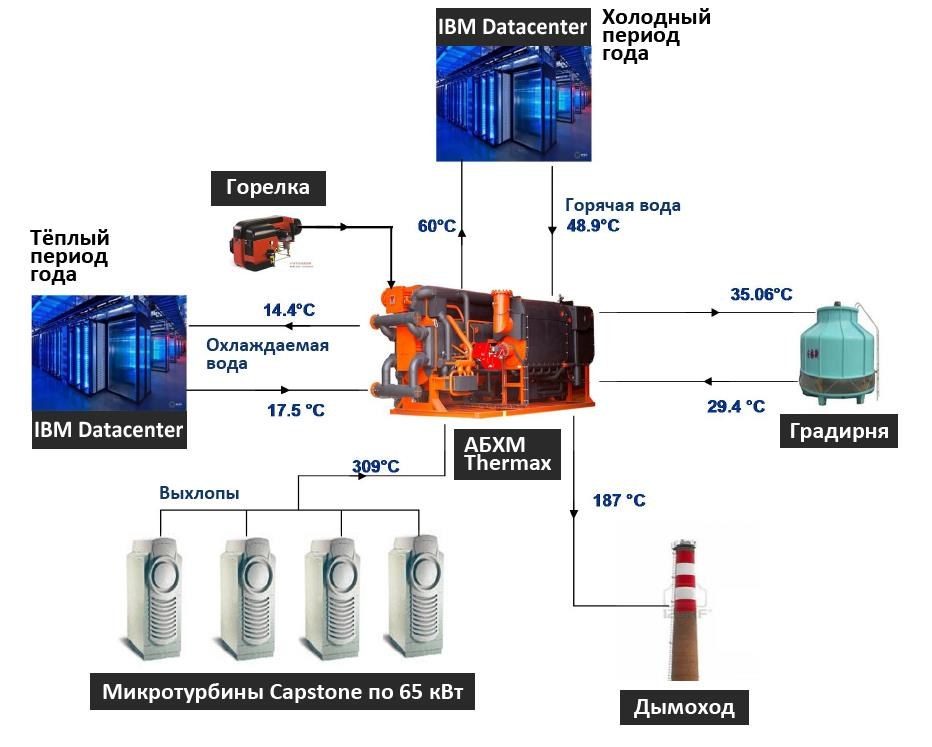
| Data center, Boston, USA | 4 Capstone C65, 65 kW each | exhaust at 309 °C, a chiller of about 350 kW of cooling and 250 kW of heat, burner | data center cooling, water 17.5/14.4 °C |
| Syracuse University data center, USA | 12 Capstone C65 | exhaust at 309 °C, two chillers | independent operation of the data center |
| Film studio, Los Angeles, USA | 4 Flex Energy units of 250 kW each | hot water from the exhaust, a chiller of about 800 kW | savings of 550,000 kWh a year |
Syracuse: the data center can be run independently of the grid; a reduction in energy consumption of about 50% compared with a conventional data center is claimed by the project authors, and there is no independent measurement. The chiller capacity is stated differently in different documents (300 or 320 tons), so we do not give the figure.
The Boston data center diagram shows how the chiller works across seasons. Warm season: chilled water at 17.5/14.4 °C goes to the servers, and the cooling tower rejects heat at 29.4/35.06 °C. Cold season: hot water at 60/48.9 °C also goes to the center. The exhaust leaves through the stack at 187 °C, and a natural gas burner is installed in case of heat shortage.
What are the downsides of microturbines?
According to EPA, microturbines cost more than gas engines per kW of electricity and have a lower electrical efficiency. Small absorption chillers also cost more per kW of cooling: according to DOE, the installed cost of a 50-ton chiller is 3.3 times higher than that of a 1,320-ton one (typical values). The threshold for an absorption chiller is from 300 kW of cooling, and at smaller loads an electric chiller usually wins. In the US, microturbines account for only about 0.1% of cogeneration capacity (355 sites).
Mistakes at the interface between microturbine and cooling are the same as everywhere: an error in exhaust back pressure, chiller shutdown without a bypass, a cooling tower sized "as for a chiller". See the "Why trigeneration does not pay off" page. Exhaust-fired chillers are described on the Thermax absorption chillers page. Cold Energy (NCT) is responsible for the cooling circuit and the interface; we take the exhaust data from the microturbine datasheet.
Want to check whether microturbines suit your building? Order a feasibility study or calculate it with the calculator.
Sources
- EPA, Catalog of CHP Technologies, September 2017: https://www.epa.gov/sites/default/files/2015-07/documents/catalog_of_chp_technologies.pdf
- DOE, Absorption Chillers for CHP Systems, DOE/EE-1608, May 2017: https://www.energy.gov/sites/prod/files/2017/06/f35/CHP-Absorption%20Chiller-compliant.pdf
- Campus Technology, 3 December 2009, Syracuse U Constructs Green Data Center: https://campustechnology.com/Articles/2009/12/03/Syracuse-U-Constructs-Green-Data-Center.aspx
- ICF for ORNL, Opportunities for CHP in Data Centers, March 2009: https://www.energy.gov/sites/prod/files/2013/11/f4/chp_data_centers.pdf
- Thermax materials on trigeneration projects (Boston, Los Angeles).
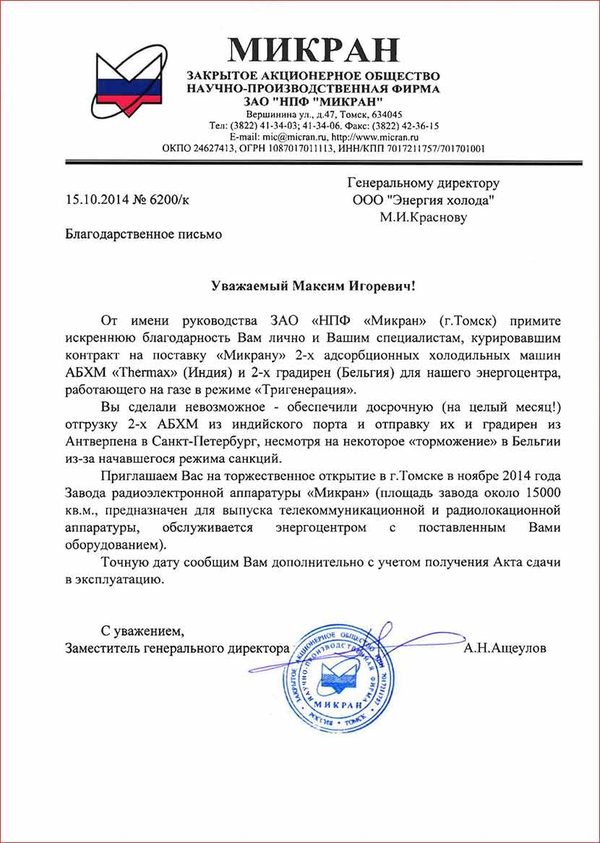
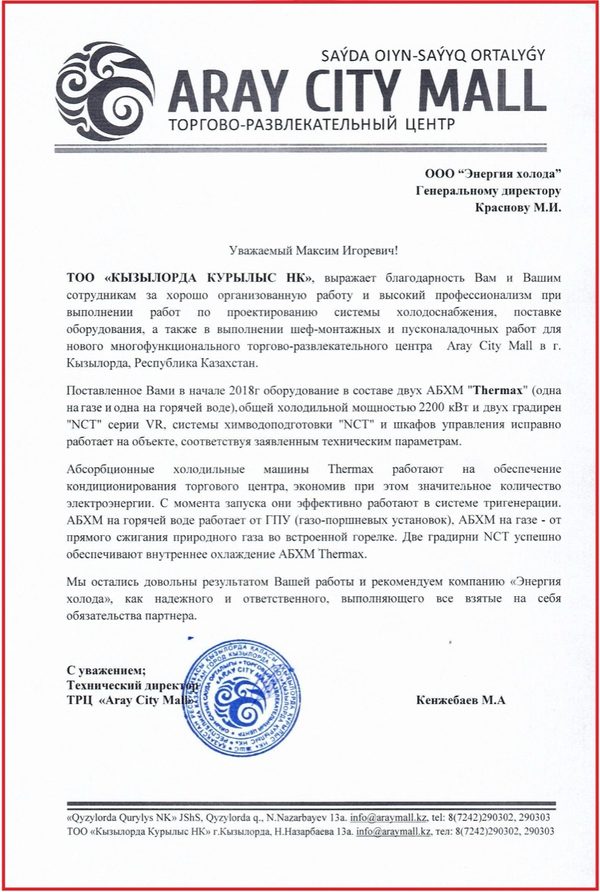
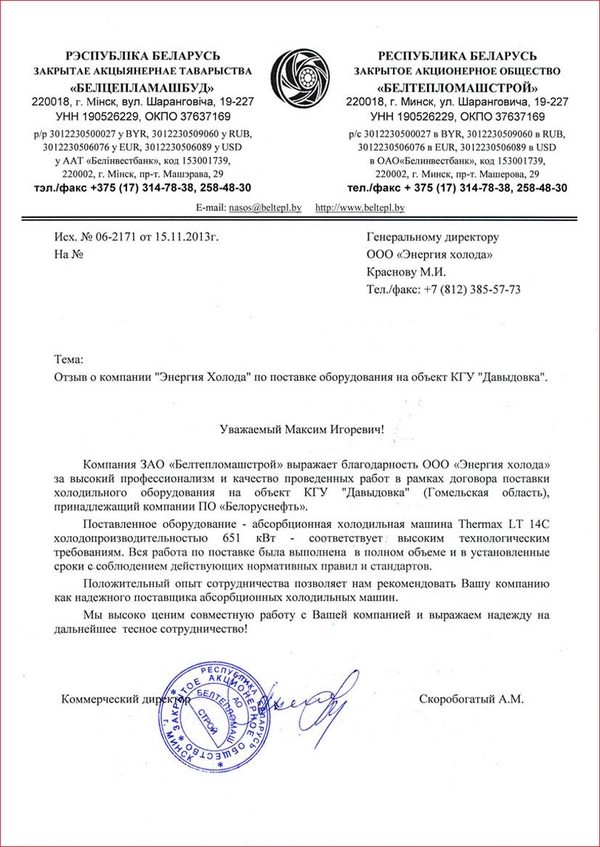
What our customers say
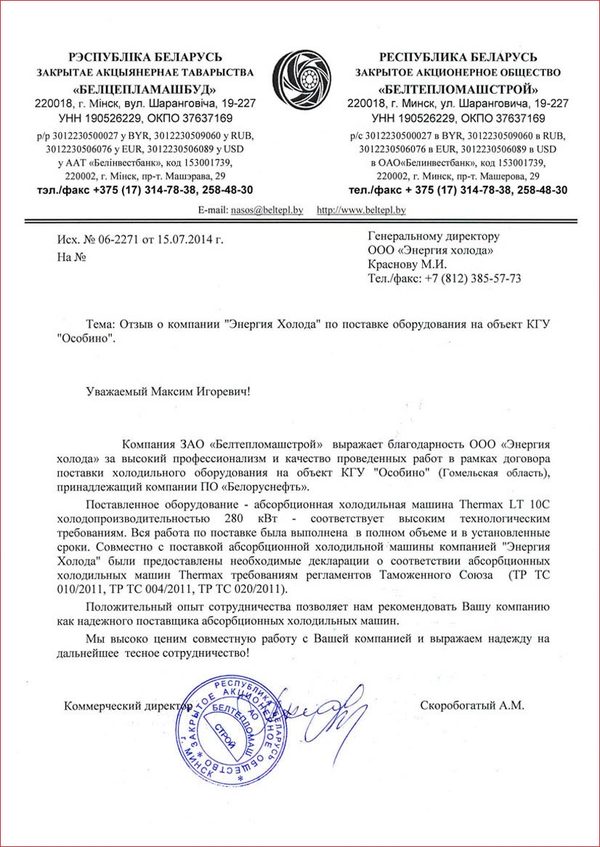
150 letters of thanks · 350+ major projects · 1,000+ customers · in business since 2011. These are real letters from customers; many others are on the references page.
Let us calculate trigeneration for your site
An engineer will put together the scheme and select the equipment, and you get a feasibility study. Free of charge, no obligation.