

Gas engines for trigeneration
In brief. Cold Energy (NCT) supplies gas engines for trigeneration. The gas engine, the cooling circuit and the interface between them can be ordered from one company. The engine is sized by heat and load profile, with data taken at 100, 75 and 50 %.
A gas engine generator set for trigeneration (CCHP) is an engine with a generator, chosen for the site's heat and cooling, not just for kilowatts. We supply these units. If the engine and the cooling are split between different contractors, nobody owns the interface between them, and that is exactly where the six places where trigeneration breaks are found.
What is included in the supply?
The unit itself and everything that turns its heat into cooling: a Thermax lithium bromide absorption chiller, NCT cooling towers, chillers and dry coolers, pump skids, water treatment and controls. The full scope, with the purpose of each component, is described on the page trigeneration plant. We name the specific unit, price and lead time only in a proposal for your site.
How is a gas engine sized for trigeneration?
By heat and by load profile. A common mistake is to take the capacity from the electricity demand and then look for somewhere to put the heat.
There must be enough heat for the cooling peak. A hot-water chiller with a COP (how much cooling you get from 1 kW of heat) of 0.7 needs 1,430 kW of heat for 1,000 kW of cooling. For an estimate, a gas engine gives about 1.1 kW of heat per 1 kW of electricity, so this cooling needs a unit of about 1,300 kWe. If the site does not need that much electricity, the scheme is revised: part of the cooling goes to a chiller, or an exhaust-fired chiller is used. How this works out in money is covered in the article how to calculate a feasibility study.
Now the load profile. An engine rarely runs at rated load all season, so three points are calculated: 100, 75 and 50 % load. From the engine data sheet, you take the exhaust flow and temperature, the jacket heat separately from the exhaust heat, and the allowable back pressure. As the load drops, the exhaust gets hotter, and a chiller selected only by the "100 %" line will not hold its mode at 75 and 50 %.
What does an absorption chiller require from the engine?
| What | Requirement |
|---|---|
| Engine jacket hot water | 90/79 °C at the chiller inlet; gas engine data also show 88/80 and 90/75 °C |
| Flow through the jacket | usually constant, so the engine and chiller circuits are separated |
| Exhaust at the chiller inlet | 350–600 °C, from 270 °C in a special design |
| Exhaust at the chiller outlet | 170 °C, 130 °C in a special design |
| Back pressure | chiller 200–250 mm H2O; the total with the exhaust ducts must not exceed the engine's limit, the engine has priority |
| Damper | diverter type; when the chiller stops or power is lost, it goes to bypass; powered from the engine |
| Backup | grid connection in case the gas engine stops; the chiller can be fed from the boiler house |
What to choose, hot water or exhaust?
Hot water is simpler. The jacket and the exhaust heat exchanger heat the water, and a single-effect chiller runs with a COP of 0.65–0.80. Exhaust is more complex, but a double-effect chiller gives a COP of 1.40–1.45, and the same portion of heat yields almost twice as much cooling. You can order a gas engine without the hot water recovery module and feed exhaust at about 400 °C into the chiller. This takes experience: part of the gas has to be routed around the chiller. Exhaust-fired series are described on the page exhaust-fired absorption chiller and Trigenie, and the other options in the section trigeneration with gas engines.
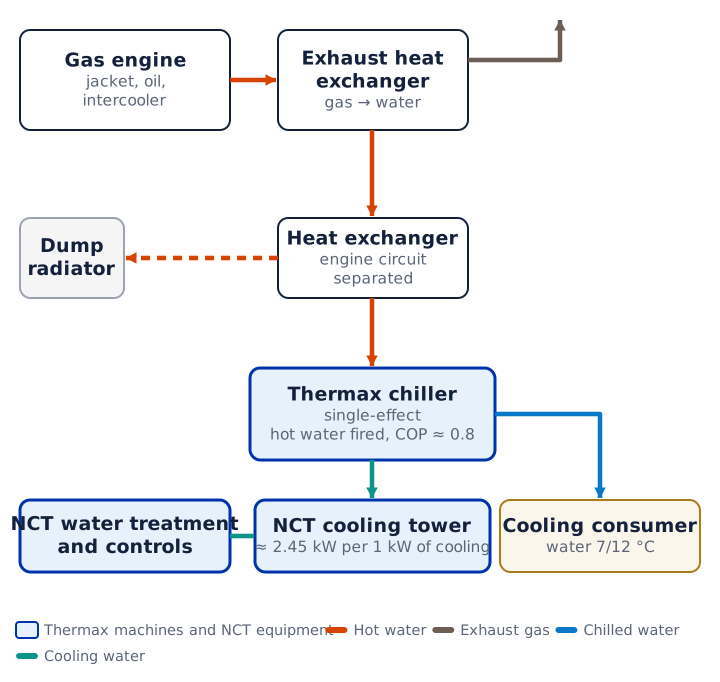
The classic: a gas engine and a hot-water absorption chiller
The easiest option for the engine. The price for it is the size of the cooling tower: it rejects both the chiller's heat and the heat that came in with the water.
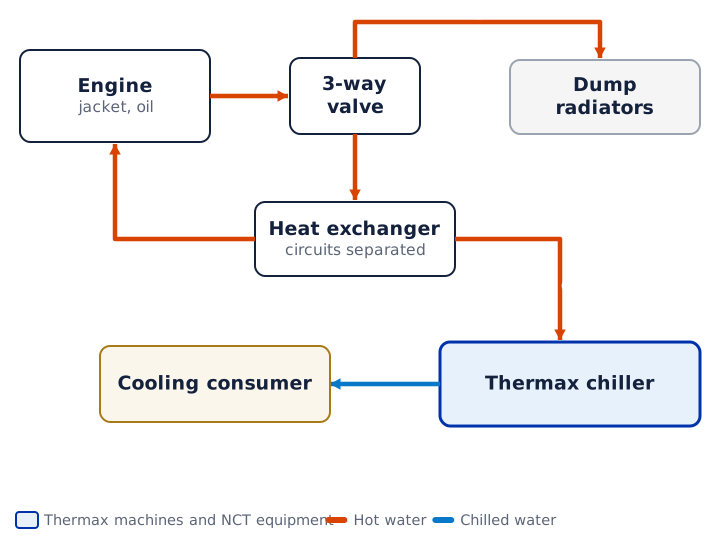
Jacket water circuit: the engine comes first
If the chiller stops, the jacket still has to reject its heat somewhere. A three-way valve holds the return temperature, the excess goes to the emergency radiators, and the engine keeps running.
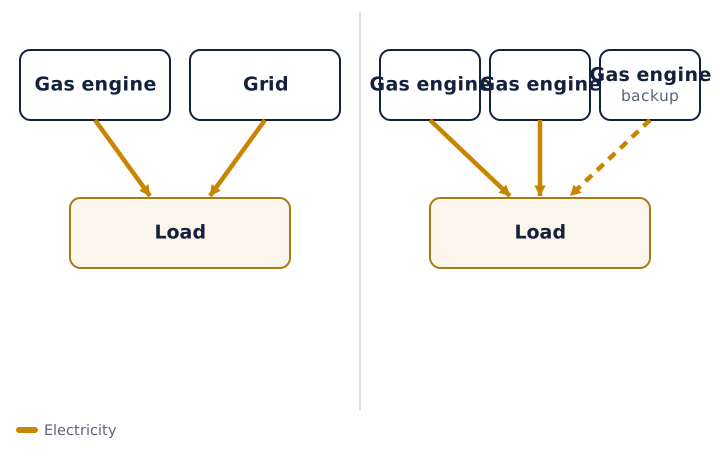
Grid-parallel or island mode
In grid-parallel mode, the plant runs together with the grid, and the grid covers peaks and backup. In island mode, the plant holds frequency and voltage on its own, so the number of units is chosen with a margin for the failure of one.
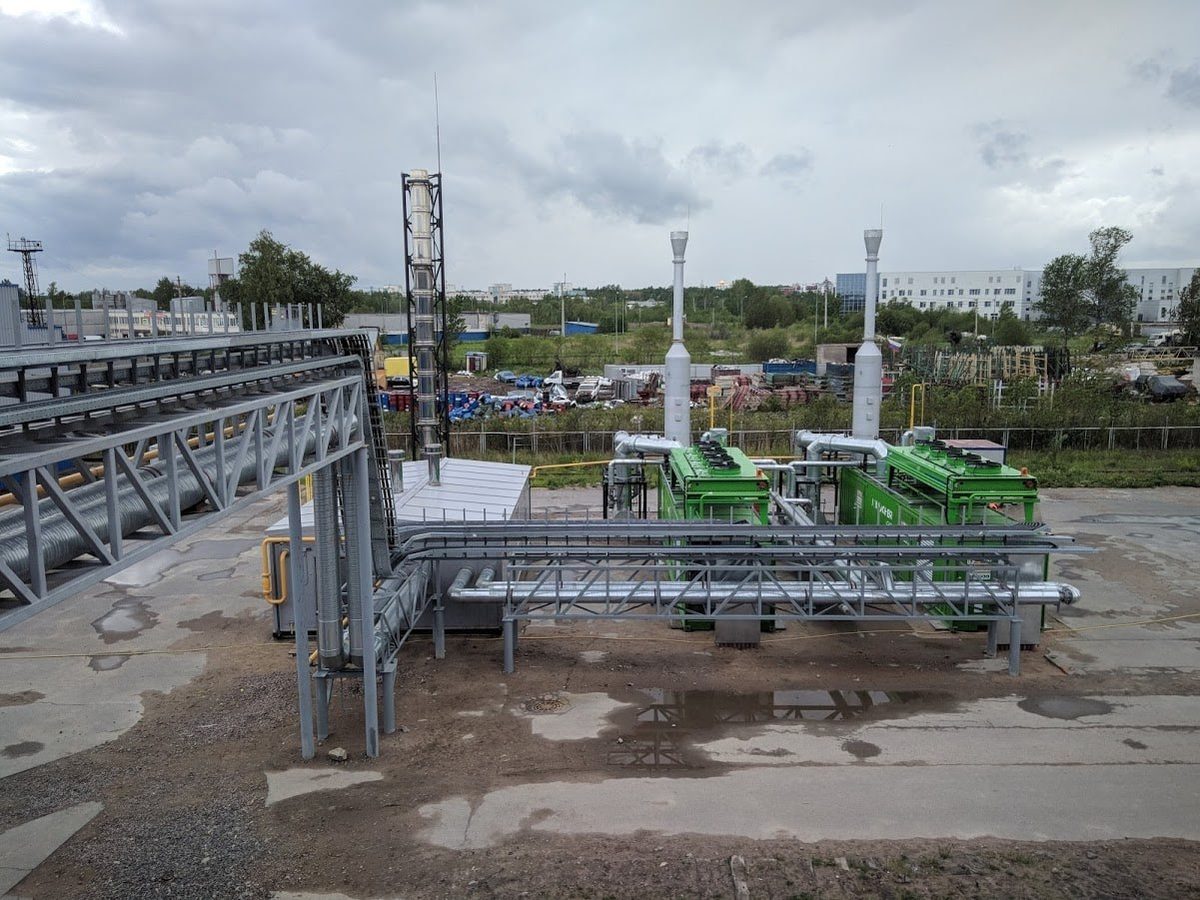
At which sites do these schemes work?
Below are the engines installed at our sites with Thermax chillers. These are facts about the sites, not a list of brands we supply. There are many examples; the rest are in the Our projects section.
| Site | Gas engines on site | Thermax absorption chiller |
|---|---|---|
| Greenhouse complex, Sverdlovsk Region | 10 JMS 624 and 4 JMC 320, island mode | 2 × LT 12 C of 400 kW each |
| Vyborzhets agricultural complex, Vsevolozhsk | 4 GE Jenbacher and 3 MWM | 2 × 5G 6LH of 1.9 MW each |
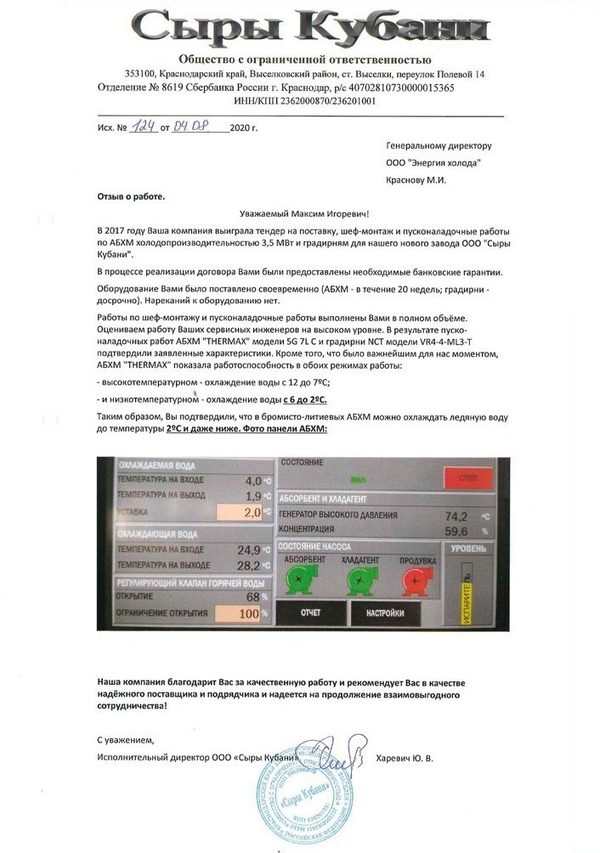
| Syry Kubani cheese plant, Vyselki | 4 MTU of 1,948 kW each | steam-fired chiller, 3,500 kW |
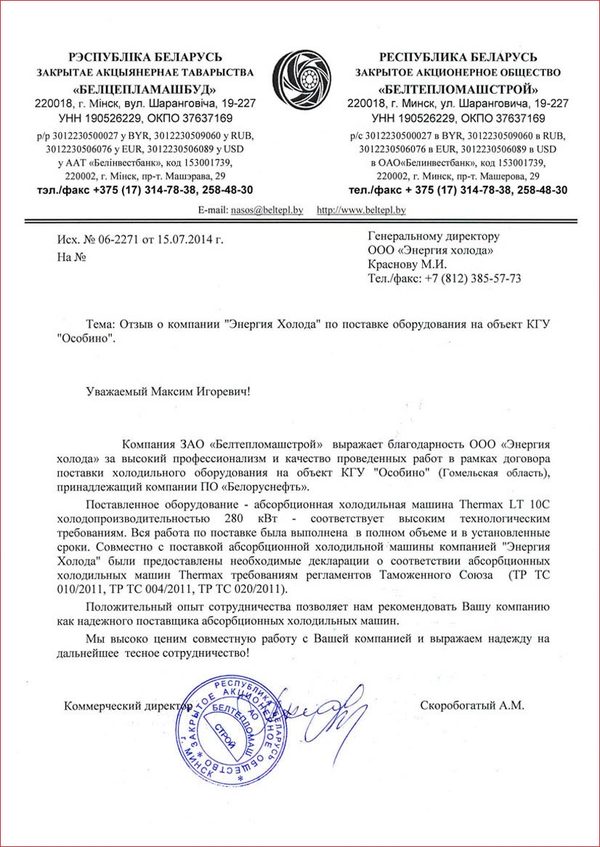
| Omega Tower, Minsk | 2 Bosch | LT 18C, 500 kW |
| And many others |
You can check how much heat and cooling an engine will give on your load profile in a feasibility study, and estimate the order of magnitude in the calculator. Equipment for the cooling side is collected on colden.ru.
Frequently asked questions
A hot-water absorption chiller fed by a gas engine at 90/70, or a conventional chiller, if you need 6 MW of cooling at 7/12 °C?
Count not 6 but 8–8.6 MW of input heat; with this temperature schedule, that is about 345–370 m³/h. Heat rejection through the cooling towers will be twice as large: 14–14.6 MW versus 7.1–7.2 MW for a vapor-compression unit, but the latter draws 1–1.2 MW from the grid. The rated capacity is given at a higher inlet temperature, so a correction is applied for 90 °C.
What our customers say
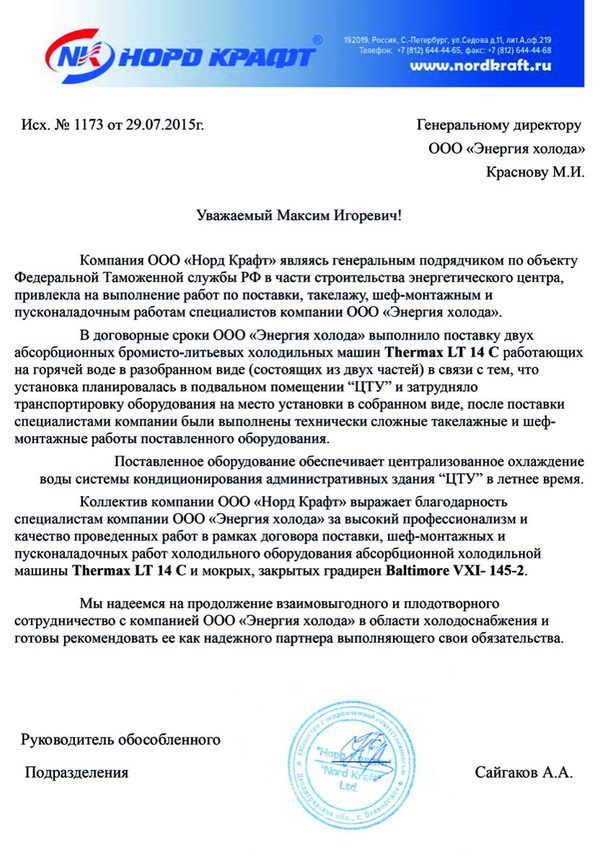
150 letters of thanks · 350+ major projects · 1,000+ customers · in business since 2011. These are real letters from customers; many others are on the references page.

Let us calculate trigeneration for your site
An engineer will put together the scheme and select the equipment, and you get a feasibility study. Free of charge, no obligation.