

Distributed energy and on-site generation at an industrial plant
In brief. Distributed energy means sources close to the consumer, in Russia usually up to 25 MW on gas. On-site generation makes sense when the grid is expensive or cannot provide the capacity, and heat and cooling are needed for 3,000–4,000 hours a year or more.
Distributed energy (small-scale energy) means your own sources of electricity and heat close to the consumer: at a factory, a shopping mall, a greenhouse. In Russia this usually refers to packaged power facilities of up to 25 MW, most often based on gas engine generator sets. On-site generation makes sense when the grid cannot provide the required capacity or electricity is too expensive, and heat and cooling can be used almost all year round.
Why do companies need on-site generation?
Electricity tariffs are rising. A grid connection is expensive, or the grid cannot provide the required capacity. Production needs an uninterruptible supply, and new buildings go up faster than the grid. In some of our projects the decisive factor was a lack of grid capacity.
At a greenhouse complex in Sverdlovsk Region an electric chiller did not fit within the available power, the substation was far away, and the complex runs in island mode on its own gas engines. The complex saved on connecting to the external grid, its energy efficiency is up to 92 %, and the payback is 5 years. In Moscow, in the historic center, where electrical capacity was short, cooling for an office building is produced from the heat of microturbines and a boiler house. We name these sites among many others; the full list is in the "Projects" section.
What does an on-site plant consist of?
The path usually has three steps.
-
On-site electricity generation. A gas engine or gas turbine, microturbines or fuel cells are used.
-
Cogeneration: engine heat is recovered for space heating and hot water. More on the "Cogeneration" page.
-
Trigeneration (CCHP): summer and surplus heat is turned into cooling in an absorption chiller. This is covered on the "Trigeneration" page.
With each step more heat goes to use instead of into the air.
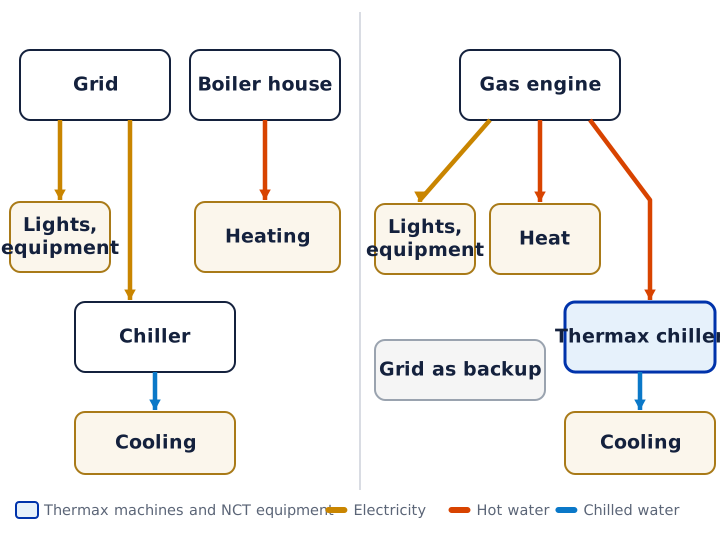
Separate supply and trigeneration
With separate supply, a site buys electricity, heat and cooling through three different chains; with trigeneration, one plant does it all.
Which engines suit small-scale energy?
| Engine | Typical capacity | Electrical efficiency |
|---|---|---|
| Gas engine | from a few kW to 10 MW | 27–41 % |
| Gas turbine | 0.5–300 MW, economical from 5 MW | 24–36 % |
| Microturbine | 0.03–1 MW | 22–28 % |
| Fuel cell | 0.2–2.8 MW | 30–63 % |
Data from the US catalog of combined heat and power technologies (EPA, 2017). At a gas turbine power station in Kazakhstan (110 MW), an exhaust-fired chiller cools the air at the turbine inlet; this is another way to use turbine heat. Breakdown by type: types of trigeneration.
With the grid or without it?
There are two modes. In parallel operation the plant and the grid supply the load together; the grid covers peaks and serves as a backup. In island mode there is no grid, the plant holds frequency and voltage itself, and the number of units is chosen with a margin for one of them failing.
Grid-connected or island
In parallel operation the grid covers peaks and provides backup, while in island mode the plant is designed for one unit failing.
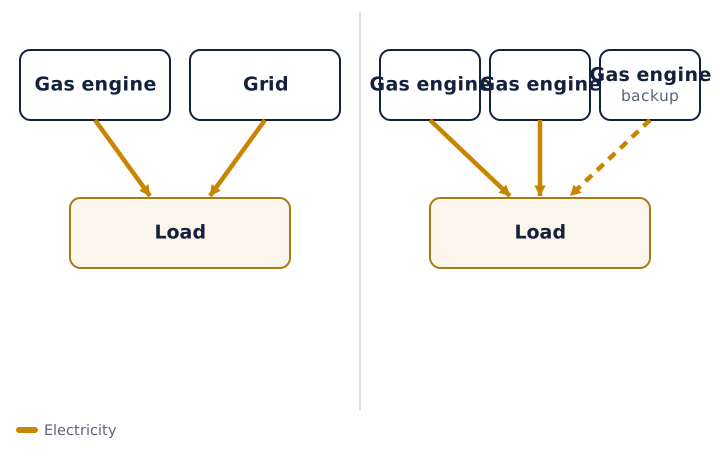
Island mode requires more redundancy and is therefore more expensive. For an absorption chiller it adds its own condition: the chiller survives a power dip of up to 3 minutes, but anything longer needs a UPS or a backup feed for the dilution cycle, otherwise the solution can crystallize.
What about the microgeneration law?
Federal Law No. 471-FZ of 27 December 2019 applies to units of up to 15 kW connected to a grid of up to 1,000 V. It does not apply to industrial trigeneration. We do not give the cost of grid and gas connection in Russia here: there is no open source with figures, so check the technical conditions for your site.
When will on-site generation not pay back?
It does not pay back if there is no heat demand in the right season, if operating hours are few, or if the capacity is chosen for electricity rather than for the heat load. US guides give benchmarks: more than 5,000 hours a year is profitable, 3,000–5,000 hours may pay back and needs a calculation, and fewer than 3,000 usually does not justify the investment. Cooling adds hours in summer. Causes of failure and the six interfaces between the engine and the cooling are collected on the "Trigeneration mistakes" page. One contractor should be responsible for these interfaces, which is why Cold Energy (NCT) supplies both gas engines and Thermax chillers with NCT equipment.
If you want to check your site, order a feasibility study or run the numbers in the calculator. Model calculations by site type are collected in the "Industries" section.
Sources
- EPA, Catalog of CHP Technologies, September 2017: https://www.epa.gov/sites/default/files/2015-07/documents/catalog_of_chp_technologies.pdf
- DOE, CHP Resource Guide for Hospital Applications, 2007: https://www.energy.gov/sites/prod/files/2013/11/f4/chp_hospital_guidebook_2007.pdf
- DOE Midwest CHP TAP, Combined Heat and Power Resource Guide, 2015: https://www.energy.gov/sites/default/files/2019/01/f58/CHPGuide2015.pdf
- Rossiyskaya Gazeta, 30 December 2019, Federal Law No. 471-FZ: https://rg.ru/2019/12/30/energetika-dok.html
Frequently asked questions
Where does the heat of an absorption heat pump go in summer, when space heating is off?
You need a backup heat sink: a cooling tower or a dry cooler for the remaining capacity. Without it the unit hits its upper temperature limit and goes into dilution, and the steam is wasted. The heat pump takes heat from the cooling water and delivers it to the district heating network, so for summer, when the network takes less, the heat sink question is settled at the design stage, not during commissioning. Equipment details are in the "Absorption heat pump" section.
What our customers say
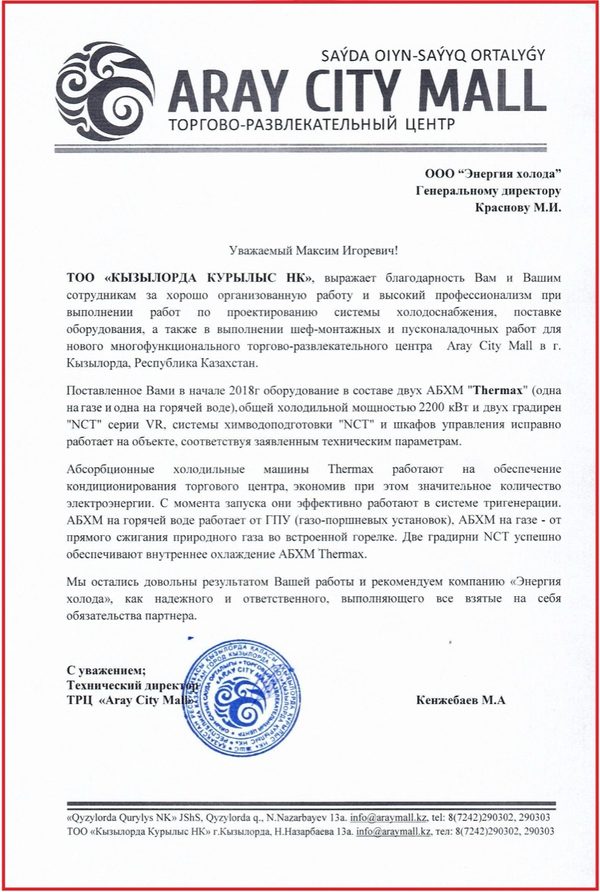
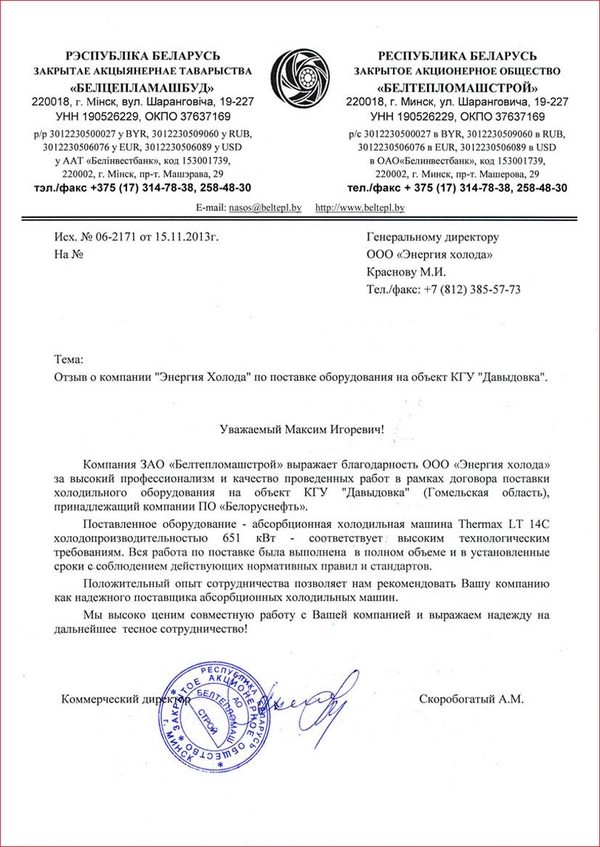
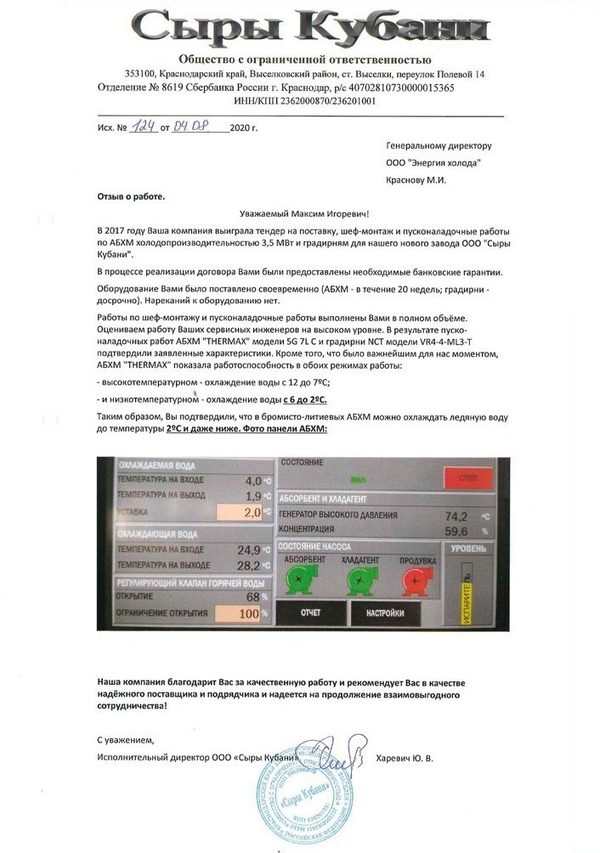
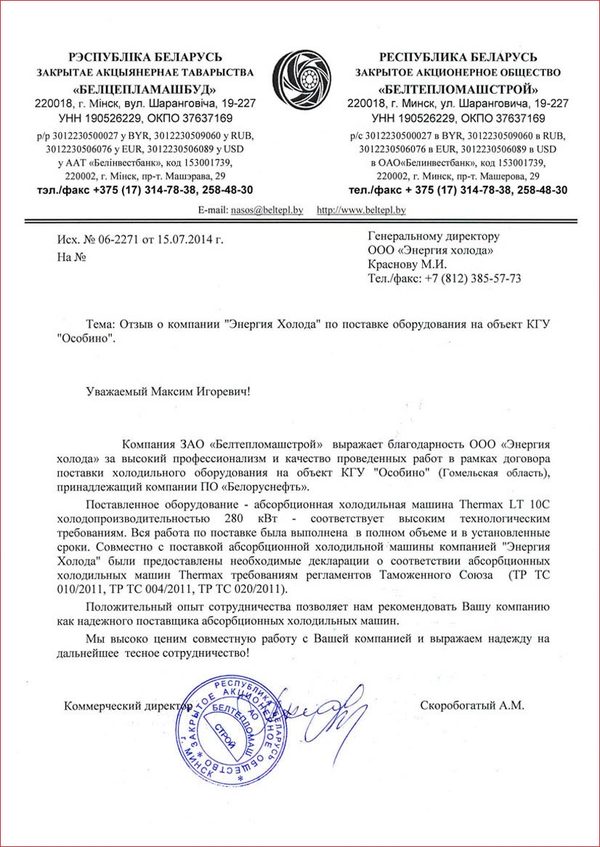
150 letters of thanks · 350+ major projects · 1,000+ customers · in business since 2011. These are real letters from customers; many others are on the references page.
Let us calculate trigeneration for your site
An engineer will put together the scheme and select the equipment, and you get a feasibility study. Free of charge, no obligation.