

Trigeneration calculator: payback in a minute
In brief. The calculator uses the same model as the six examples on the site. The result is indicative; equipment prices are replaced by the price from a commercial proposal.
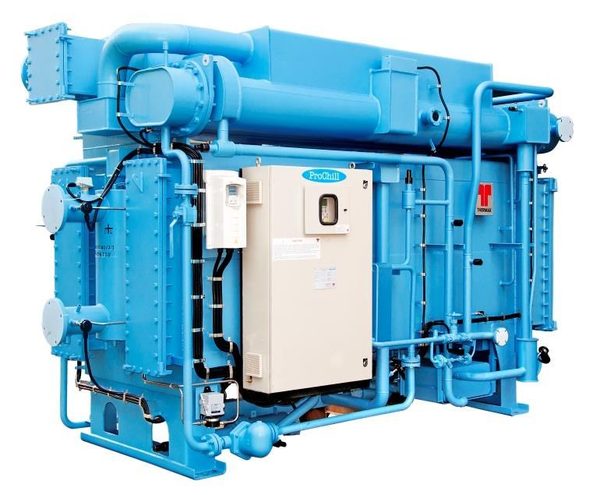
In a minute, the calculator shows whether trigeneration (CCHP) is worth calculating for your facility at all: how much you can save per year and in how many years the difference in investment pays off. It works on the same model as the six ready-made calculations. This is a model calculation and a guideline, not an offer and not a guarantee.
How to read the result?
The calculator gives six numbers.
- Savings per year. The costs of the "grid, chillers, boiler house" scheme minus the costs of the "gas engine plus absorption chiller" scheme.
- Payback of the extra investment. Not the full cost of the plant, but what you pay on top of the chillers. If the scheme turns out cheaper, the calculator says "immediately". If there are no savings, it says "does not pay back".
- Own electricity. What a kilowatt-hour from your own gas engine costs: gas plus service. With gas at RUB 9/m³, it comes to RUB 3.72 versus RUB 10 from the grid.
- Generating capacity. The engines are selected so that the average load does not exceed 85%.
- Investment in trigeneration. A model guideline, not a cost estimate.
- Share of cooling from waste heat. If it is below 100%, the remainder is made by an electric chiller powered by the same gas engine.
The main part of the savings comes from on-site electricity. Cooling gives the engine heat a use in the warm season and takes the load off the electric chillers. So if the facility's electrical load is small and cooling is needed only a few hours, the calculator will show a long payback. An example of such a case: business center.
Two fields that change the answer most
Which chiller we compare against. The choice ranges from an old one with a COP of 3 to a modern one with a COP of 5.5 and free cooling (cooling with outdoor air). If you leave the old one, trigeneration looks better than it is. If you have already installed a modern one, choose it. More about the pitfalls on the how to calculate payback page.
Grid capacity. If there is no electrical capacity, the baseline scheme has to pay a grid connection fee, and trigeneration pays off noticeably faster. In the model, the connection costs RUB 47,000 per kW; in some regions it reaches RUB 100,000. If the grid connection is in place, select "Already available".
What assumptions are behind the calculator?
| Assumption | Value | What it means |
|---|---|---|
| Grid tariff | RUB 10/kWh | can be changed in the field |
| Gas | RUB 9/m³ | can be changed in the field |
| Water | RUB 50/m³ | cooling tower make-up |
| Gas engine efficiency | 40% and 45% | electricity and heat |
The rest is fixed:
- gas engine service RUB 1.3 per kilowatt-hour;
- hot water absorption chiller COP 0.75;
- chiller plant electricity 46 kW per MW of cooling;
- investment guidelines: RUB 78,000 per kW of electrical capacity, RUB 65,000 per kW of cooling and RUB 30,000 per kW for the baseline chiller.
These investment figures come from the company's 2026 model. Prices for generation and the chiller plant can be replaced in the fields with the price from a commercial proposal. The boiler house remains in both options; winter engine heat only replaces part of its gas.
When should you not trust the calculator?
It warns you itself, but check by eye.
- Less than 300 kW of cooling: an absorption chiller usually does not pay off, consider an electric chiller.
- Fewer than 2,000 hours of cooling a year: the machine sits idle.
- Gas above RUB 11/m³ or a tariff below RUB 5/kWh: on-site generation gives almost no benefit, and the result should be checked with an engineer.
- Heat below 80 °C: the machine loses capacity, and the scheme does not work economically.
- The load changes sharply by the hour: average figures hide the dips, and an hourly profile for a year is needed.
Standby engines, export of surplus power to the grid and tariff growth are not included in the model.
What to do next with the result?
The number from the calculator is there to decide whether to calculate further. A real calculation is done using the questionnaire and the equipment price from a commercial proposal. Send the data through a feasibility study request, and we will calculate the gas engine, the cooling circuit and the interface between them. For comparison, open the industry examples: data center, greenhouse, shopping mall. About the machine itself: Thermax absorption chillers.
Frequently asked questions
How do we compare the costs of an absorption chiller and an electric chiller at our tariffs, connection fee and gas price?
Start with the grid connection specifications: the connection rate charged by the grid company. In the model it is RUB 47,000 per kilowatt; in different regions it ranges from RUB 20,000 to 100,000, and at a site with a capacity shortage it decides the outcome. Then compare the full cost of a kilowatt-hour of cooling, not the datasheet COPs: it includes make-up water (a 5 MW double-effect lithium bromide absorption chiller takes about 12.5 m³/h of water, a single-effect one more), machine service, and the cooling tower, which is noticeably larger for absorption.
How much electricity does an absorption chiller consume?
The machine itself uses 5–10 kW per megawatt of cooling, less than 10% of an electric chiller of the same capacity. The whole plant with pumps and cooling tower fans takes 46–130 kW per megawatt, a compressor chiller 180–350. The calculator uses the lower bound, 46, so for long pipelines and high pump heads you need to add a margin manually.
What our customers say
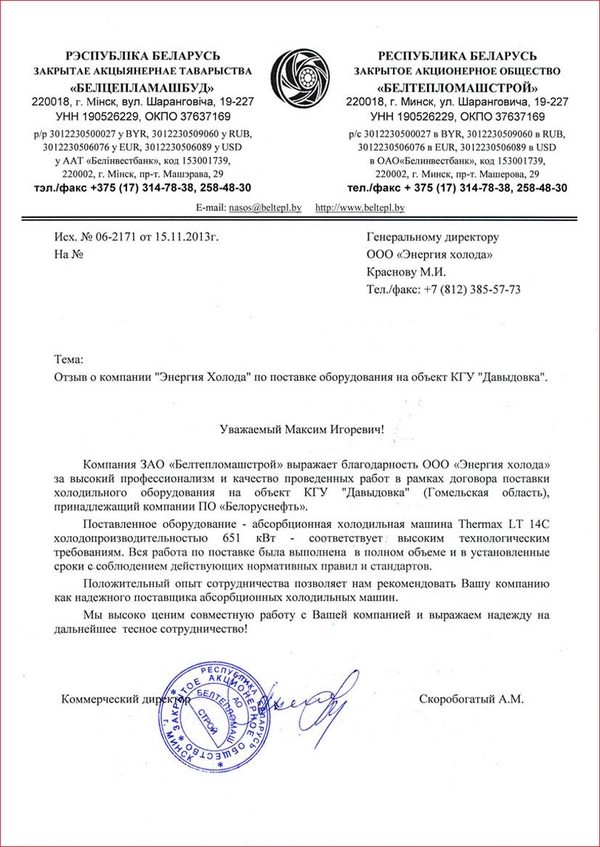
150 letters of thanks · 350+ major projects · 1,000+ customers · in business since 2011. These are real letters from customers; many others are on the references page.



Let us calculate trigeneration for your site
An engineer will put together the scheme and select the equipment, and you get a feasibility study. Free of charge, no obligation.