

Trigeneration feasibility study for a shopping mall
In brief. For a shopping mall with 4.4 MW of cooling and 2,200 load hours, the model gives savings of RUB 155.3 million per year and a payback of 2.9 years. This is a model calculation and a guideline, the longest payback of the five quick models.
For a shopping mall with a cooling peak of 4,400 kW and an electrical load of 3,200 kW, the model gives a payback of 2.9 years with the grid connection in place and 1.5 years if capacity had to be connected. Of the five quick calculations, this one is the longest: cooling is needed only in summer, just 2,200 hours a year.
The calculation is a model and a guideline, and the main savings come from on-site electricity. The general rules are described on the how to calculate payback page.
What facility did we calculate?
Cooling of 4,400 kW at 2,200 full-load hours, an electrical load without cooling of 3,200 kW and 6,000 hours a year. The baseline is a chiller with a seasonal COP of 3.5. In winter, the engine heat goes to heating: 2,000 kW for 4,000 hours. In summer, the same heat goes to the absorption chiller.
What was the result?
| Item | Value |
|---|---|
| Peak cooling | 4,400 kW |
| Full-load cooling hours | 2,200 h/year |
| Electrical load excluding cooling | 3,200 kW, 6,000 h/year |
| Reference chiller, seasonal COP | 3.5 |
| Winter heat | 2,000 kW, 4,000 h/year |
| Gas engine output | 19.6 million kWh/year |
| Required generating capacity | about 3,900 kW |
| Gas | 5.3 million m³/year |
| Own electricity | RUB 3.72/kWh vs RUB 10 from the grid |
| Cooling from waste heat | 100% of annual demand |
| Costs: grid and chiller | RUB 223.5 million/year |
| Costs: trigeneration | RUB 68.2 million/year |
| Savings | RUB 155.3 million/year |
| Capex: trigeneration | about RUB 586.5 million |
| Capex: chillers | about RUB 132.0 million |
| Payback of the difference, grid capacity available | 2.9 years |
| Payback if a grid connection is needed | 1.5 years (connection fee RUB 219.3 million) |
Waste heat covers all the annual cooling. On-site power costs RUB 3.72/kWh versus RUB 10 from the grid, and the main part of the savings comes from it. Cooling is needed here so that in summer the engine heat is not dumped to the air and the chillers do not create a summer peak load on the grid.
What happens at a different tariff and gas price?
| Gas, RUB/m³ | Power RUB 7.5 | Power RUB 10 | Power RUB 12 |
|---|---|---|---|
| 7 | 4.2 years | 2.8 years | 2.2 years |
| 9 | 4.5 years | 2.9 years | 2.3 years |
| 12 | 5.2 years | 3.2 years | 2.4 years |
The spread is from 2.2 to 5.2 years, wider than for facilities with year-round cooling. The conservative cell, a tariff of RUB 7.5 and gas at RUB 12, gives 5.2 years. That is already longer than customers usually accept (up to 3–3.5 years, about 4 at most).
What assumptions does the calculation use?
Tariff RUB 10/kWh, gas RUB 9/m³, water RUB 50/m³, gas engine efficiency 40% and 45%, gas engine service RUB 1.3/kWh. Investment is based on the 2026 model guidelines: RUB 78,000 per kW of generation, RUB 65,000 per kW of cooling, RUB 30,000 per kW for the baseline chiller. These are guidelines; the price from a commercial proposal replaces them.
What does the calculation not take into account?
- The mall's opening hours. The load is assumed to be flat, while a real mall runs on a schedule and needs less electricity at night.
- The generating capacity of 3,900 kW is selected for electricity and cooling. If the mall does not operate all year round or has few tenants, the engine will run at part load, which is worse for the economics.
- Cooling redundancy. A mall must not be left without air conditioning in hot weather, so a chiller is needed for the peak and as a backup.
Which of our facilities is similar?
The TAU Galereya shopping mall in Saratov: two 5G 6L C machines of 2,200 kW each, 4,400 kW together, a 2014 contract. The facility's sources cite an annual benefit of more than RUB 7 million from the waste heat of gas engine flue gases in summer; the calculation method is not given. The sources refer only to the benefit from summer heat, while in our model the savings also include on-site electricity, so these numbers cannot be compared. This is just one of many shopping malls; the others are in the shopping malls section.
What to do next?
A real calculation needs the mall's operating schedule and a year of electricity bills. Send them through a feasibility study request or estimate the numbers in the calculator. About the machines: Thermax absorption chillers and NCT chillers.
Frequently asked questions
What to choose: an absorption chiller or a compressor chiller, for example for a business center or a shopping mall?
It depends on whether there is a steady source of cheap heat or waste heat. If there is, the lithium bromide absorption chiller covers the base load, an electric chiller covers the peaks, and the scheme is called a hybrid. N+1 redundancy is provided for separately in the design. If there is no heat or it is unstable, a compressor chiller is installed. An absorption chiller always works together with a cooling tower, and its cooling tower is almost twice as large. You need to compare the cost of a kilowatt-hour of cooling, not the COP.
What our customers say
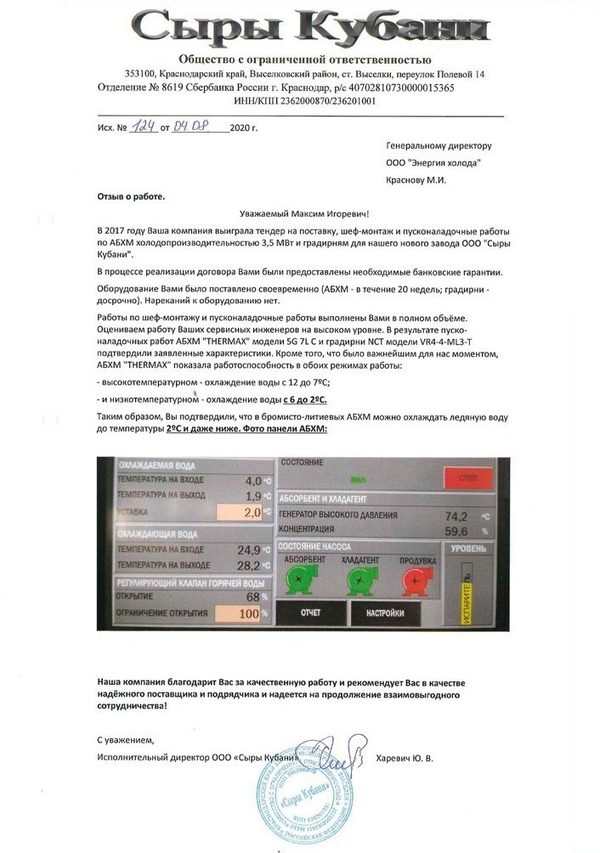
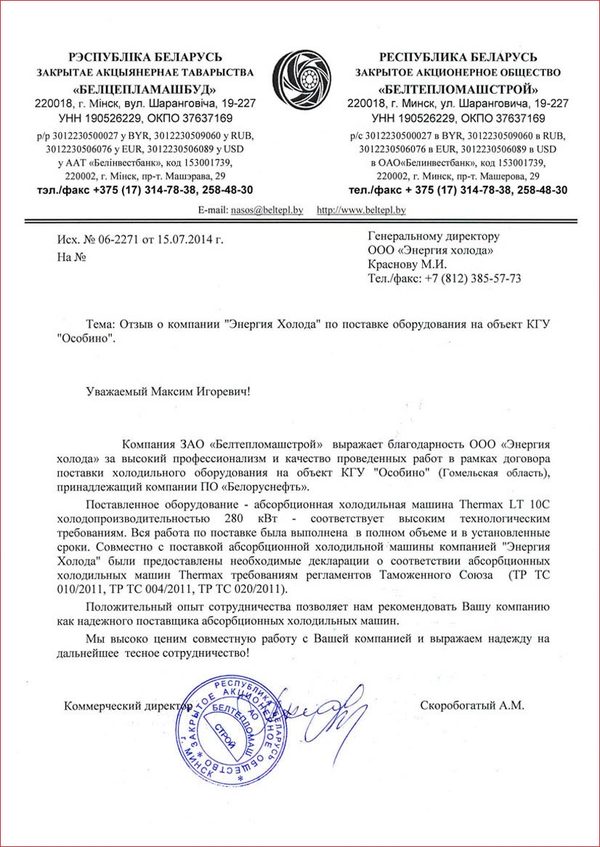
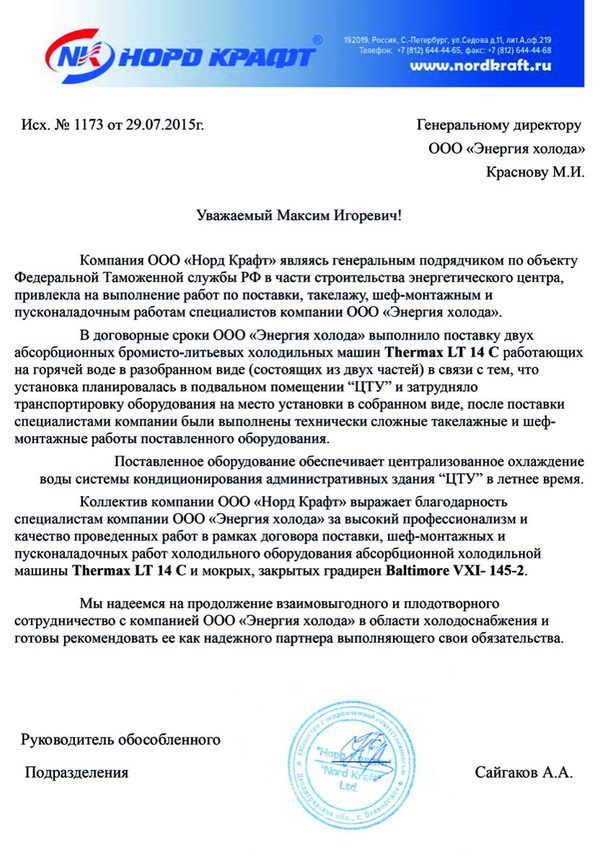
150 letters of thanks · 350+ major projects · 1,000+ customers · in business since 2011. These are real letters from customers; many others are on the references page.

Let us calculate trigeneration for your site
An engineer will put together the scheme and select the equipment, and you get a feasibility study. Free of charge, no obligation.