

How to calculate trigeneration payback: formulas and pitfalls
In brief. Payback equals the difference in investment divided by the annual savings. The result depends most on which chiller you compare against, the load hours and the electricity tariff.
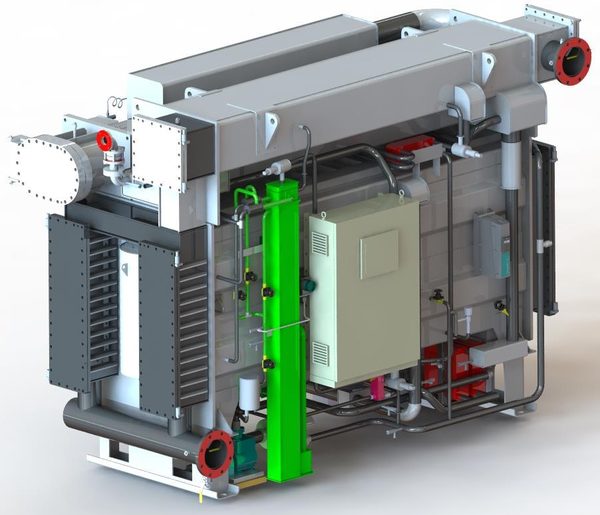
Trigeneration (CCHP) payback is calculated in two steps. First, we compare the annual costs of two options: the grid, electric chillers and a boiler house versus a gas engine generator set with an absorption chiller. The difference in costs is the annual savings. Then we divide the difference in investment by it: the result is the simple payback period in years.
This page covers the formulas, the pitfalls that spoil a feasibility study, and the data that must be collected before the calculation. Ready results for six facilities are on the trigeneration feasibility study page, and you can calculate your own facility in the calculator.
How are the savings calculated, in plain words?
The company's model is built from six steps.
| Step | What we calculate | How |
|---|---|---|
| 1 | Cooling per year | peak cooling times full-load hours |
| 2 | Baseline costs | electricity for the facility and the chiller (annual cooling divided by COP) at the tariff, plus water and service |
| 3 | Heat for the absorption chiller | annual cooling divided by the machine's COP, about 0.75 |
| 4 | Trigeneration costs | gas engine fuel (output divided by 40% efficiency and 9.3 kWh/m³) plus service, water, absorption chiller, minus the boiler gas we no longer burn |
| 5 | Savings | baseline costs minus trigeneration costs |
| 6 | Payback | difference in investment divided by the savings |
If the engine heat is not enough for all the cooling, the shortfall is covered by an electric chiller powered by the same gas engine, there is more heat, and the calculation is repeated until it converges. The share of cooling from waste heat in the six models came out at 80 to 100%.
The model assumptions are listed below, in the section "What assumptions does the model use?".
Where the heat for cooling comes from
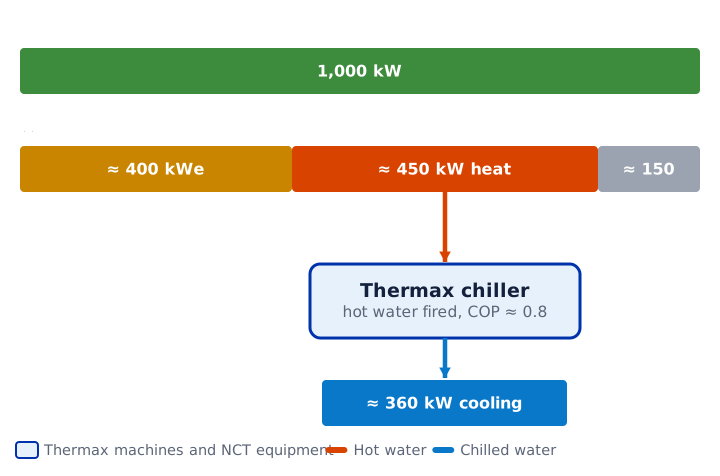
From one megawatt of gas, a gas engine gives about 400 kW of electricity and about 450 kW of heat, and about 150 kW is lost. That is the 40% electricity, 40–45% heat and 80–85% fuel utilization. A hot water absorption chiller with a COP of about 0.8 turns 450 kW of heat into roughly 360 kW of cooling. The model uses a more conservative COP of 0.75.
How much heat goes to the cooling tower
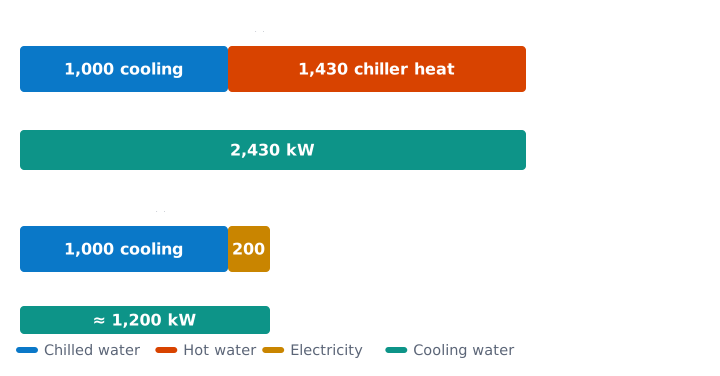
An absorption chiller rejects more heat to the cooling tower than an electric chiller: 2.45 kW per 1 kW of cooling for a single-effect machine, 1.72 for a double-effect one, about 1.20 for a chiller with a COP of 5. That is why the cooling tower in a scheme with an absorption chiller is almost twice as large and evaporates noticeably more water. This is included in the water and investment lines.
What comes from electricity and what from cooling?
The main part of the savings comes from on-site electricity. Gas costs RUB 9/m³, a cubic meter holds 9.3 kWh, an engine with 40% efficiency turns them into electricity, and the gas per kilowatt-hour costs RUB 2.42. Add RUB 1.3 for service, and your own power costs RUB 3.72 versus RUB 10 from the grid. This difference applies to the entire output.
Against this background, cooling is secondary in money terms but essential to the concept. It gives the engine heat a use all year round: in winter it heats the building, in summer it goes to the absorption chiller. And it takes the electric chiller load off the grid, which also reduces the capacity that would otherwise have to be connected. That is why the calculation for a business center gives 6.8 years: the electrical load is small, and cooling is needed only 1,200 hours a year.
Which chiller to compare against: COP 3 or 5.5?
This matters more than any tariff. If you take an old chiller with a seasonal COP of 3 as the baseline, trigeneration looks impressive. If you take a modern one with free cooling (cooling with outdoor air), with a COP of about 5.5, the advantage on cooling is noticeably smaller.
In a model of a gas-fired absorption chiller without a gas engine, 5,000 kW of cooling versus a chiller with a COP of 3, this shows in the range of savings when a parameter changes by ±20%:
| Parameter | Range of savings, RUB million/year |
|---|---|
| Baseline chiller COP | 42.5 |
| Electricity tariff | 35.2 |
| Load hours | 28.4 |
| Absorption chiller COP | 7.1 |
| Gas price | 6.8 |
Compared with a modern packaged chiller rather than an old one, the same gas-fired absorption chiller pays off in about 11 years, and about 6.8 years if the grid connection fee is taken into account. That is why in our six calculations the baseline chiller is a fair one: COP 5.5 for the data center, 3.5–4 for the rest. Trigeneration holds up even against such a chiller, because the main savings come from electricity, not from cooling. But if you are comparing only an absorption chiller with an electric chiller, without a gas engine, ask the contractor what COP is used for the baseline.
How many load hours are needed?
For an absorption chiller, payback is usually acceptable from 3,000–4,000 hours of cooling a year; below 2,000 hours it does not pay off. For trigeneration with exhaust heat recovery, ORNL names a year-round base heat load and at least 4,500 hours a year. In the company's model, the load is set as equivalent full-load hours: 6,130 for the data center, 3,456 for the dairy plant, 2,200 for the shopping mall, 1,200 for the business center.
How are projects screened in international practice?
The US DOE and EPA programs for combined heat and power have long used screening: questions that weed out facilities before any feasibility study.
| What is checked | Threshold or guideline |
|---|---|
| Heat load | high and steady throughout the year |
| Operating hours | more than 3,000 h (ORNL, 2022); more than 5,000 h is attractive (DOE and EPA, 2015) |
| Electricity price | above $0.06/kWh (ORNL); at least $0.07/kWh (DOE, 2015) |
| Heat utilization | more than 50% of the available heat over a year: the project makes sense (DOE, 2007) |
The spark spread is also calculated: the difference between the grid electricity price and the cost of on-site power including gas and maintenance. For trigeneration, absorption cooling in summer evens out loads and reduces the peak and demand charges. On the Austin project (2004, ORNL report), the estimated payback was 7 years, and the actual efficiency was 74% against the design 79%.
What pitfalls spoil a feasibility study?
Feasibility studies from different years repeat the same mistakes. The calculator is built to rule them out.
| Pitfall | What it breaks |
|---|---|
| Payback as an investment ratio instead of years | the number does not answer "how many years" |
| Negative payback when the absorption chiller costs less to install | reads as "never" but means "immediately" |
| One-time benefit added to annual savings | the payback looks deceptively short |
| Different operating hours for electricity and gas | savings are distorted |
| No winter electricity for the chillers | the baseline is understated, trigeneration looks worse |
| Gas engine electricity not credited, but gas counted | trigeneration looks unprofitable |
| One machine versus three with different total capacity | the comparison is unfair |
| Tariffs from RUB 7.5 to 12 in different files of the same project | results cannot be compared |
What affects the result most?
The order is as follows, from the strongest.
-
The baseline: what COP the chiller has and whether there is spare electrical capacity.
-
Equivalent load hours. Below 2,000 hours an absorption chiller does not pay off; above 4,000 the gain grows linearly.
-
The electricity tariff and the grid connection cost. The tariff applies to every kilowatt-hour; the connection is one-time but can outweigh the difference in machine prices.
-
The heat source: waste heat from a gas engine or purchased heat and gas.
-
The gas price. While gas is below RUB 11/m³, it has about five times less influence than the tariff.
-
Absorption chiller COP, service life, discount rate, tariff growth.
Discounted payback is 1.3–1.6 times longer than simple payback.
What payback range is honest?
A single number in a feasibility study always looks more convincing than it is. We show a range: the estimated savings at a tariff of RUB 10 and gas at RUB 9, and a conservative case at a tariff of RUB 7.5 and gas at RUB 12.
| Facility | Estimated payback | Conservative payback |
|---|---|---|
| Data center | 2.1 years | 4.1 years |
| Dairy plant | 2.2 years | 4.1 years |
| Pharmaceutical plant | 2.3 years | 4.2 years |
| Shopping mall | 2.9 years | 5.2 years |
| Greenhouse complex | 2.0 years | 3.9 years |
| Business center | 6.8 years | 12.5 years |
In our experience, Russian customers are prepared to consider a payback of up to 3–3.5 years, about 4 years at most, and consider seven years unattractive. If the conservative number works for you, the project is worth doing. If only the estimated number works, it is risky.
What assumptions does the model use?
The same for all six calculations and for the calculator: grid tariff RUB 10/kWh, gas RUB 9/m³, water RUB 50/m³, gas engine efficiency 40% electrical and 45% thermal, gas engine service RUB 1.3/kWh. Investment guidelines: RUB 78,000 per kW of electrical capacity, RUB 65,000 per kW of cooling (a plant with absorption chillers, cooling towers, pumps and controls) and RUB 30,000 per kW of cooling for the baseline chiller. These are the company's 2026 model guidelines; they are replaced by the price from a commercial proposal. The payback is simple, without discounting, tariff growth or standby gas engines.
What data are needed for a real calculation?
To request a selection, collect the data using the questionnaire. While even one item is empty, it is too early to send the request.
| Block | What is needed | What happens if it is wrong |
|---|---|---|
| Chilled water | profile by hour and month, temperatures, redundancy | capacity shortfall at peak or running at 20% |
| Heat source | temperatures, flow, year-round demand, exhaust back pressure | capacity shortfall, the engine loses power |
| Gas engine | required, minimum and maximum output, grid-parallel or island mode | wrong generation capacity |
| Cooling tower and water | wet bulb, noise, make-up water analysis | the cooling tower cannot keep up in summer, scale |
| Electrical | spare capacity, connection price, tariff, gas price | lost months |
Three questions define the economics: the actual tariff, the load hours and profile, and the cost of an hour of downtime. Selection of gas engines and Thermax and NCT equipment is based on this questionnaire. NCT cooling towers, chillers and dry coolers are described on the cooling towers and dry coolers pages.
If you are ready to calculate your facility, submit a request for a feasibility study or start with the calculator. Typical reasons for failure are described on the trigeneration mistakes page.
Sources
- ORNL and DOE CHP TAP, CHP Project Screening, 2022: https://bptraining.ornl.gov/wp-content/uploads/2022/12/Session-2-CHP-Project-Screening-2022-12-01-FINAL.pdf
- DOE Midwest CHP TAP, Combined Heat and Power Resource Guide, 2015: https://www.energy.gov/sites/default/files/2019/01/f58/CHPGuide2015.pdf
- DOE and Midwest CHP Application Center, CHP Resource Guide for Hospital Applications, 2007: https://www.energy.gov/sites/prod/files/2013/11/f4/chp_hospital_guidebook_2007.pdf
- ORNL, Berry et al., Advanced absorption chiller converts turbine exhaust to air conditioning, 2005: https://webarchive.library.unt.edu/web/20080920092112id_/http://www.ornl.gov/sci/engineering_science_technology/cooling_heating_power/pdf/ISHPC-095-2005.pdf
Frequently asked questions
Will trigeneration pay off if the site still has enough electrical capacity?
If the new load does not need additional electricity and the cooling demand is small, the project may not be justified. If the connected capacity will not be enough in the future, the scheme can pay off. A grid connection costs from RUB 20,000 to 100,000 per kilowatt, so look at the margin in the grid connection specifications three to five years ahead. And check the limits: at a tariff below RUB 5 or gas above RUB 11, the calculation must be rechecked separately.
Does the payback calculation include the cost of the cooling tower, pumps and piping?
In our model, yes: RUB 65,000 per kilowatt of cooling covers the machine, cooling tower, pumps and controls. What is more often missed is operation. For the machine alone, the specification gives 5–10 kW per MW; with all the auxiliaries, 46–130. Make-up water for the cooling tower of a 5 MW double-effect absorption chiller is about 12.5 m³/h; for a single-effect hot water machine, evaporation alone is about 18 m³/h, plus blowdown. Ask for these lines separately in the commercial proposal and check that the water and pump electricity are included too.
What our customers say
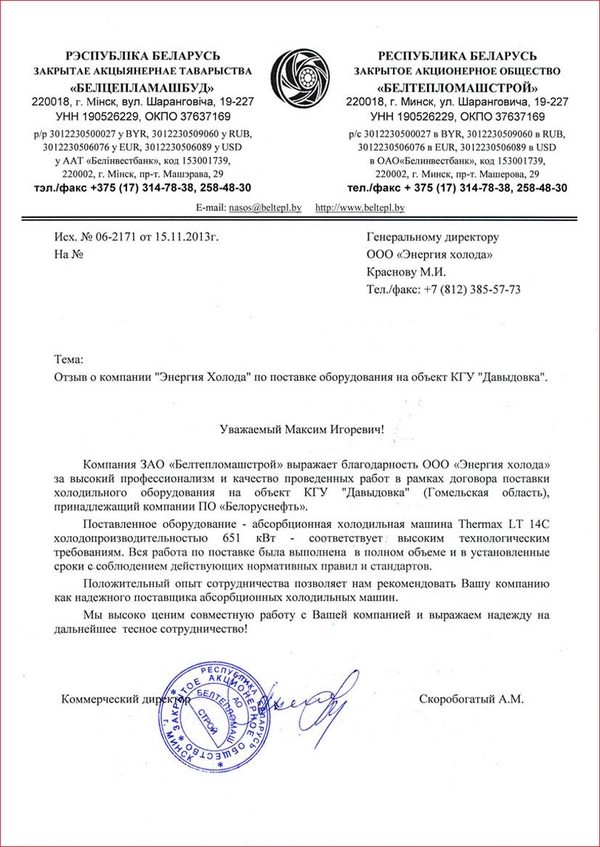
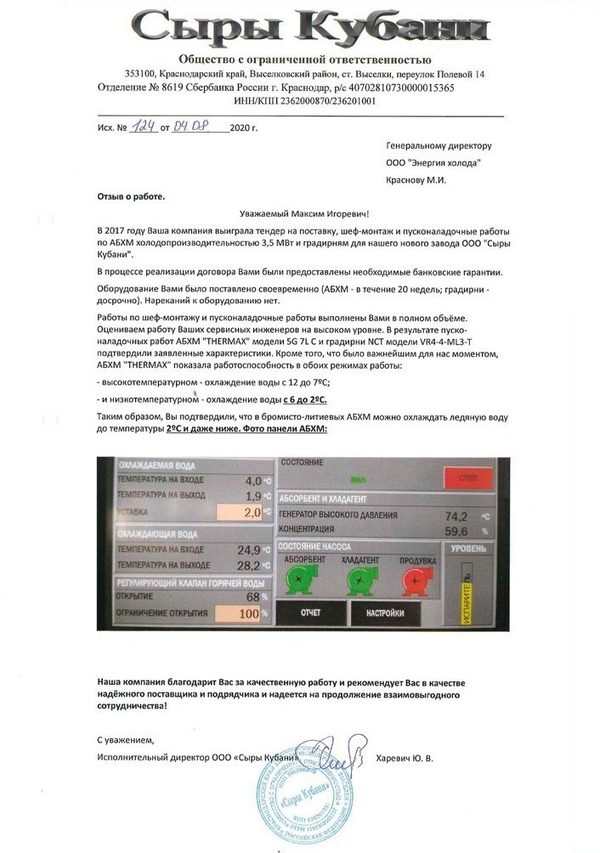
150 letters of thanks · 350+ major projects · 1,000+ customers · in business since 2011. These are real letters from customers; many others are on the references page.


Let us calculate trigeneration for your site
An engineer will put together the scheme and select the equipment, and you get a feasibility study. Free of charge, no obligation.