

Cogeneration: What It Is and How It Differs from Trigeneration
In brief. Cogeneration produces electricity and heat from one fuel and uses 80–85 % of the gas energy versus 35–40 % for an engine without heat recovery. In summer there is often more heat than needed, and then cooling is added, which is trigeneration.
Cogeneration (CHP, combined heat and power) is the production of electricity and heat by one plant from one fuel. The engine burns gas and drives a generator, and the heat that would otherwise go up the stack and out through the radiator is recovered for space heating and hot water. Fuel utilization reaches 80–85 %, versus 35–40 % for an engine without heat recovery.
What does cogeneration give, in plain words?
Imagine a gas engine with a generator: electricity takes about 40 % of the gas energy, and the rest heats the air. In cogeneration this heat is recovered in two places: from the engine jacket water and from the exhaust. The jacket gives hot water at about 90 °C; the exhaust can give hot water or steam. Using both the jacket and the exhaust puts 80–85 % of the fuel energy to work.
From one megawatt of gas, a gas engine generator set gives roughly 400 kW of electricity and 450 kW of heat. According to engine datasheets, heat output is 1.0–1.2 kW per 1 kW of electricity; for a first estimate, take 1.1.
What engines are used for cogeneration?
They are chosen by the ratio of electricity to heat and by the kind of heat the site needs.
| Engine | Electrical efficiency | Electricity to heat | Where the heat comes from |
|---|---|---|---|
| Gas reciprocating engine | 27–41 % | 0.5–1.2 | jacket (hot water), exhaust |
| Gas turbine | 24–36 % | 0.6–1.1 | exhaust, steam via a heat recovery steam generator |
| Microturbine | 22–28 % | 0.5–0.7 | exhaust |
| Fuel cell | 30–63 % | 1–2 | hot water or low-pressure steam |
The table is based on the EPA technology catalog (USA, 2017); efficiencies are given on a higher heating value basis. Gas engines are made from a few kW up to 10 MW; gas turbines for cogeneration are economical from 5 MW. More on each type: types of trigeneration.
Where does cogeneration pay off on its own?
Cogeneration works well where heat is needed all year round: hot water, process steam, a swimming pool, a greenhouse, food production. US screening methods assume the site must have a thermal load equal to the plant's heat output and that the plant must run more than 3,000 hours a year, with 5,000 hours and above considered attractive.
Typical reasons a plant does not pay back: its capacity was chosen by electricity rather than heat, it was sized "with a margin, just in case," or there was no heat demand in the right season. All of this is covered on the page "Trigeneration mistakes".
What happens in summer, and where does cooling come in?
In winter, engine heat goes to space heating. In summer the heating is off, fewer consumers remain, and the heat is dumped to the air through emergency radiators. That part of the gas has been paid for but gives no benefit, and the plant no longer earns anything on its heat.
There is only one way out: give the heat a summer job. If the site needs cooling (air conditioning, process water, air cooling), the heat is sent to an absorption machine, and cogeneration becomes trigeneration (CCHP). The electricity stays the same. The plant's year-round utilization goes up: in summer its heat has a consumer again.
Cooling also brings new requirements: the machine must work with the heat your engine supplies. The page on the operating principle explains how this works. Someone has to be contractually responsible for this interface. Cold Energy (NCT) supplies both the engine and the machine.
When is cogeneration enough, and cooling not needed?
If the site has no cooling consumer of 300 kW or more, or it needs cooling for less than 2,000 hours a year, an absorption machine will not pay back, and it is better to stop at cogeneration. For an estimate, use the calculator: it shows at what operating hours and gas price cooling adds to or eats into the benefit.
Order a feasibility study if you want to compare cogeneration with trigeneration on your data.
Sources
- EPA, Catalog of CHP Technologies, September 2017: https://www.epa.gov/sites/default/files/2015-07/documents/catalog_of_chp_technologies.pdf
- DOE/EPA, Combined Heat and Power: A Clean Energy Solution, August 2012: https://www.energy.gov/sites/prod/files/2013/11/f4/chp_clean_energy_solution.pdf
- ORNL / DOE CHP TAP, CHP Project Screening, 2022: https://bptraining.ornl.gov/wp-content/uploads/2022/12/Session-2-CHP-Project-Screening-2022-12-01-FINAL.pdf
Frequently asked questions
In summer the emergency dry coolers of the gas engine cannot cope and output has to be reduced. How do we solve the overheating?
First, the gas engine datasheet and the actual parameters of the installed dry coolers are requested, and the missing cooling is calculated. Then the risks of running on the emergency circuit are described, and dry coolers of the required capacity, or air coolers without an intermediate heat exchanger, are selected. If the site has a cooling consumer of 300 kW or more, it is worth calculating an absorption machine as well: it will take part of the heat that is now dumped to the air.
Can the hot water that goes to the cooling towers at a combined heat and power plant be used for other needs?
It all depends on its temperature. Water at 75–120 °C is suitable as a drive for the machine. If it is colder, it will not work for cooling, but an absorption heat pump can take low-grade heat from the cooling water and deliver it to the district heating network as water at up to 90 °C. The assessment is made from a questionnaire: water temperature, flow rate, and how many hours a year the discharge runs.
What our customers say
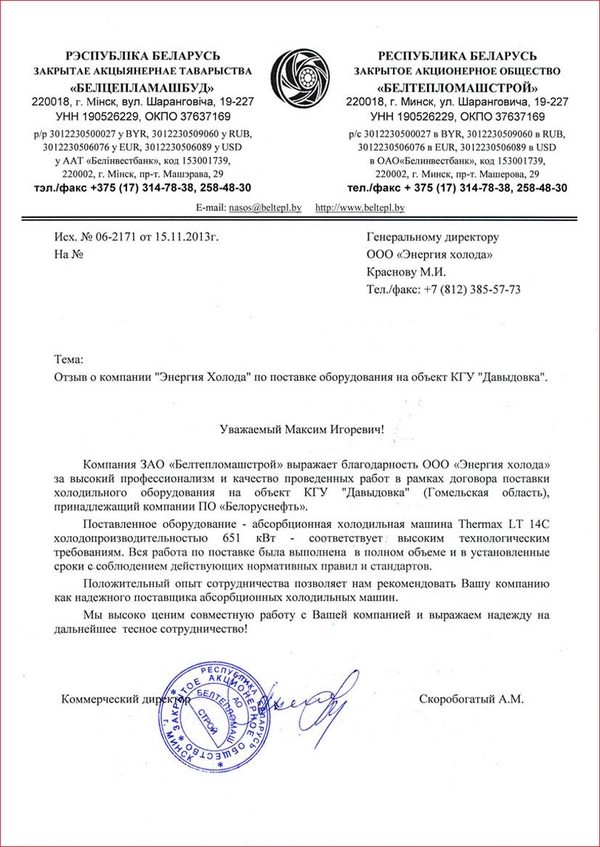
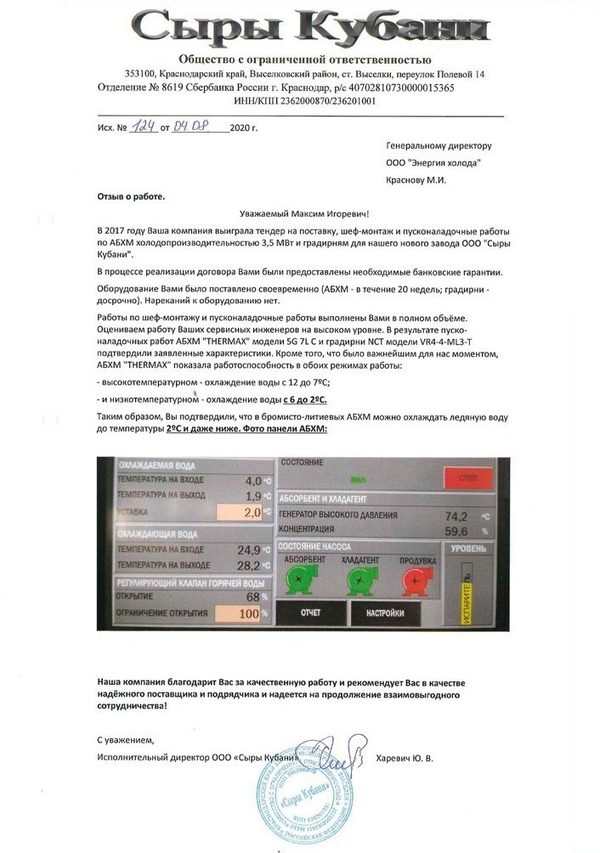
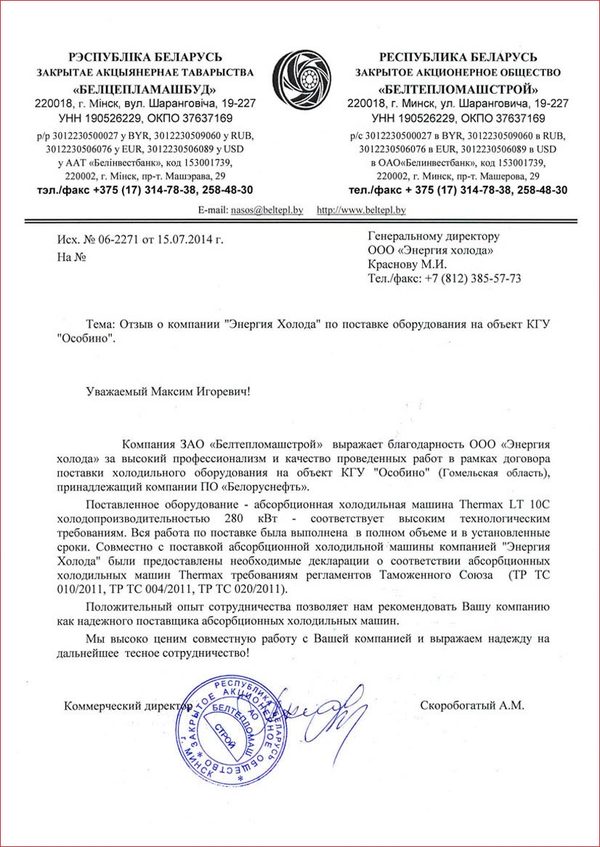
150 letters of thanks · 350+ major projects · 1,000+ customers · in business since 2011. These are real letters from customers; many others are on the references page.

Let us calculate trigeneration for your site
An engineer will put together the scheme and select the equipment, and you get a feasibility study. Free of charge, no obligation.