

Thermax absorption chillers, series, COP and capacity
In brief. A Thermax absorption chiller makes cooling from heat. On hot water the COP is 0.65–0.80; on exhaust, steam and gas it is 1.30–1.45. For trigeneration, the LT, 5G, 2D and Trigenie series are used.
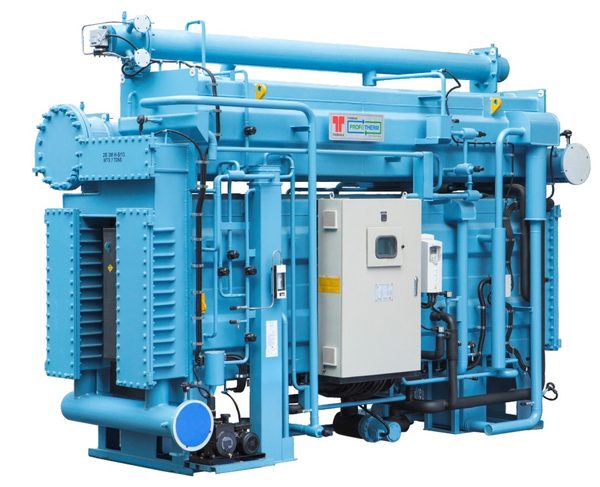
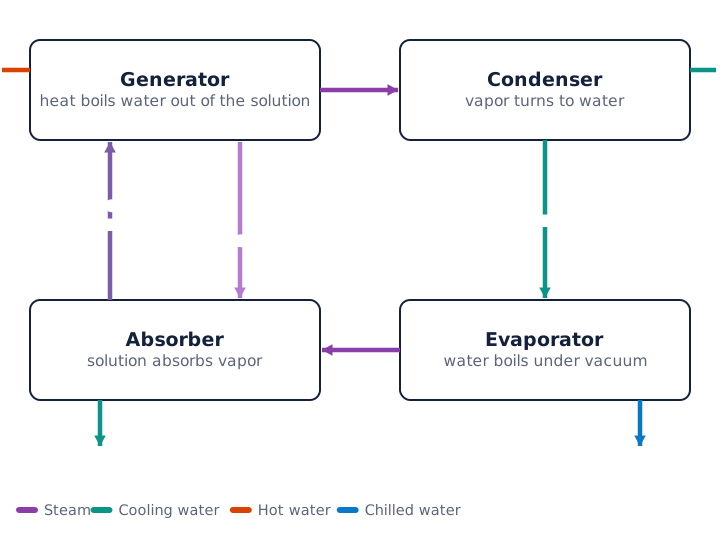
A lithium bromide absorption chiller makes cooling from heat. Water boils under vacuum and takes heat from the consumer's water, the vapor is absorbed by a lithium bromide solution, and heating the solution returns the water to the cycle. The refrigerant here is water, and the absorbent is lithium bromide (LiBr). Trigeneration (CCHP) needs four Thermax families: LT and 5G on hot water, 2D on exhaust, and Trigenie on exhaust together with hot water.
Thermax has more than 8,300 cooling and heating installations worldwide. In Russia and the CIS, Thermax chillers are supplied only by Cold Energy (NCT). We are the official representative of Thermax: we select the chiller for the engine, supply it, and provide installation supervision, commissioning and service.
How an absorption chiller makes cooling
The generator boils water out of the lithium bromide solution using external heat. The vapor condenses, the water boils in the evaporator under vacuum and cools the consumer's water, the vapor is absorbed by the concentrated solution in the absorber, and a pump returns the diluted solution to the generator.
Which Thermax absorption chiller series are there and what is their COP?
COP (coefficient of performance) shows how much cooling you get from one kilowatt of heat. The figures are rated values at nominal conditions.
| Series | Heating medium | COP | Cooling, kW |
|---|---|---|---|
| LT (Cogenie) | hot water, single-effect | 0.65–0.72 | 70–739 |
| 5G | hot water, single-effect | 0.75–0.80 | 850–3,650 |
| SS | steam up to 3.5 bar, single-effect | up to 0.75 | 440–6,689 |
| SD | steam 3–10 bar, double-effect | up to 1.43 | 426–6,654 |
| 2B | steam 1.4–9.9 bar, double-effect | 1.30–1.45 | 422–8,793 |
| 2V, GD | natural gas and other fuels, burner in the chiller | 1.40–1.45 | 400–5,060 |
| 2D | gas engine and gas turbine exhaust, double-effect | 1.40–1.45 | 455–8,545 |
| Trigenie | exhaust and engine jacket water | about 1.4 on exhaust, about 0.8 on water | 140–10,500 |
| Triple-effect | steam 10–25 bar or water at 190–225 °C | about 1.8 | 350–3,500 |
The capacities are taken from the tables in the Thermax catalog: for some series, the catalog text and the table differ for the smallest and largest sizes, and the exact value is given in the data sheet for the model.
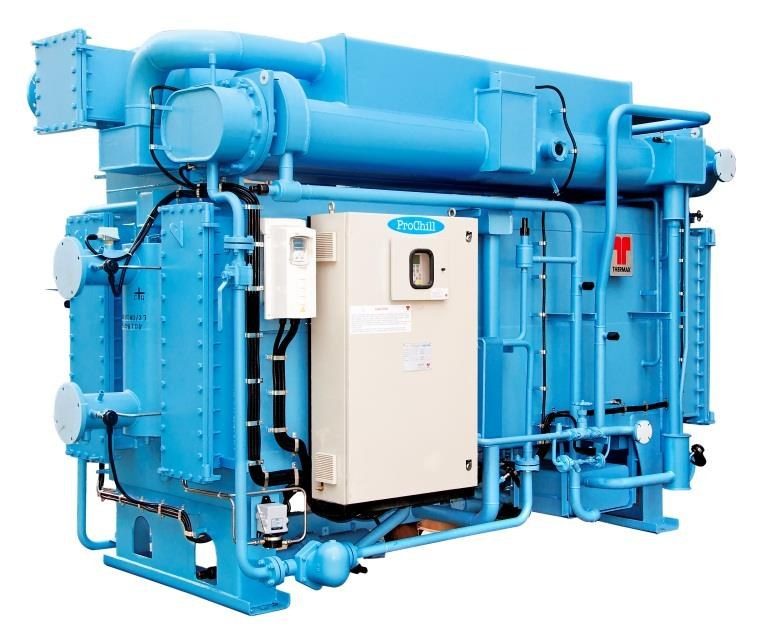
How do the series differ in practice?
Hot water, LT and 5G. The classic option for a gas engine: the jacket and the exhaust heat exchanger heat water to 90 °C, and the chiller turns it into chilled water at 7/12 °C. The COP is below one, so a lot of heat is needed, and the cooling tower is larger than for a chiller. LT is designed for small capacities, while 5G uses the least heat among single-effect units. At Mikran, two 5G 4L C chillers of 1,100 kW each are installed.
Exhaust, 2D. A double-effect chiller takes exhaust gas at 350–600 °C directly. It gets twice as much cooling from the same heat as a hot-water unit. The price for this is the chiller's gas-side pressure drop of 200–250 mm H2O, which adds to the exhaust duct: the engine must not lose output. At ZhGTES (a gas turbine power plant), a 2D 5M C chiller of about 3.2 MW makes 15/8 °C water to cool the inlet air of the gas turbines.
Trigenie. One chiller takes both the exhaust and the engine jacket water. No separate exhaust heat exchanger is needed. Details are on the page exhaust-fired absorption chiller, Trigenie.
Steam, SS, SD and 2B. For plants with a steam boiler or a heat recovery steam generator. Double-effect steam chillers give a COP of 1.30–1.45. They need dry saturated steam with a dryness fraction of 0.99: most boilers give 0.95–0.97, so a separator is installed.
Gas, 2V and GD. The burner is built into the chiller, and no engine is needed. This chiller is installed for peak loads, as backup, or at a site without its own generation. If the engine is stopped or there is not enough heat, the burner tops up cooling to the required level, and the consumer does not lose cooling.
Triple-effect. It needs a heating medium at 190–225 °C; engine jacket water is too cold for it. The COP is 1.8.
What chilled water does the chiller deliver?
The standard mode is 12/7 °C. The minimum outlet temperature depends on the series.
| Series | Minimum chilled water |
|---|---|
| SS, SD, 2B, 2V, GD, 2D | +1 °C, −2 °C on glycol |
| LT, 5G | 3.5 °C |
| Double-effect, special design | down to −5 °C |
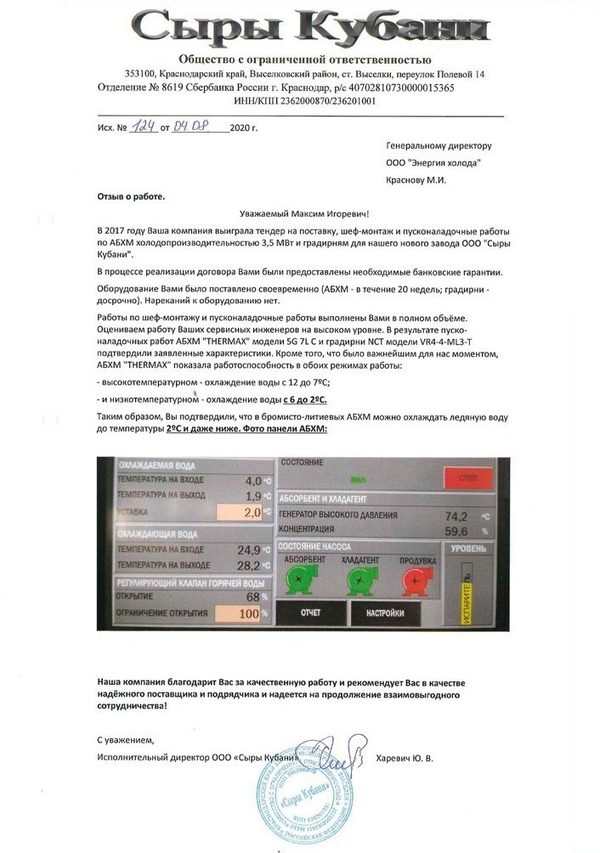
At Syry Kubani cheese plant, a 3,500 kW steam-fired Thermax absorption chiller runs in 12/7 and 6/2 °C modes, and an outlet temperature down to 2 °C is confirmed by the customer's letter.
The flow through the evaporator must be constant: the chiller trips on the flow switch if the water flow drops below 50 % of nominal. The chiller modulates its load smoothly from 10 to 100 %.
How much electricity, water and space are needed?
The chiller itself consumes 5–10 kW per MW of cooling, and the whole plant with pumps and cooling tower takes 46–130 kW per MW. An electric chiller with a seasonal COP of 3–5.5 takes 180–350 kW per MW. Trigeneration wins where electricity is expensive or unavailable.
The price for this is heat rejection. For 1 kW of cooling, a single-effect chiller rejects 2.45 kW to the cooling tower, a double-effect unit 1.72 kW, and a chiller with a COP of 5 about 1.20 kW. The cooling tower for an absorption chiller is sized for the chiller's heat rejection, not "as for a chiller", otherwise the capacity will not hold in the first hot summer. Details are on the page about NCT cooling towers.
As an example, the dimensions depend on the chiller: a 1,500 kW gas-fired unit takes 7.6 × 3.6 × 3.8 m with a dry weight of 30.5 t. The floor slab is calculated for the emergency weight, when the chiller is flooded with water: a 400 kW model has a dry weight of 4.8 t, an operating weight of 5.8 t and an emergency weight of 9.4 t. The service life according to the manufacturer's catalog is 20–25 years.
When is an absorption chiller not worth it?
The threshold starts at 300 kW of cooling and 3,000–4,000 hours per year. Below 2,000 hours, an absorption chiller does not pay back, and an electric chiller is cheaper. How to calculate payback is described in the article how to calculate a feasibility study, and the mistakes that keep projects from reaching the calculation stage are collected on the page why trigeneration does not pay back. Detailed series and questionnaires are available on abxm-thermax.ru.
If you want to check whether your site qualifies, submit a request for a feasibility study or try the calculator.
Frequently asked questions
How much cooling can you get from 1 MW of heat?
Roughly 0.65–1.45 MW, depending on the chiller type. After that, the temperature difference of the source decides: at a COP of 0.7, 1,000 kW of cooling takes 1,430 kW of heat, and with a 10 K temperature difference you need 123 m³/h of heating water, while with 5.6 K it is already 220 m³/h. On the engine side, everything is more modest: 1 MW of gas leaves about 450 kW of heat, which is roughly 360 kW of cooling.
Can a gas-fired absorption chiller supply hot water along with cooling?
Yes, as a chiller-heater: up to 60 °C through the evaporator circuit and up to 95 °C through an additional heat exchanger. There are "both heating and cooling" and "either heating or cooling" modes; in one of the selections, heating was at 55/60 °C. For winter heating, the cooling tower circuit is isolated and drained, the absorber insulation is chosen to withstand up to 80 °C, and the position of every valve is posted in a table next to the unit. That is why the heating mode is specified right away in the order.
What is the minimum hot water temperature an absorption chiller needs?
The LT series works from 70 °C, but its capacity is then well below nominal. It makes economic sense from 80 °C. The nominal conditions are 90.6/85 °C for LT and 90/80 °C for 5G. The factory selects the chiller for your mode based on supply temperature, return temperature and flow, so send the temperature schedule right away, not a single figure.
What is the coefficient of performance of an absorption chiller, if a Chinese unit is claimed at 1.4?
The figure 1.4 by itself proves nothing: for gas-fired and high-pressure steam chillers, it is about the same for all manufacturers. On hot water from an engine you get about 0.8, half as much, and that is a different design, with one stage instead of two. Ask the supplier at what heating medium, temperatures and flows the coefficient was obtained, and compare only identical conditions.
What our customers say
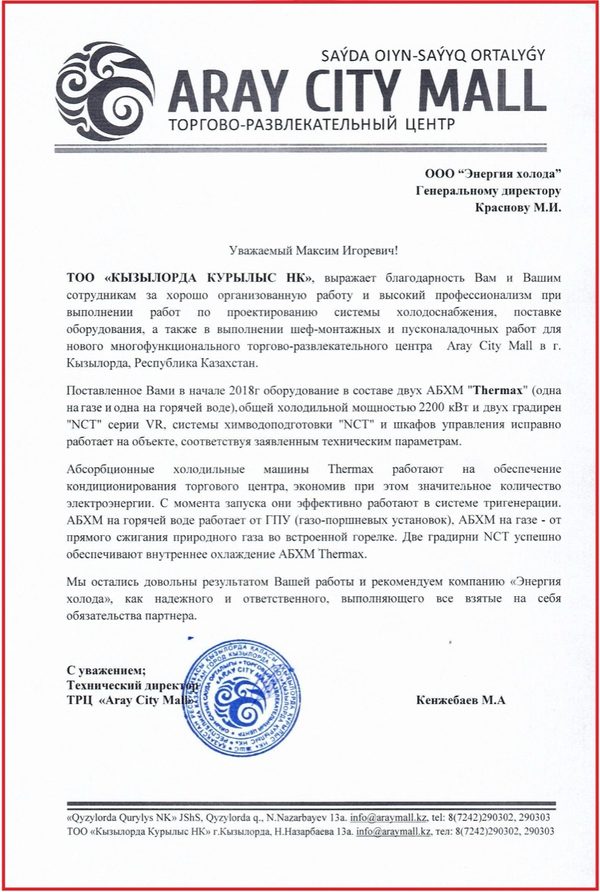
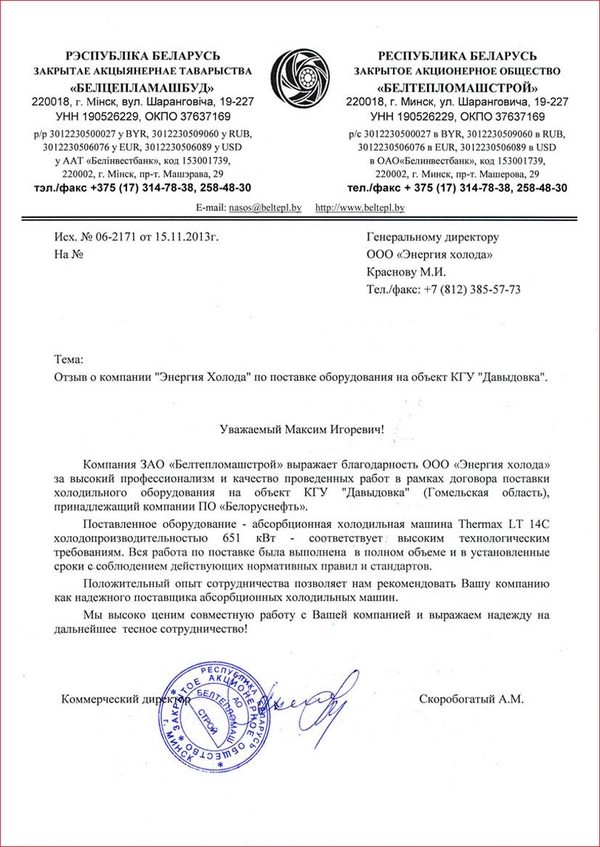
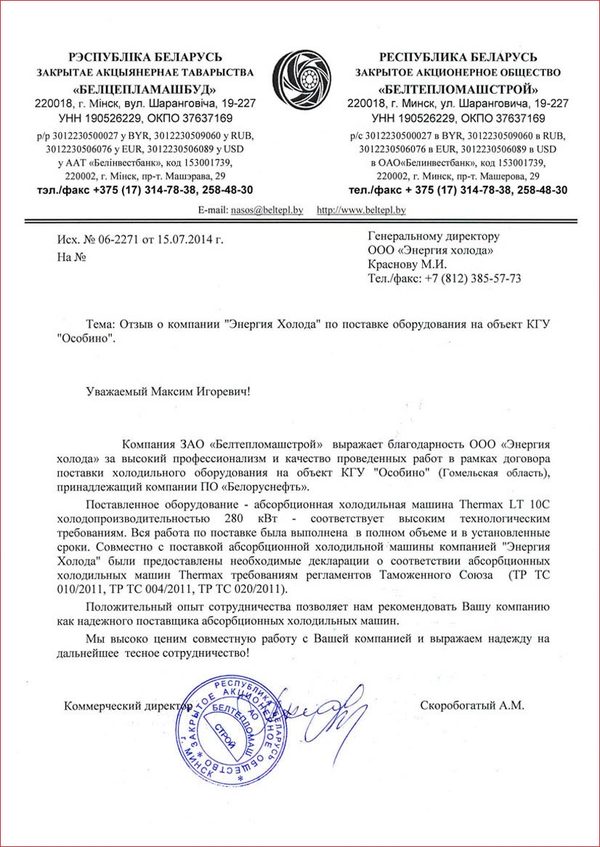
150 letters of thanks · 350+ major projects · 1,000+ customers · in business since 2011. These are real letters from customers; many others are on the references page.
Let us calculate trigeneration for your site
An engineer will put together the scheme and select the equipment, and you get a feasibility study. Free of charge, no obligation.