

How a Trigeneration Plant Works
In brief. A gas engine makes electricity, its heat boils a lithium bromide solution in an absorption machine, and the machine cools water for the consumer to 7 °C. The machine needs about 30 minutes to reach operating mode.
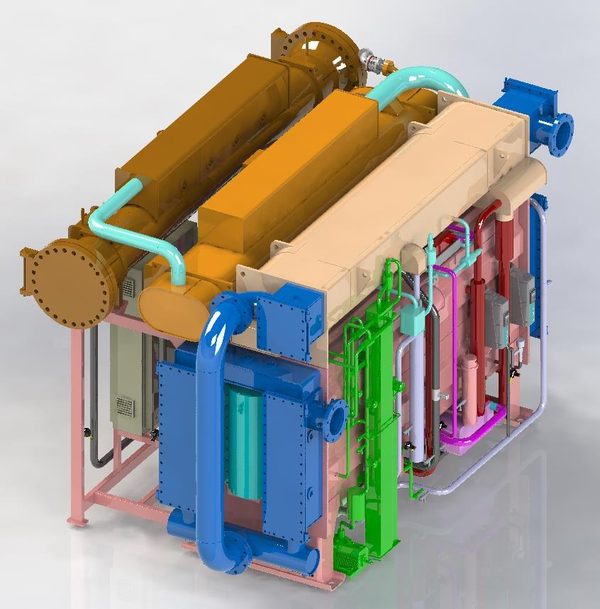
A trigeneration (CCHP) plant has two parts. A gas engine with a generator makes electricity, and its heat is taken by an absorption machine (lithium bromide absorption chiller), which turns it into chilled water for air conditioning or process use. There is no compressor in the machine: its job is done by a lithium bromide solution, which readily absorbs water vapor. The machine uses electricity only for pumps, 5–10 kW per megawatt of cooling.
How does an absorption machine make cooling from heat?
The machine has four vessels: a generator, a condenser, an evaporator and an absorber. Water is the refrigerant, and a lithium bromide (LiBr) solution is the absorbent.
-
In the generator, external heat boils water out of the solution. The solution becomes stronger.
-
The water vapor goes to the condenser and turns back into water, giving its heat to the cooling water from the cooling tower.
-
The water enters the evaporator, where under vacuum it boils at a low temperature and takes heat from the consumer's water. This is where the cooling is produced.
-
The vapor from the evaporator is absorbed by the strong solution in the absorber. A pump returns the diluted solution to the generator, and the cycle closes.
How an absorption machine makes cooling from heat
Four vessels and two solutions: the strong one goes to the absorber, the weak one returns to the generator.
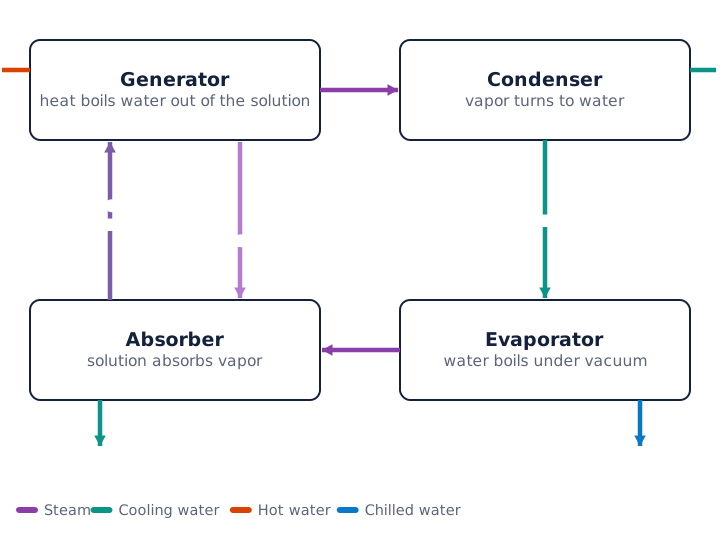
This shows why the machine needs a cooling tower. The heat that went into the generator and the heat taken from the consumer both leave through the condenser and the absorber into the cooling water. Per 1 kW of cooling, heat rejection is 2.45 kW for a single-effect machine and 1.72 for a double-effect one; for comparison, an electric chiller with COP 5 rejects about 1.20.
What heat can drive the machine?
Any heat at a high enough temperature will do. The temperature determines the number of effects and the coefficient of performance (COP): how many kW of cooling you get per 1 kW of heat.
| Heat source | Machine | COP | Drive parameters |
|---|---|---|---|
| Hot water | LT, single-effect | 0.65–0.72 | 75–120 °C |
| Hot water | 5G, single-effect | 0.75–0.80 | 75–120 °C |
| Steam | double-effect | 1.30–1.45 | steam 1.4–9.9 bar |
| Gas engine and gas turbine exhaust | 2D, double-effect | 1.40–1.45 | exhaust 350–600 °C |
| Direct gas firing | 2V, double-effect | 1.40–1.45 | gas 60–100 mbar |
| Steam or hot water | triple-effect | 1.8 | steam 10–25 bar or water 190–225 °C |
The classic: gas engine and hot-water absorption chiller
The engine jacket and the exhaust heat exchanger heat water to 90 °C, the water goes to a single-effect machine, and surplus heat is removed by emergency radiators.
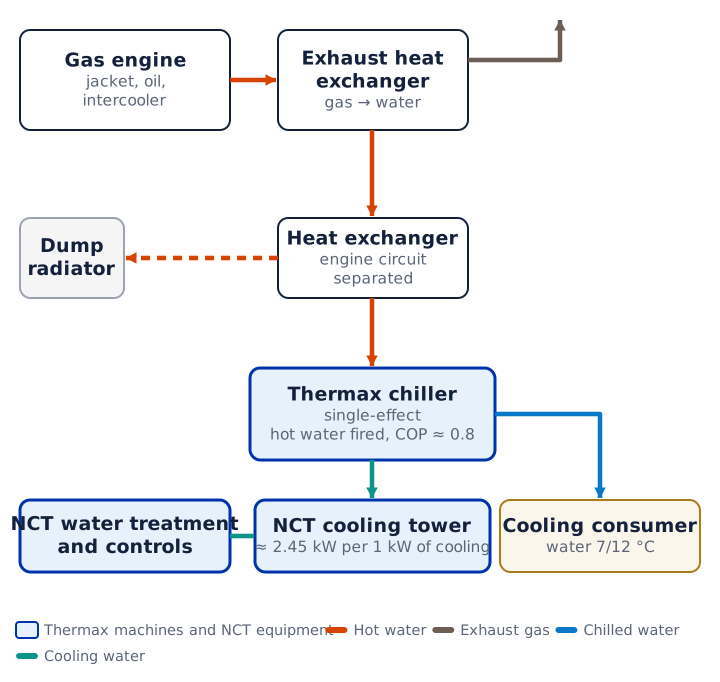
This is the most common option, and most of our sites run on it. Water acts as an intermediary between the engine and the machine, so the engine and the machine are separated by a heat exchanger. The engine circuit follows the engine datasheet, and the machine circuit follows the machine datasheet.
Twice the cooling: exhaust straight into the machine
Exhaust gases pass through a diverter damper into a double-effect machine. When cooling is not needed, the damper sends the gas through a bypass.
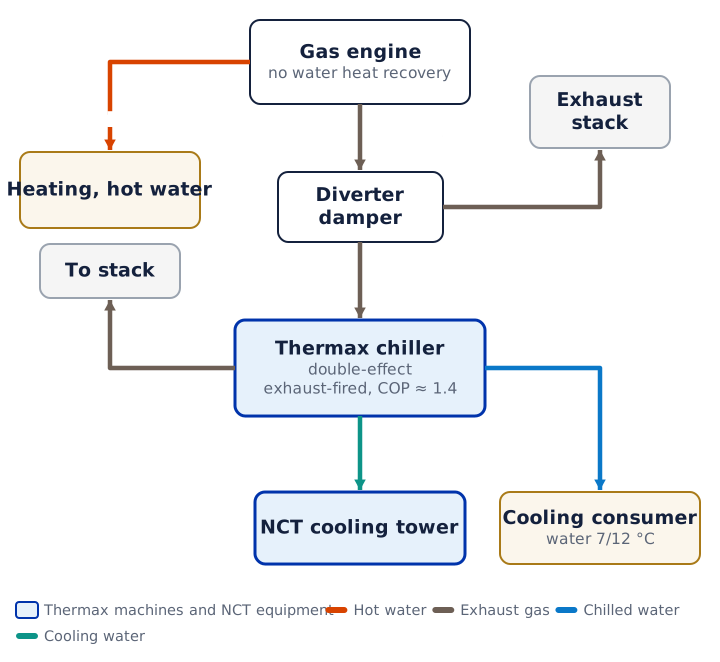
Exhaust is hotter than water, so the same heat gives twice as much cooling. The price for this is in the gas path: the machine's resistance of 200–250 mm H2O adds up with the flue duct, bends, damper and silencer. The total must not exceed the engine's allowable back pressure, or the engine loses power. The engine always has priority.
Trigenie: exhaust and jacket in one machine
One machine takes exhaust with a COP of about 1.4 and jacket hot water with a COP of about 0.8.
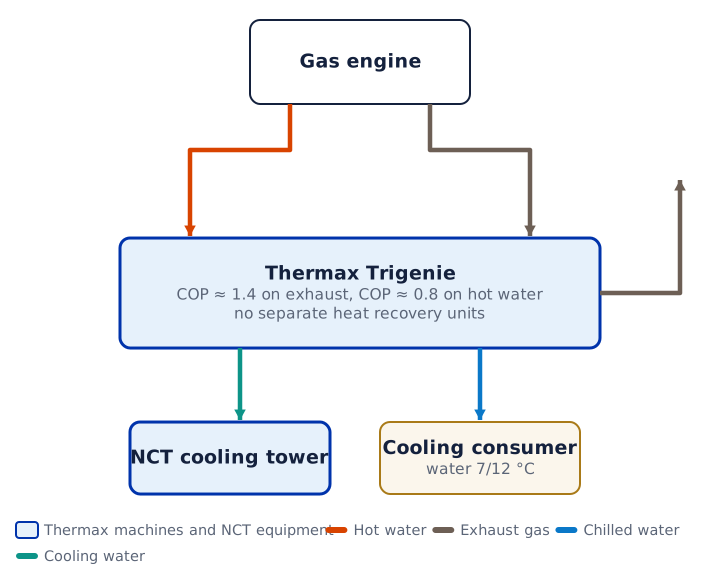
Trigenie has a separate generator for jacket hot water and separate generators for the exhaust of each engine, so one machine can be installed on the exhaust of three engines without the gases mixing. More: Trigenie and Thermax absorption chiller.
What water does the machine supply, and what does it need at the inlet?
The standard chilled water mode is 12/7 °C. The standard minimum outlet temperature is +1 °C, and −2 °C with glycol. For LT and 5G, the minimum is 3.5 °C. Cooling water from the cooling tower should be about 27 °C within an operating range of 22–32 °C. Double-effect machines accept water from 10 °C, single-effect ones from 20 °C. Flow through the evaporator is constant: the machine trips if the flow drops below 50 % of rated.
How does the machine start and stop?
Start-up follows a sequence. First the chilled water pump comes on, then 15 seconds later the cooling water. At start-up the cooling tower runs in bypass with the fan off until the water at the machine inlet warms up to 20 °C. Heating water or steam is supplied gradually, smoothly over the first 10 minutes. The machine reaches operating mode in about 30 minutes. That is why, for a data center or a continuous process, a cold storage tank or a backup peak chiller is installed alongside.
On shutdown, the heating medium is closed off and the machine goes into a dilution cycle: the solution is diluted so that it does not precipitate. This is the protection against crystallization. Lithium bromide solution at a concentration of 65 % crystallizes as early as 42 °C. The machine survives a power loss of up to 3 minutes; a longer one requires a dilution cycle, which means a backup power feed or a UPS. Crystallization is one of the six interface points on the page "Trigeneration mistakes".
What does it look like at a real plant?
A typical plant with two gas engines, one machine and a cooling tower is walked through frame by frame in a 3D model on the page "Trigeneration complex". Diagrams for other heat sources are collected in the atlas, and the types by engine are described in the section "Types of trigeneration".
The engine and the machine each follow their own datasheet, so someone has to be responsible for the interface between them. If the engine and the cooling are split between different contractors, it belongs to no one. At Cold Energy (NCT), the design, Thermax machines, NCT equipment, installation supervision and service of the cooling circuit are brought together in one company, and gas engines can be ordered there as well.
To find out which scheme suits your site, order a feasibility study or work out an option in the calculator.
Frequently asked questions
Can surplus heat from polymer extruders be turned into cooling?
Yes, if the heat transfer fluid is hotter than 80 °C. The hotter it is, the cheaper the machine for the same cooling. The second lever is on the consumer side: if the line can work with water at 9–10 °C instead of 7, the machine often drops one frame size. Allow for changeovers: when the extruder stops, there is no heat, and during those hours someone else has to supply the cooling.
What failures are typical for absorption machines, and why is solution crystallization dangerous?
Besides crystallization, there is freezing of water in the evaporator with tube rupture (usually after a power outage), loss of vacuum and solution spills. Machines with spray nozzles and a small margin to the crystallization line are at greater risk: when power is lost, the solution stays at the top. Ask the supplier what exactly is installed in the machine. A crystallization prevention system and a decrystallization system, which only warms the machine back up after a failure, are different things.
What our customers say
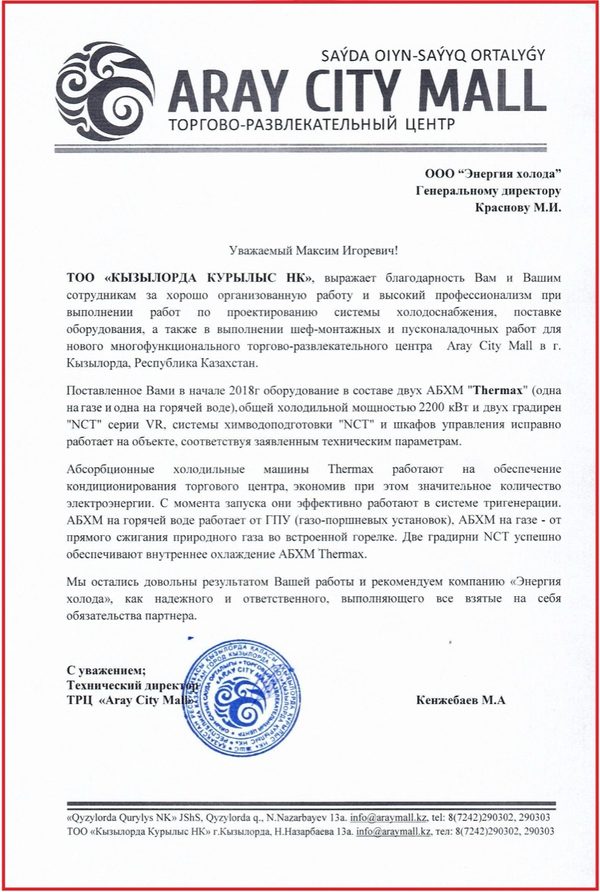
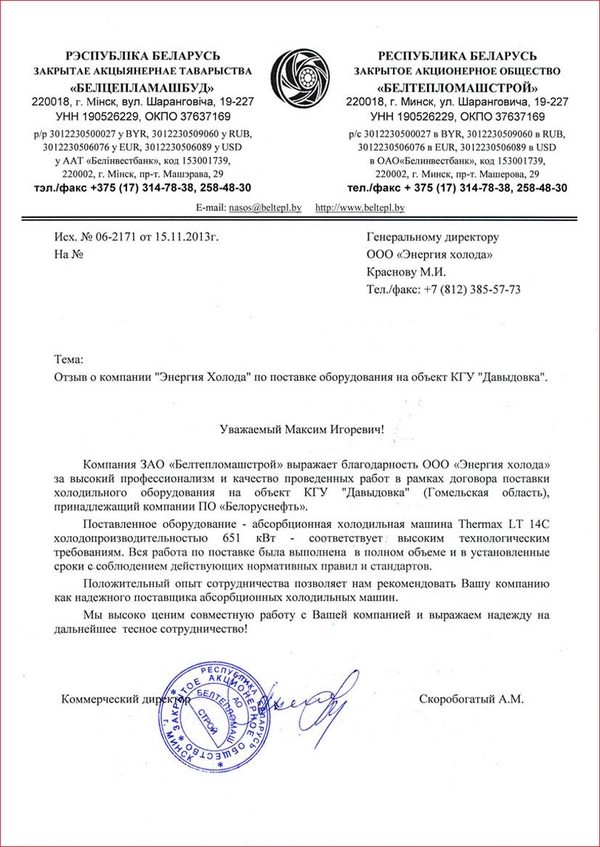
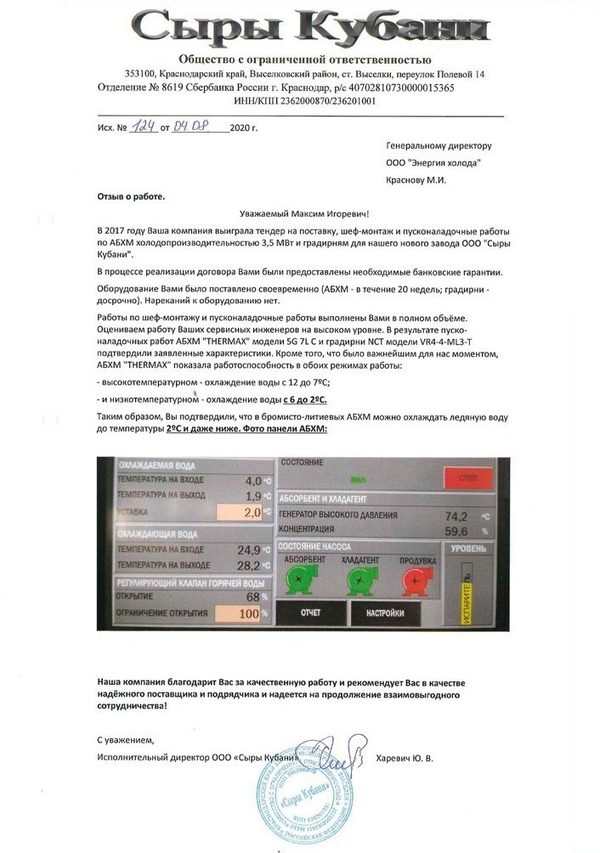
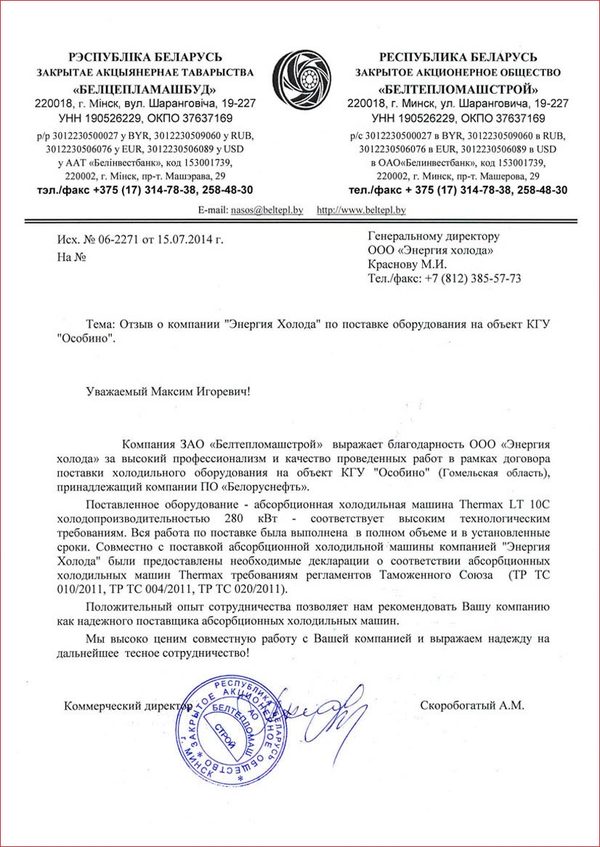
150 letters of thanks · 350+ major projects · 1,000+ customers · in business since 2011. These are real letters from customers; many others are on the references page.
Let us calculate trigeneration for your site
An engineer will put together the scheme and select the equipment, and you get a feasibility study. Free of charge, no obligation.