

When trigeneration does not pay back: a business center
In brief. With a short cooling season and a small constant load, trigeneration pays back in 6.8 years with the grid already in place. This is a model calculation and a guide; it is longer than customers accept, and a different scheme is needed here.
For a business center with 1,000 kW of cooling for 1,200 hours per year and an electrical load of 400 kW for 3,000 hours, the model gives a payback of 6.8 years with the grid already in place. That is longer than people are usually prepared to wait: customers accept up to 3–3.5 years, at most about 4. If the capacity had to be connected, the period would be 3.7 years, and the picture would be different.
We show this model calculation, a guide, alongside the fast ones. Trigeneration (CCHP) does not suit everyone, and the contractor should say so before the contract is signed. The other five calculations are collected on the page trigeneration feasibility studies.
What site did we calculate?
Cooling of 1,000 kW at 1,200 full-load hours (a short summer air conditioning season), an electrical load without cooling of 400 kW for 3,000 hours per year. The baseline is a chiller with a seasonal COP of 3.5. Winter heating with engine heat is not included in the calculation.
What was the result?
| Item | Value |
|---|---|
| Peak cooling | 1,000 kW |
| Full-load cooling hours | 1,200 h/year |
| Electrical load excluding cooling | 400 kW, 3,000 h/year |
| Reference chiller, seasonal COP | 3.5 |
| Gas engine output | 1.3 million kWh/year |
| Required generating capacity | about 500 kW |
| Gas | 0.3 million m³/year |
| Own electricity | RUB 3.72/kWh vs RUB 10 from the grid |
| Cooling from waste heat | 90% of annual demand |
| Costs: grid and chiller | RUB 16.2 million/year |
| Costs: trigeneration | RUB 5.3 million/year |
| Savings | RUB 10.8 million/year |
| Capex: trigeneration | about RUB 104.3 million |
| Capex: chillers | about RUB 30.0 million |
| Payback of the difference, grid capacity available | 6.8 years |
| Payback if a grid connection is needed | 3.7 years (connection fee RUB 34.5 million) |
Waste heat covers 90 % of the cooling. Own energy costs the same RUB 3.72/kWh versus RUB 10 from the grid, but the engine can generate little of it: 1.3 million kWh per year, versus tens of millions at other sites. The main savings come from own electricity, and there is too little of it to pay back the investment quickly: RUB 104.3 million in trigeneration versus RUB 30.0 million in chillers. Cooling does not save the case either: the chiller runs 1,200 hours per year, and the rest of the time the capital sits idle.
What happens at a different tariff and gas price?
| Gas, RUB/m³ | Power RUB 7.5 | Power RUB 10 | Power RUB 12 |
|---|---|---|---|
| 7 | 9.7 years | 6.4 years | 5.1 years |
| 9 | 10.6 years | 6.8 years | 5.3 years |
| 12 | 12.5 years | 7.6 years | 5.8 years |
The range is from 5.1 to 12.5 years. Even at a tariff of RUB 12 and cheap gas, the period does not drop below five years.
What assumptions are in the calculation?
Tariff RUB 10/kWh, gas RUB 9/m³, water RUB 50/m³, gas engine efficiency 40 % and 45 %, gas engine service RUB 1.3/kWh. Investment is based on the company's 2026 model benchmarks: RUB 78,000 per kW of generation, RUB 65,000 per kW of cooling, RUB 30,000 per kW of chiller in the baseline. These are benchmarks, and the price from a commercial proposal replaces them. At low capacity, the specific equipment price is usually above the benchmark, so the real period may turn out even longer.
What to do if the scheme does not pay back?
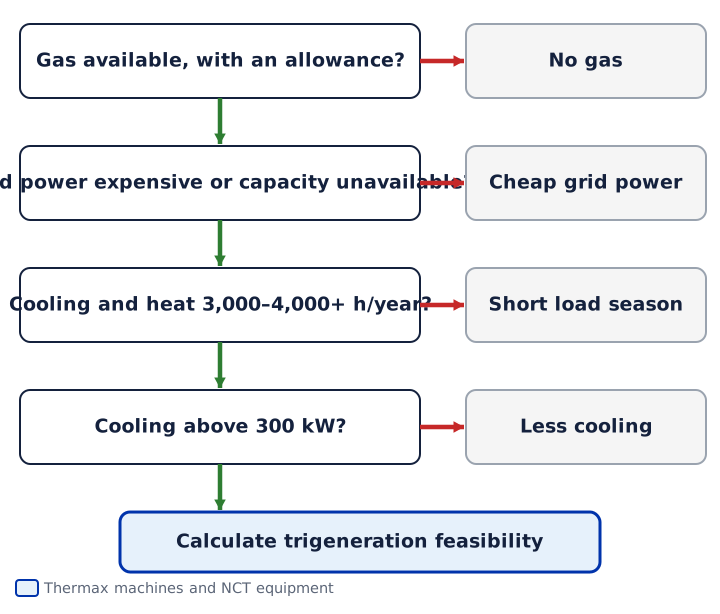
Four questions that show whether it is worth calculating further: is there gas and a limit for it, is electricity expensive or does the grid not provide the capacity, are cooling and heat needed for 3,000–4,000 hours per year or more, is cooling above 300 kW. Here the answer to the third question is "no".
There are three paths to choose from.
-
Install a chiller. The simplest path. A modern chiller with free cooling (COP of about 5.5) plus the grid means a small investment. At 1,200 hours of cooling, it usually wins. More about the machines on the page NCT chillers.
-
A gas-fired absorption chiller. It makes sense only where electrical capacity is unavailable or the connection is very expensive. With a short season, it runs into the 2,000-hour threshold itself, below which an absorption chiller does not pay back, so it has to be checked separately.
-
Give up on generation. If there is no year-round load, it is better not to install an engine. An engine at part load runs worse, and the heat is wasted.
There is also a fourth path: increase the load. If round-the-clock heat and electricity consumers appear nearby, the calculation changes. For example, several buildings can be combined on one plant.
Which of our sites are similar?
Omega Tower business center in Minsk: one LT 18 C chiller of 500 kW, two Bosch gas engines, and the cooling goes to three buildings: the business center, a shopping mall and a fitness club. Nobel Park business center in Tyumen, 15 floors: gas engines and a hot-water absorption chiller running on waste heat. For comparison, at the Teplichnoye greenhouse complex the payback is 5 years; these are site data. We have about 15 trigeneration sites; these are only examples, and many others are collected in the projects section. The industry's tasks are covered on the page about business centers and hotels.
What next?
If you are not sure whether this scheme suits your building, send us the load profiles: the answer may be "install a chiller". Submit a request for a feasibility study or estimate the figures in the calculator. How to avoid mistakes in the calculation is described on the page trigeneration mistakes.
Frequently asked questions
Does it make sense to install an absorption chiller on the heat of a small 100–350 kW gas engine?
As a rule, no. Hot water of about 300 kW at 85 °C is usually not enough for an absorption chiller, especially if cooling is not critical, and such a project loses to vapor-compression cooling. At a coefficient of 0.75, that is about 225 kW of cooling, below the 300 kW threshold. Small absorption chillers are expensive per kilowatt, and gas engine suppliers confirm that there is no point at these capacities. In any case, the calculation needs the inlet and outlet temperatures and the heating medium flow.
What our customers say
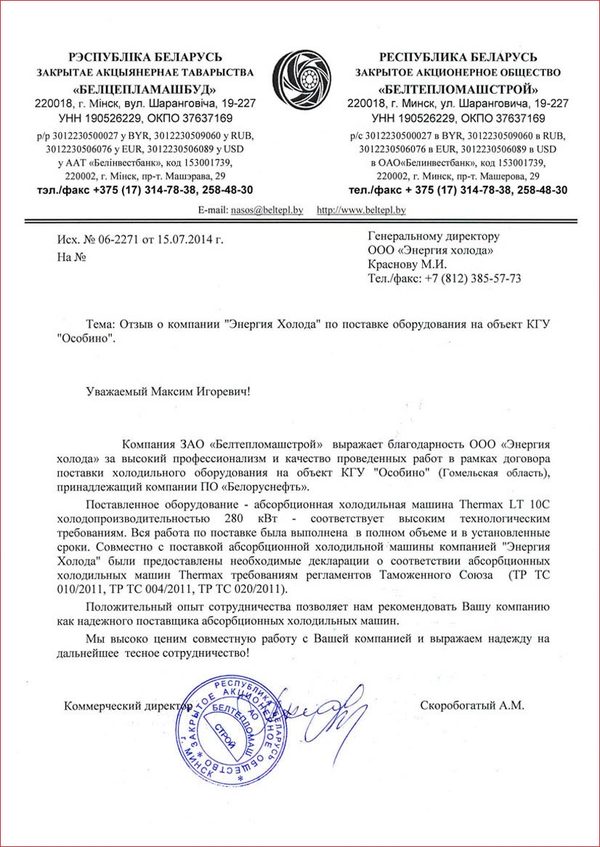
150 letters of thanks · 350+ major projects · 1,000+ customers · in business since 2011. These are real letters from customers; many others are on the references page.



Let us calculate trigeneration for your site
An engineer will put together the scheme and select the equipment, and you get a feasibility study. Free of charge, no obligation.