

Trigeneration for business centers, hotels and hospitals
In brief. In a business center model with 1 MW of cooling and 1,200 hours a year, trigeneration pays back in 6.8 years, and in 5.1 years at high tariffs. The scheme makes sense if there is a year-round load or the grid cannot supply the capacity. Hotels and hospitals with a year-round load are calculated separately.
For an ordinary business center, trigeneration (CCHP) pays back slowly. Cooling is needed for a short season, the constant load is small, and the investment in the engine, the chiller and the cooling tower takes years to return. In our model with 1 MW of cooling and 1,200 hours a year, the difference in capital costs pays back in 6.8 years. This is a case where we openly advise calculating a vapor-compression chiller first. Hotels, hospitals and buildings with a year-round load look better, and if the grid cannot supply the capacity at all, the calculation changes.
When does a business center not need trigeneration?
When the cooling season is short and electricity is needed mainly during the day. In the model, the electrical load without cooling is 400 kW and 3,000 hours a year, while cooling is 1,000 kW and only 1,200 full-load hours. With so few hours, the engine simply does not have time to earn back its price. Savings in the model are RUB 10.8 million per year, with capital costs for trigeneration of about RUB 104.3 million versus about RUB 30.0 million for chillers.
International methods know this limit. The US Department of Energy (DOE) holds that more than 6,000 operating hours a year is a good result, 5,000 to 6,000 calls for a detailed analysis, 3,000 to 5,000 may give an adequate payback, and fewer than 3,000 hours usually does not justify the investment. An example from practice: the BYU-Idaho university campus with a 4.5 MW gas turbine sent up to 45% of its exhaust to bypass on hot days (22% in a typical year), because in summer the heat had nowhere to go. The authors state plainly that a short cooling season lowers the payback of all options.
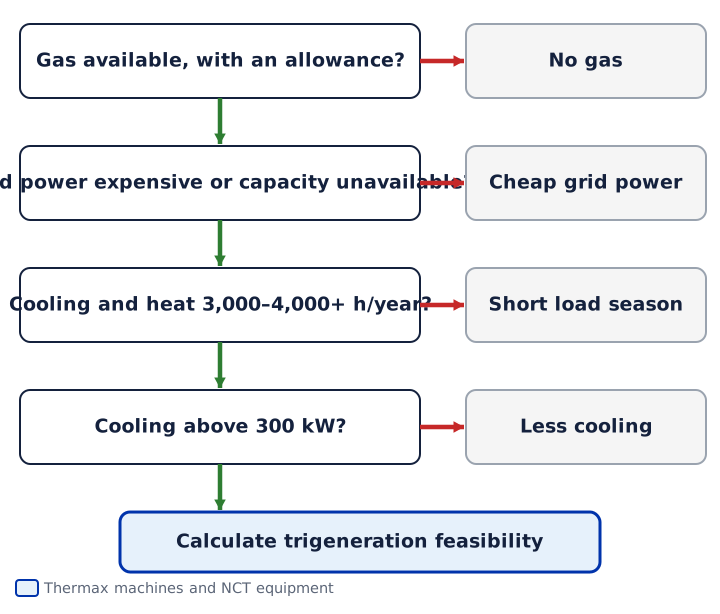
That is why we do not propose the scheme for an office building without a specific reason. The threshold for a lithium bromide absorption chiller: from 300 kW of cooling and from 3,000–4,000 hours a year. Below 2,000 hours it does not pay off.
When does it still make sense?
-
Electrical capacity is unavailable or very expensive. In the model with a grid connection (grid connection fee RUB 34.5 million), the payback shortens to 3.7 years. For a building that the grid has refused capacity, this is one of the few ways to get electricity.
-
There is a year-round load. A hotel, a hospital, or tenants working around the clock keep the engine running constantly. DOE names hospitals and hotels among the sites where absorption cooling works most effectively.
-
Tariffs are high. The sensitivity table shows a range from 5.1 to 12.5 years depending on gas price and tariff. The best payback of 5.1 years is reached at a tariff of RUB 12/kWh and gas at RUB 7/m³.
-
There is a winter heat consumer nearby: domestic hot water or a neighboring building.
Four questions before the calculation
If the answer to at least one is "no", calculate other schemes first.
Hospitals and hotels need backup
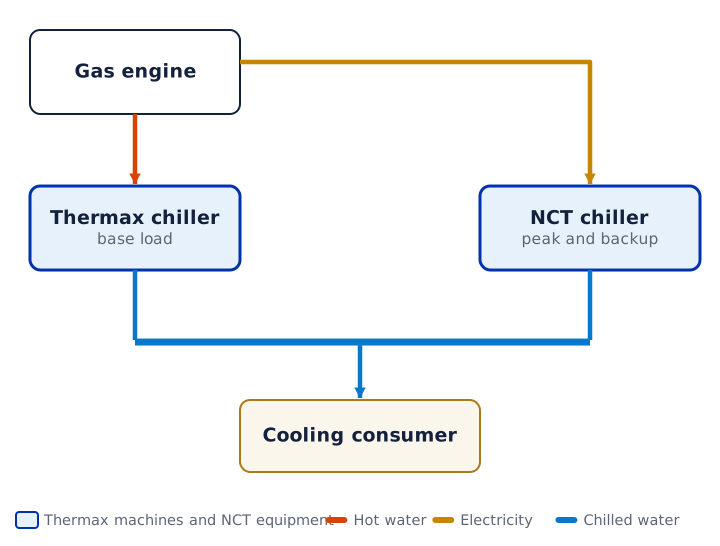
In a hospital, a cooling outage is unacceptable; in a hotel it is expensive. That is why the absorption chiller takes the base load, and an NCT chiller covers the peak and serves as backup.
Which building projects do we have?
The table shows examples, and many others are in the projects section.
| Site | Generation | Cooling | What we did |
|---|---|---|---|
| Omega Tower business center, Minsk | 2 Bosch gas engines | LT 18C, 500 kW | Supply, installation supervision, commissioning |
| Nobel Park business center, Tyumen | Gas engine | Thermax hot water chiller | Supply, commissioning |
| Central Customs Administration building, Moscow | 5 Capstone C200 microturbines | 2 × LT-14 C, 500 kW each | Supply, installation supervision, commissioning |
| Smolensk Academy of Physical Culture | MTU gas engine on site | 2 × 5G 4L C, 1,100 kW each | Supply, installation supervision, commissioning |
Omega Tower cools three buildings: the business center itself, the Globo shopping mall and a fitness club.
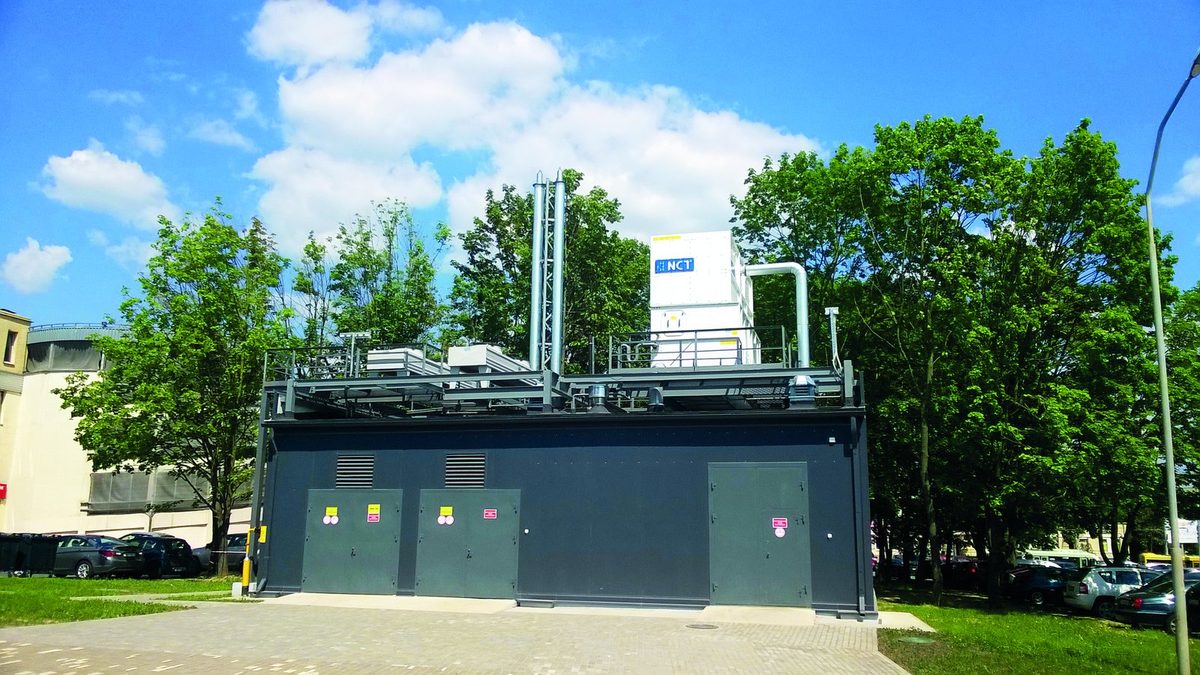
Nobel Park is a 15-story Class A business center of 19,551 m²; the chiller runs on waste heat from a gas engine.
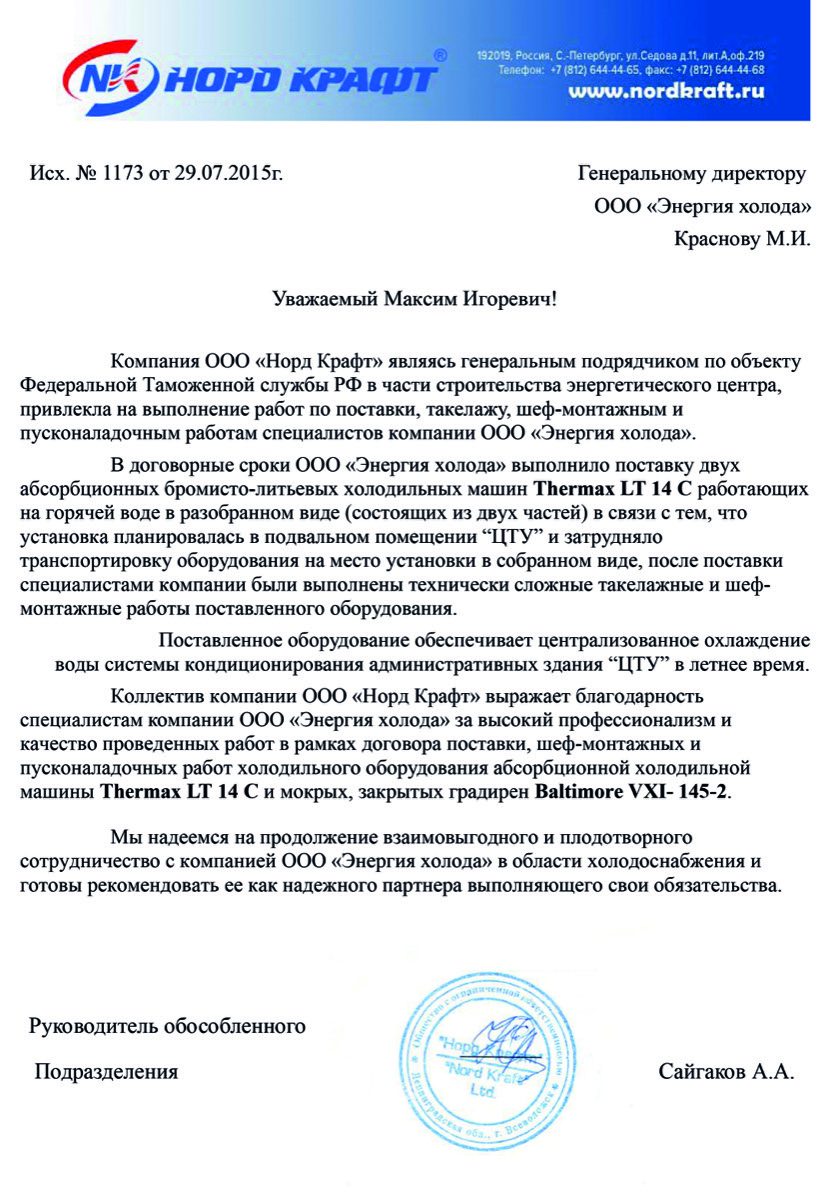
The Central Customs Administration building in Moscow lacked electrical capacity, so cooling was produced from microturbine heat. The chillers were delivered in sections and assembled in a basement with narrow passages. A letter from the energy center's general contractor thanks us for on-time delivery, rigging, installation supervision and commissioning.
The Smolensk academy gets hot water for the chillers from its own boiler house, although there is also an MTU gas engine on site.
As an example of Thermax chillers in operation, without our involvement: the Moscow Region Government House, three LT 42 T chillers running on heat from four Jenbacher JMS 620 engines, started up in 2006. Cold Energy (NCT) was not involved in this project.
What examples are there worldwide?
| Site | Generation | Cooling from heat | Result |
|---|---|---|---|
| 101 Miller Street, North Sydney (Australia) | 2 MTU engines, 1,166 kW each | Exhaust-fired absorption chiller | About 50% less greenhouse gas, 5 Star NABERS |
| Green Gold Complex, Zagreb (Croatia) | 2 Jenbacher gas engines, 637 kW each | Two chillers, 1,230 kW in total, and 460 kW of heat | 700 kW backup chiller, 810 t less CO2 per year |
| Sanjiban Hospital, Kolkata (India) | 6 units of 250 kW running on wood gas | 2 absorption chillers | Surplus electricity goes to the grid |
101 Miller Street cools 40,000 m² of offices and 10,000 m² of retail. Green Gold Complex runs on cooling in summer and on heating in winter, and a vapor-compression chiller stays there as backup. The 300-bed Sanjiban Hospital received a subsidy from India's Ministry of New and Renewable Energy.
What does the model feasibility study for a business center show?
This is a model calculation (tariff RUB 10/kWh, gas RUB 9/m³), not an offer.
| Indicator | Value |
|---|---|
| Costs: grid and chiller, RUB million/year | 16.2 |
| Costs: trigeneration, RUB million/year | 5.3 |
| Savings, RUB million/year | 10.8 |
| Payback of the difference in capital costs | 6.8 years |
The gas engine generates 1.3 million kWh a year at a capacity of about 500 kW. Waste heat covers 90% of the annual cooling demand. The shorter the season and the lower the constant load, the slower the investment returns. The full calculation and assumptions are on the feasibility study for a business center page. Typical reasons for low payback and the interfaces between engine and cooling are covered on the trigeneration mistakes page. If the numbers work, the engine and the cooling equipment can be ordered together from Cold Energy.
Submit a request for a feasibility study or check the numbers in the calculator: if the payback comes out longer than five years, we will tell you so.
Sources
- DOE, Absorption Chillers for CHP Systems, DOE/EE-1608, 2017: energy.gov
- DOE, CHP Resource Guide for Hospital Applications, 2007: energy.gov
- APPA, From Cogen to Trigen (BYU-Idaho), 2019: appa.org
- 101 Miller Street, Green Gold Complex and Sanjiban Hospital projects: Thermax materials
Frequently asked questions
Is there a hot water absorption chiller with a gas burner? Which chiller should I choose for trigeneration?
No, these are different machines: hot water chillers have no burner; a burner exists only on direct-fired chillers and on exhaust-fired chillers with a burner option. For trigeneration, the type is chosen by the main heat source: exhaust, jacket water or direct firing. Dimensions and weight are tied to a specific model and confirmed with the factory.
What our customers say
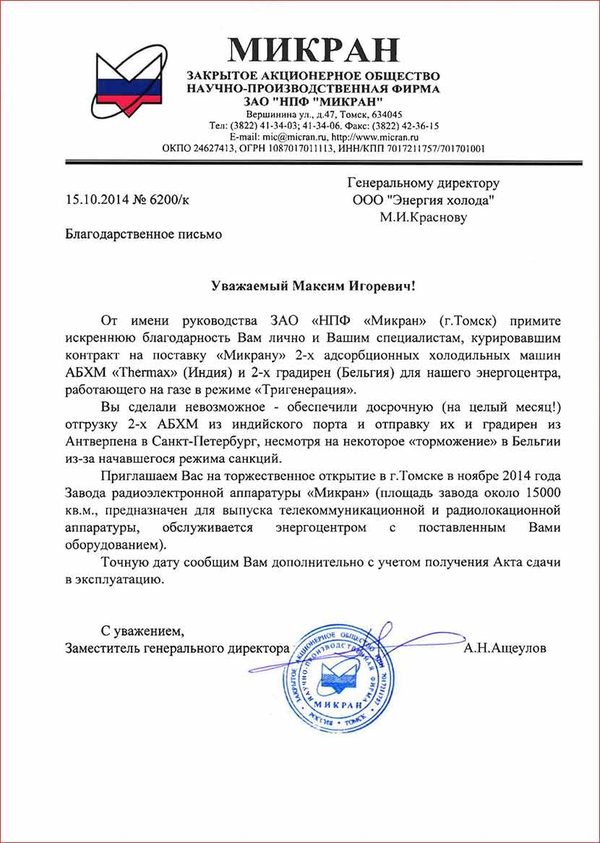
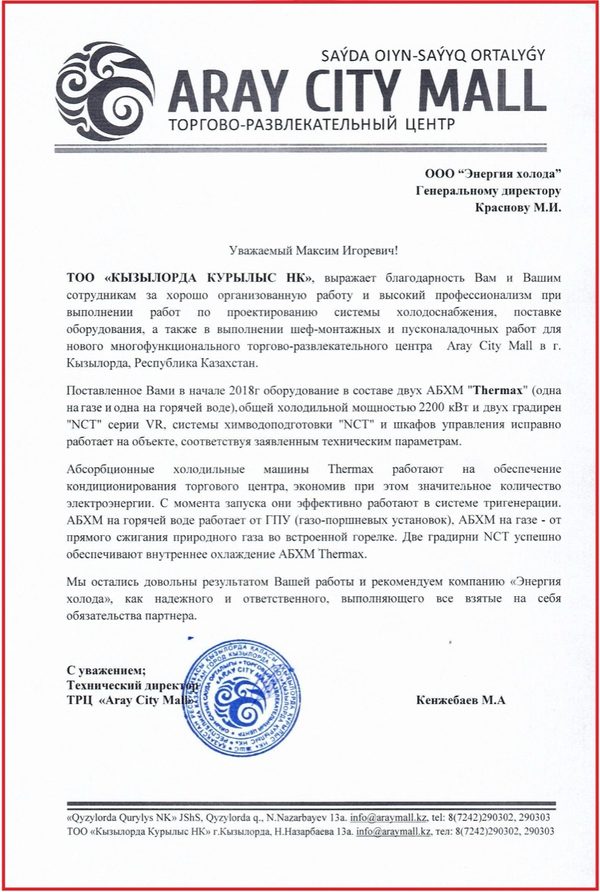
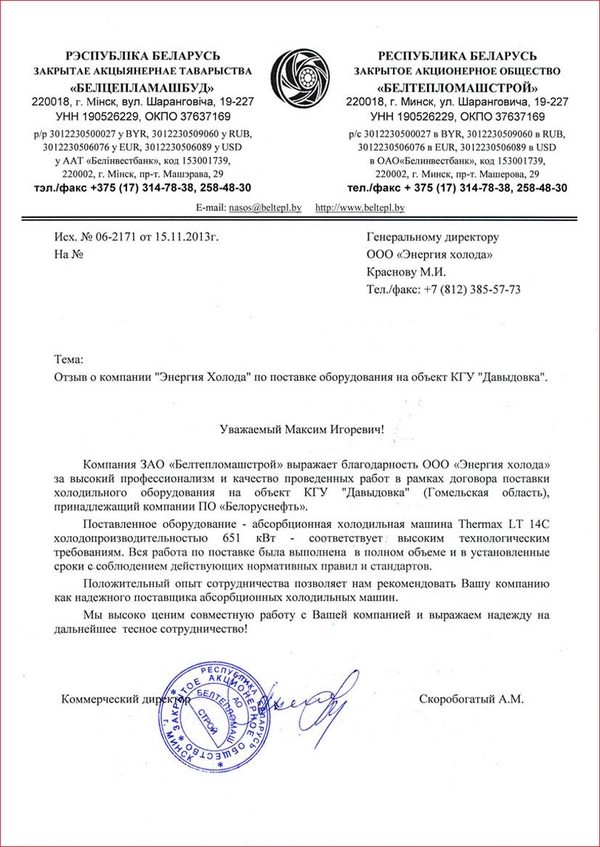
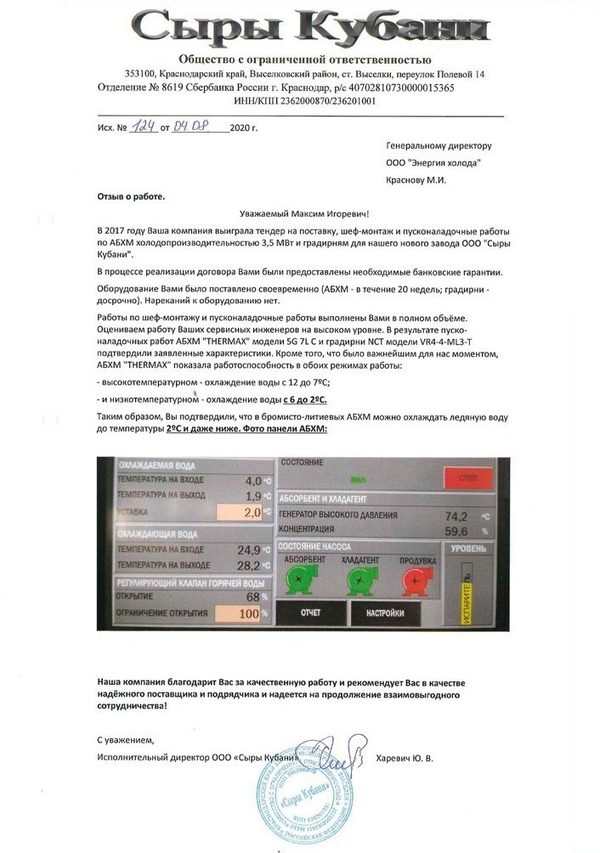
150 letters of thanks · 350+ major projects · 1,000+ customers · in business since 2011. These are real letters from customers; many others are on the references page.
Let us calculate trigeneration for your site
An engineer will put together the scheme and select the equipment, and you get a feasibility study. Free of charge, no obligation.