

Trigeneration for shopping malls
In brief. A shopping mall has a high electrical load, but needs cooling for about 2,200 hours a year. A model with 4.4 MW of cooling gives a payback of 2.9 years, the longest among the large industries. A chiller with a burner can work as a heater in winter.
A shopping mall is a conditional fit for trigeneration (CCHP): it needs electricity every day for many hours, but cooling almost exclusively in summer. A model with 4.4 MW of cooling shows a payback of the difference in capital costs of 2.9 years. That is longer than for a data center or a dairy plant, but noticeably shorter than for a business center. The main benefit here comes from on-site electricity, not from the cooling itself.
How does a shopping mall differ from other industries?
A shopping mall's load is uneven across seasons. In the model, the electrical load without cooling is 3,200 kW and 6,000 hours a year, peak cooling is 4,400 kW, but only about 2,200 full-load hours a year. In winter cooling is hardly needed, and the engine heat goes to space heating: in the model, 2,000 kW of heat for 4,000 hours.
So a shopping mall relies on two things: electricity from the engine is cheaper than from the grid (RUB 3.72/kWh versus RUB 10 in the model), and the heat finds a consumer in both halves of the year. In summer it is turned into cooling by a lithium bromide absorption chiller; in winter it goes to space heating.
What are the drawbacks of trigeneration for a shopping mall?
-
Few cooling hours. About 2,200 hours a year against a threshold of 3,000–4,000 hours or more: the absorption chiller itself takes longer to earn back its cost. The scheme pays off primarily thanks to the engine.
-
Seasonality. If the winter heat has nowhere to go, it is released to the atmosphere, and the scheme loses its point. International methods call this the absence of a year-round thermal load.
-
Dependence on tariffs. With gas at RUB 12/m³ and a tariff of RUB 7.5/kWh, the shopping mall model's payback goes beyond five years. With a tariff of RUB 12/kWh and gas at RUB 7/m³, it shortens to 2.2 years.
-
Space. Cooling towers for an absorption chiller are about 1.5–2 times larger than for a chiller with the same cooling capacity. On a shopping mall roof this has to be checked in advance.
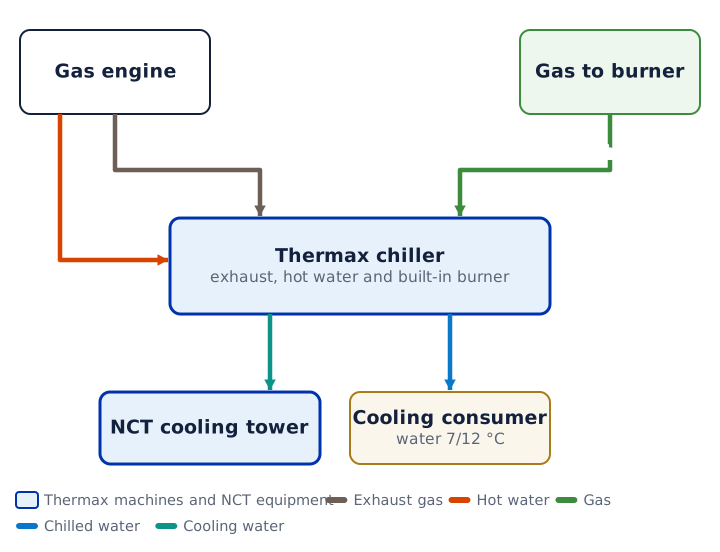
A gas-fired absorption chiller as a heater in winter
For a shopping mall, there is an option with a built-in burner. In summer the chiller produces cooling, and in winter it can work as a heater and supply hot water up to 95 °C. It does not stand idle in the season when cooling is not needed.
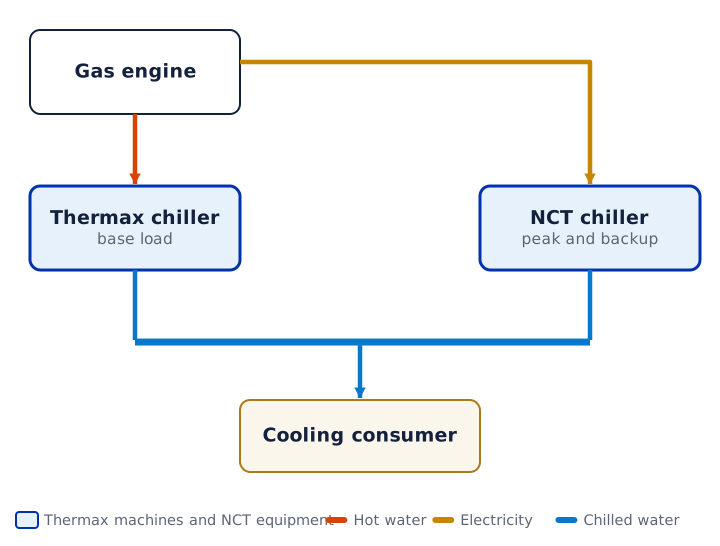
Absorption chiller for the base, electric chiller for the peak
The second approach: the absorption chiller carries the base load, and an NCT chiller comes on for the peak and serves as backup.
Which shopping mall projects do we have?
The table gives examples. There are more sites, and many others are in the projects section.
| Site | Generation | Cooling | What we did |
|---|---|---|---|
| TAU Galereya shopping mall, Saratov | Gas engine | 2 × 5G 6L C, 2,200 kW each | Supply, installation supervision, commissioning |
| Aray City Mall, Kyzylorda | Gas engine | 5G 4L C and gas-fired 2V 3L C, 1,100 kW each | Design, supply, installation supervision, commissioning |
TAU Galereya is a large shopping mall in the Volga region: more than 150 shops, over 10 restaurants, a cinema and a hypermarket. The contract was signed in April 2014, and the equipment was delivered in November of the same year.
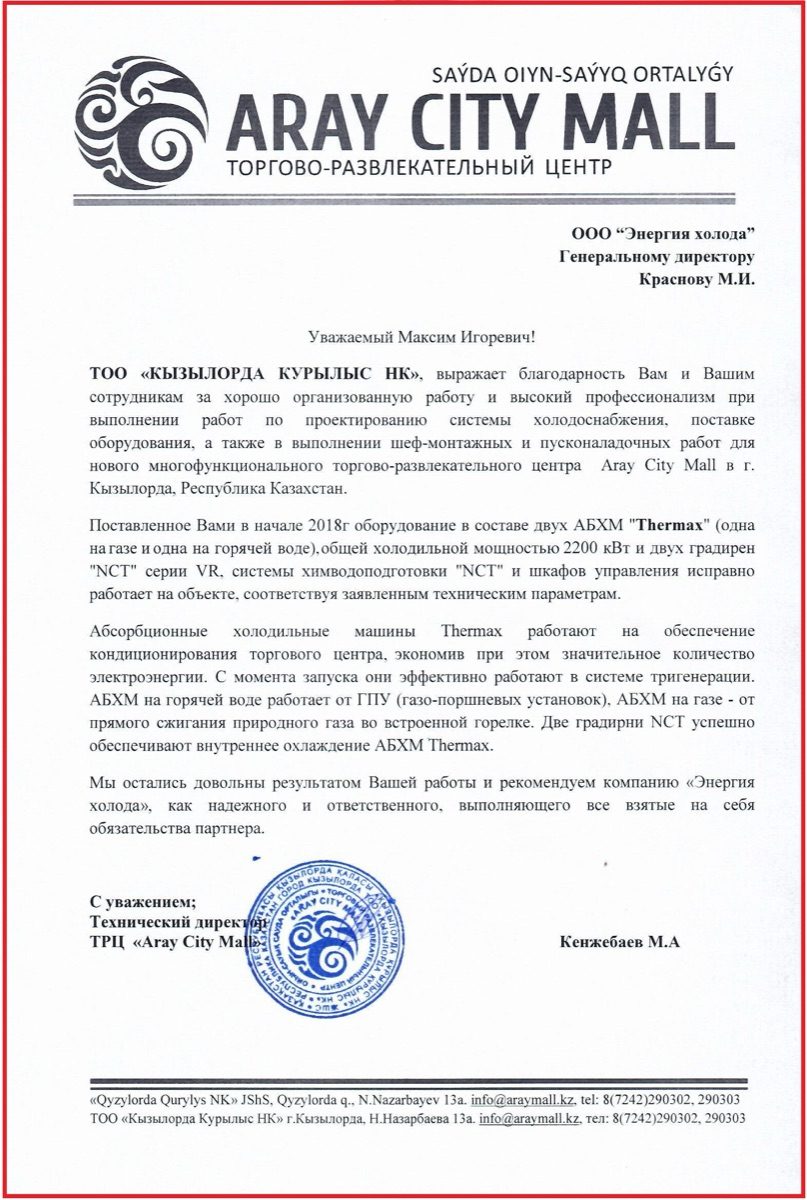
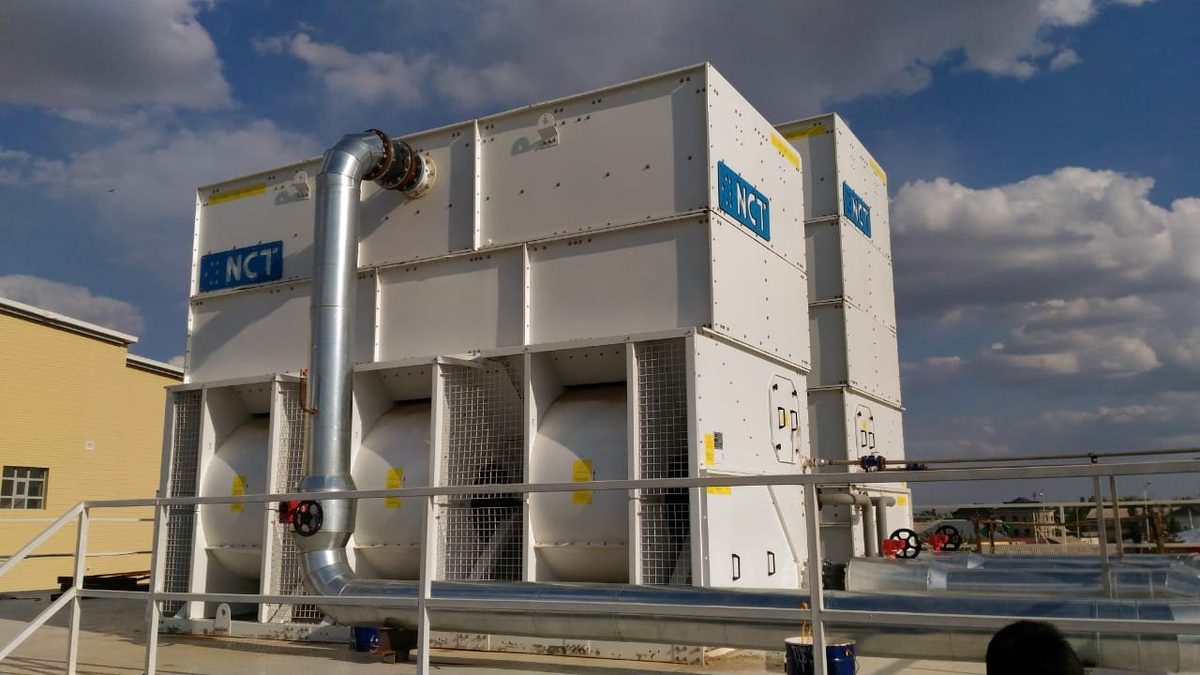
Aray City Mall (opened in August 2018) has two chillers: one runs on hot water from a gas engine, the other on natural gas with a built-in burner. Together they give 2,200 kW. We also supplied two NCT VR series cooling towers, two W2C water treatment units, controls and pump skids. In a letter, the mall's owner confirms the design, supply, installation supervision and commissioning, trouble-free operation and electricity savings.
What examples are there worldwide?
Two examples from Thermax materials.
| Site | Generation | Cooling from heat | Result |
|---|---|---|---|
| Pacific Mall, Sahibabad (India) | 2.7 MW gas engine | 2 absorption chillers of 415 TR each, 2,918 kW in total | Cooling from waste heat, lower capital costs |
| Grand Venezia, Noida (India) | 8 gas engines of 2 MW each, 16 MW in total | 8 absorption chillers of 600 TR each, 16,877 kW in total | The engines cover 61% of the complex's demand |
Pacific Mall cools a retail area of 500,000 sq ft. Grand Venezia combines 1 million sq ft of retail space and a 200-room hotel. The claims of "practically free cooling" are the manufacturer's; there is no independent verification.
What does the model feasibility study for a shopping mall show?
This is a model calculation (tariff RUB 10/kWh, gas RUB 9/m³), not an offer.
| Indicator | Value |
|---|---|
| Costs: grid and chiller, RUB million/year | 223.5 |
| Costs: trigeneration, RUB million/year | 68.2 |
| Savings, RUB million/year | 155.3 |
| Payback of the difference in capital costs | 2.9 years |
Capital costs are about RUB 586.5 million versus about RUB 132.0 million for chillers. If the site has to be connected to the grid (grid connection fee RUB 219.3 million), the payback is 1.5 years. Cooling from waste heat covers 100% of the annual demand. The detailed calculation is on the feasibility study for a shopping mall page. The chiller series are described on the Thermax absorption chillers page, and heat rejection on the NCT cooling towers page. The interface between the engine and the chiller is covered on the trigeneration mistakes page. The engine and the cooling equipment can be ordered together from Cold Energy (NCT), and then there is a single interface.
Send us your mall's load profile and we will calculate it in a feasibility study, or estimate it yourself in the calculator.
Sources
- DOE, CHP Resource Guide for Hospital Applications, 2007: energy.gov
- ORNL / DOE CHP TAP, CHP Project Screening, 2022: ornl.gov
- Pacific Mall and Grand Venezia projects: Thermax materials
Frequently asked questions
Will an absorption chiller work if the heat transfer fluid is only about 75 °C in summer?
Low-temperature chillers are considered for a 7/12 °C schedule, but the capacity with such water is noticeably below nominal. The LT series works from 70 °C and is economically reasonable from 80 °C. In one project, the customer compared the options, chose direct gas firing and requested a calculation for 1 and 2 MW.
What our customers say
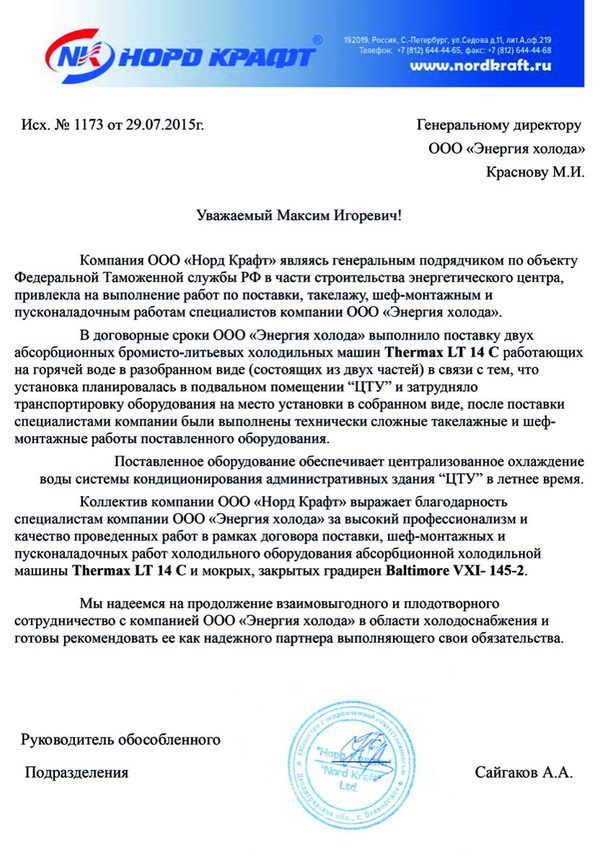
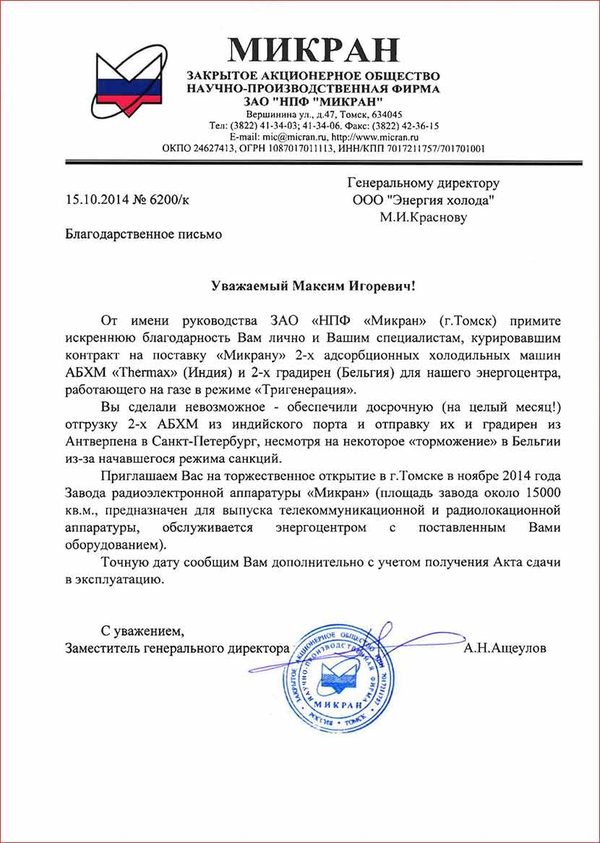
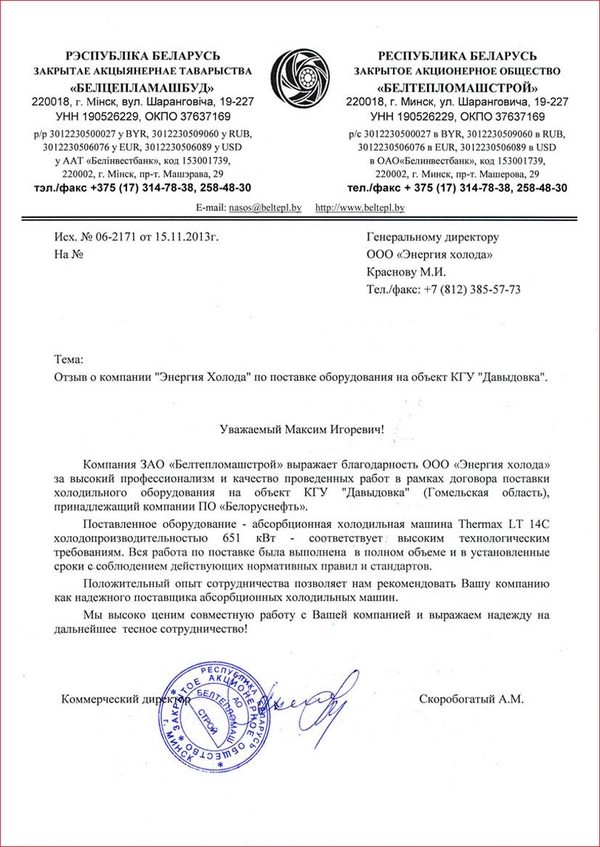
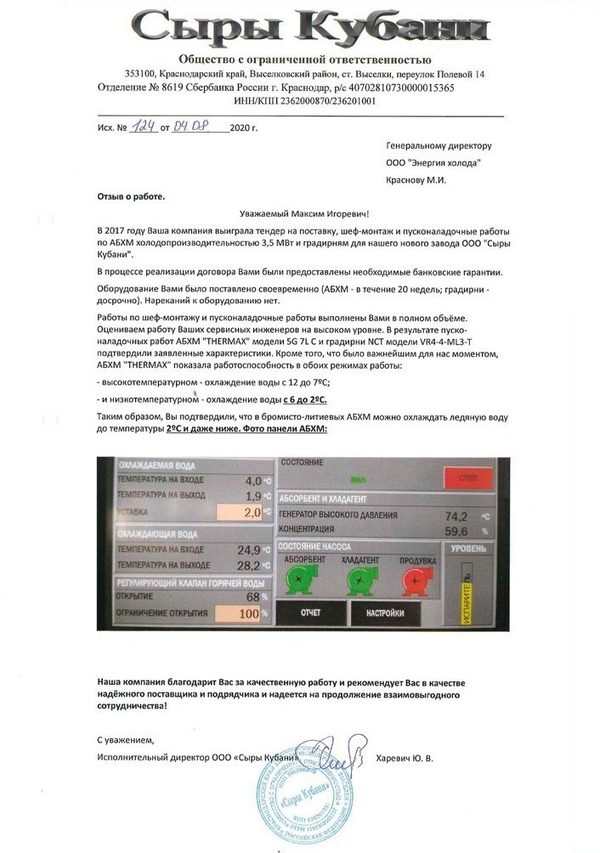
150 letters of thanks · 350+ major projects · 1,000+ customers · in business since 2011. These are real letters from customers; many others are on the references page.
Let us calculate trigeneration for your site
An engineer will put together the scheme and select the equipment, and you get a feasibility study. Free of charge, no obligation.