

Trigeneration feasibility study for a greenhouse complex
In brief. For a greenhouse with a large lighting and heat load, the model gives a payback of 2.0 years. This is a model calculation and a guide. The real Teplichnoye complex came out at 5 years.
For a greenhouse complex with an electrical load of 6,000 kW and only 800 kW of cooling, the model gives a payback of 2.0 years with an existing grid connection and 1.0 years if the capacity had to be connected. The real Teplichnoye greenhouse complex has a payback of 5 years, and the difference between the model and the site needs to be understood.
This is a model calculation, a guide, not an offer. The model's rules are described on the how to calculate payback page.
What site did we calculate?
An electrical load without cooling of 6,000 kW and 7,000 hours a year: lighting and equipment. Cooling only for the packing area, 800 kW and 2,500 full-load hours. In winter the engine heat warms the greenhouses: 3,000 kW for 4,500 hours. The baseline is a chiller with a seasonal COP of 3.5.
What were the results?
| Item | Value |
|---|---|
| Peak cooling | 800 kW |
| Full-load cooling hours | 2,500 h/year |
| Electrical load excluding cooling | 6,000 kW, 7,000 h/year |
| Reference chiller, seasonal COP | 3.5 |
| Winter heat | 3,000 kW, 4,500 h/year |
| Gas engine output | 42.1 million kWh/year |
| Required generating capacity | about 7,100 kW |
| Gas | 11.3 million m³/year |
| Own electricity | RUB 3.72/kWh vs RUB 10 from the grid |
| Cooling from waste heat | 100% of annual demand |
| Costs: grid and chiller | RUB 426.4 million/year |
| Costs: trigeneration | RUB 143.0 million/year |
| Savings | RUB 283.4 million/year |
| Capex: trigeneration | about RUB 603.8 million |
| Capex: chillers | about RUB 24.0 million |
| Payback of the difference, grid capacity available | 2.0 years |
| Payback if a grid connection is needed | 1.0 years (connection fee RUB 294.5 million) |
The structure of the economics is clearer here than in any other calculation. Most of it comes from electricity (RUB 3.72/kWh versus RUB 10) and from winter heat replacing the boiler house. In money terms, cooling is secondary here: the capital cost of chillers in the baseline is only RUB 24.0 million versus RUB 603.8 million for trigeneration (CCHP). Cooling is needed so that the engine heat is not wasted in summer and so that large electric chillers do not have to be installed.
What happens with a different tariff and gas price?
| Gas, RUB/m³ | Power RUB 7.5 | Power RUB 10 | Power RUB 12 |
|---|---|---|---|
| 7 | 3.0 years | 1.9 years | 1.5 years |
| 9 | 3.3 years | 2.0 years | 1.6 years |
| 12 | 3.9 years | 2.3 years | 1.7 years |
The range is 1.5 to 3.9 years. With the most cautious pair, a tariff of RUB 7.5 and gas at RUB 12, the payback is 3.9 years.
What assumptions are in the calculation?
Tariff RUB 10/kWh, gas RUB 9/m³, water RUB 50/m³, gas engine efficiency 40 % and 45 %, gas engine service RUB 1.3/kWh. Investment based on the 2026 model benchmarks: RUB 78,000 per kW of generation, RUB 65,000 per kW of cooling, RUB 30,000 per kW of chiller. The benchmarks are replaced by the price from a commercial proposal.
Why is the model shorter than the real payback?
The real complex was calculated differently from the model, and the sources do not disclose exactly how. Here is what is known and what the model does not include.
- The model calculates a typical complex with a steady load; the real one was built in phases.
- Island mode is not included. The real complex runs in island mode, which means backup engines and substations are needed. The model does not have them.
- The model does not know about the customer's requirement for 3.5 °C water at the outlet: the chiller was ordered for that mode.
- The site was commissioned in 2017–2018, while the model uses 2026 prices and benchmarks.
Read it this way: the model shows the potential of the scheme, and the site's payback, 5 years, shows that reality costs more. For a decision, take the larger of the two.
Which of our sites is similar?
The Teplichnoye complex in Sverdlovsk Region. Two LT 12 C chillers of 400 kW each on hot water from the engines and the boiler house, water at 8.5/3.5 °C (the 3.5 °C outlet was the customer's requirement), 10 JMS 624 and 4 JMC 320 engines in island mode. The complex's energy efficiency is up to 92 %, and the payback is 5 years. This was the first trigeneration plant for a greenhouse complex in Russia. According to the project implementation report, electrical capacity was short, the substation was far away, and an electric chiller did not fit. This is one of our many sites; the others are in the projects section, and the industry is covered on the greenhouses page.
Sources
- DECC (UK), Factors affecting the uptake of gas CHP, December 2014: https://assets.publishing.service.gov.uk/media/5a7ef55240f0b62305b843e9/Factors_affecting_the_uptake_of_gas_CHP_Final_v6.pdf
What to do next?
A real calculation needs monthly lighting and heat profiles, the technical conditions for the power connection and fuel prices. Send them through a feasibility study request or estimate the figures in the calculator.
Frequently asked questions
How does the payback of a gas engine with an absorption chiller change if surplus electricity cannot be sold to the grid?
Without selling the surplus, and without your own need for additional electricity and a large volume of cooling, the project is not justified. That is why the gas engine capacity should be chosen for your own load and heat, not for the output you would like to have. In our model there is no surplus by design: all output is consumed, and that is exactly what keeps the payback at 2.0 years. A 2014 UK survey named sizing for electricity rather than for the heat load as the reason for the weak finances of older schemes.
What our customers say
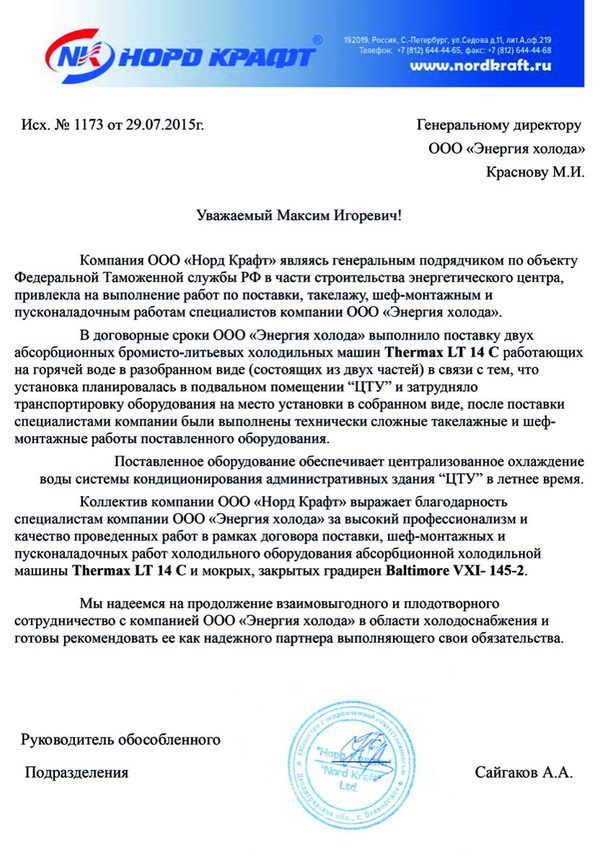
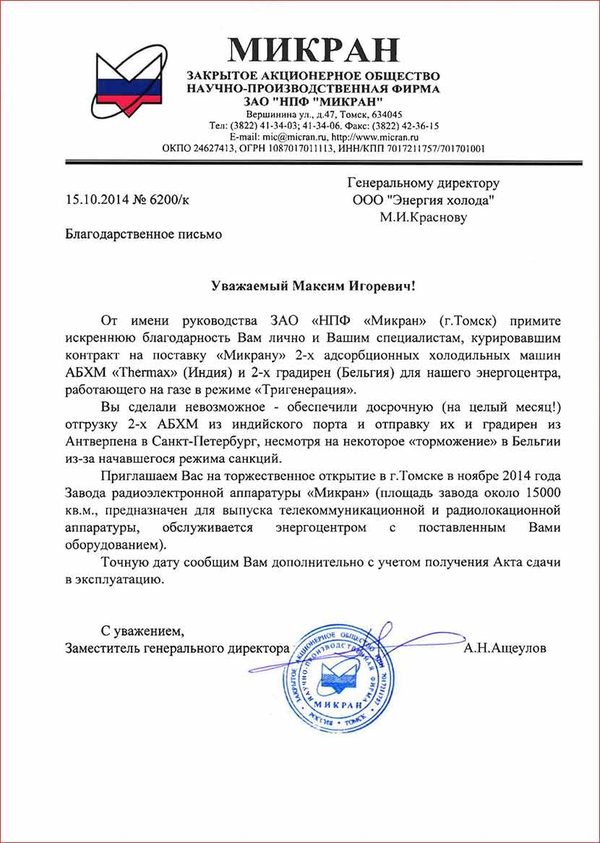
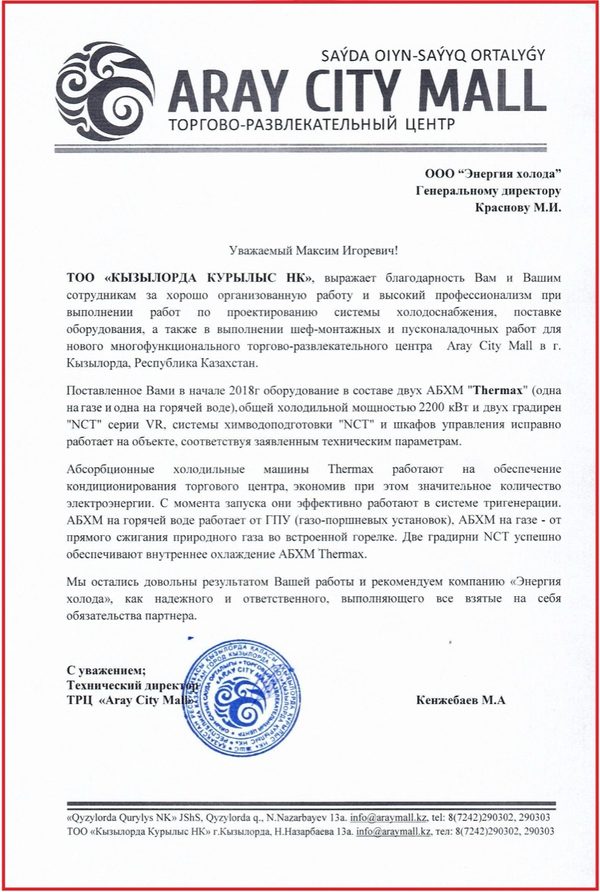
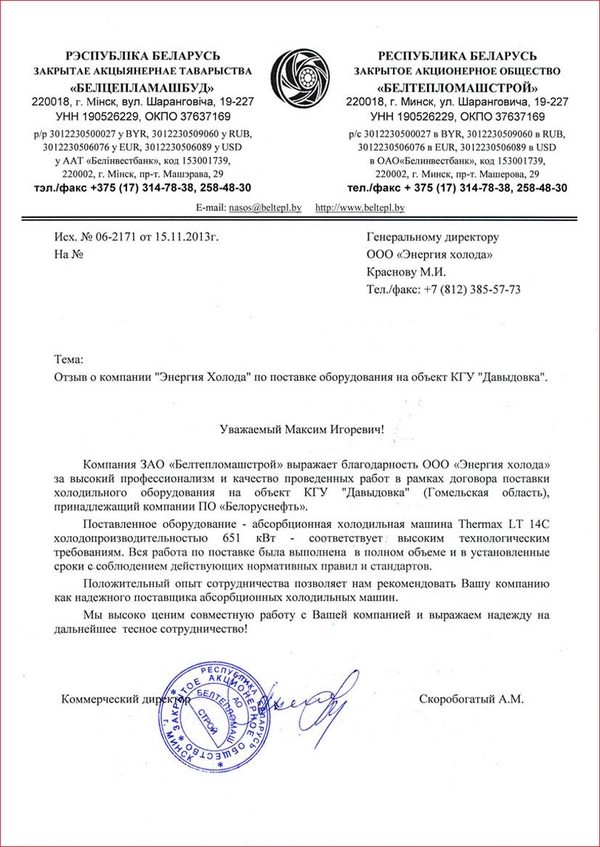
150 letters of thanks · 350+ major projects · 1,000+ customers · in business since 2011. These are real letters from customers; many others are on the references page.
Let us calculate trigeneration for your site
An engineer will put together the scheme and select the equipment, and you get a feasibility study. Free of charge, no obligation.