

Trigeneration for greenhouses and agricultural complexes
In brief. In a greenhouse, trigeneration rests on the engines: light, heat and CO2 matter more than cooling. A model with 800 kW of cooling and 6,000 kW of electrical load pays back in 2.0 years. Cooling is a small add-on in this scheme, and it is more honest to call it cogeneration with cooling.
A greenhouse complex suits gas engines: it needs electricity for supplemental lighting, heat for heating and carbon dioxide for the plants. Cooling is needed least of all, and only for packing, storage and administrative areas. In a model with 800 kW of cooling and 6,000 kW of electrical load, the difference in capital expenditure pays back in 2.0 years. The benefit comes mainly from own electricity, and the absorption chiller adds the use of heat in summer. Do not expect more from cooling than it gives.
How does a greenhouse differ from other industries?
The load is the reverse of a data center. In the model, the electrical load is 6,000 kW for 7,000 hours per year, winter heat is 3,000 kW for 4,500 hours, and peak cooling is 800 kW for only about 2,500 hours per year. The engines are needed to cover lighting and heating. Cooling uses the heat that would otherwise be rejected to the air in summer.
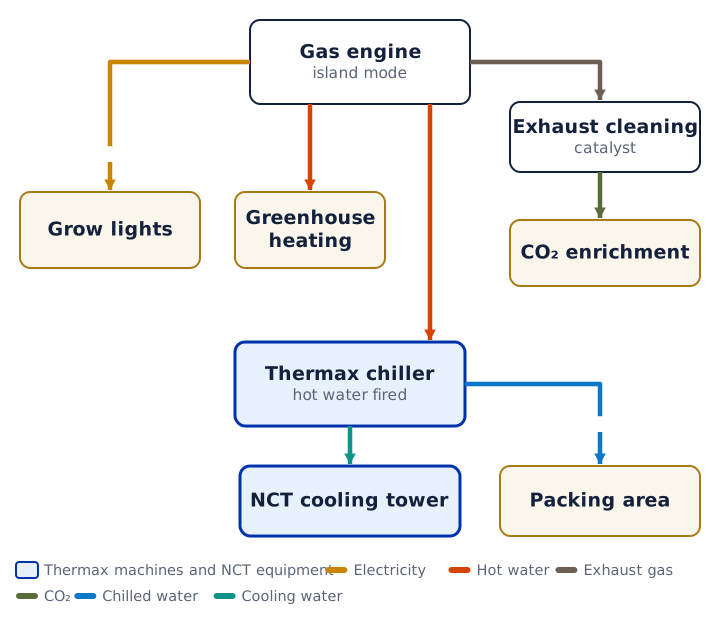
Carbon dioxide also comes from the engines. Cleaned exhaust is fed to the plants, and this is a separate benefit item: the model table has no separate line for it. At the Vyborzhets agricultural complex, a COdiNOx system is installed for this purpose: it cools, cleans and extracts CO2, and a separate hot water boiler is used to produce it.
Greenhouse complex scheme
Gas engines provide lighting and heating, cleaned exhaust supplies CO2 to the plants, and hot water cools the packing area through a Thermax chiller.
What are the downsides of the scheme?
-
Cooling in this scheme is small. In the model, its peak is 800 kW with an electrical load of 6,000 kW. If cooling is needed only for packing, the absorption chiller remains an add-on to the project.
-
Low temperature. At the Teplichnoye greenhouse complex, 3.5 °C was needed at the chiller outlet. This is the lower limit for the LT and 5G series.
-
Island mode. The complex runs without the grid, so engine redundancy is built into the project, and the chiller must receive heat while one of the units is stopped.
-
The engine capacity is set by lighting and heat, not by cooling. That is why the gas engines are sized for these loads, and the lithium bromide absorption chiller is fitted to the heat that remains.
Two heat sources: engines and the boiler house
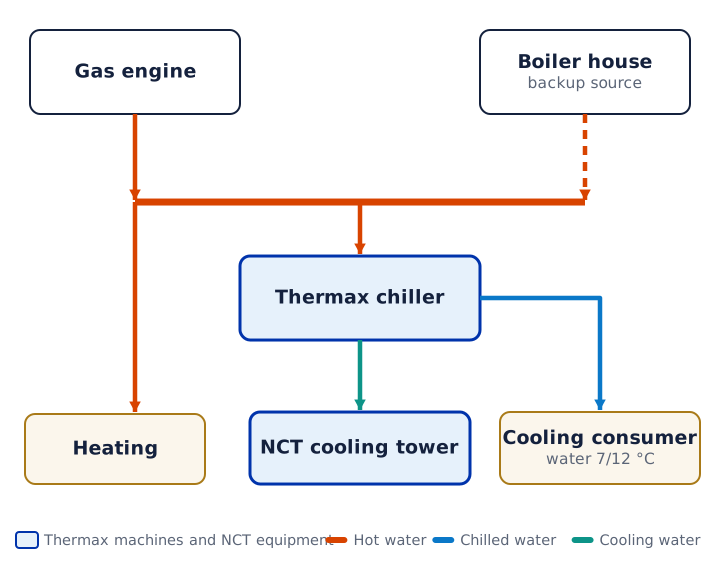
So that the chiller gets heat even when an engine is stopped, the hot water header is fed from the gas engines and from the boiler house. This scheme works at the greenhouse complex in Sverdlovsk Region.
What greenhouse sites do we have?
This is an example, not the full list. They are among many other sites in the projects section.
| Site | Generation | Cooling | What we did |
|---|---|---|---|
| Teplichnoye greenhouse complex, Sverdlovsk Region | 10 JMS 624 and 4 JMC 320 gas engines, island mode | 2 × LT 12 C of 400 kW each, 8.5/3.5 °C | Design, supply, installation supervision of controls, commissioning |
| Vyborzhets agricultural complex, Leningrad Region | 4 GE Jenbacher and 3 MWM | 2 × 5G 6LH on hot water | Design, supply, installation supervision, commissioning |
The Teplichnoye complex grows more than 5,000 tonnes of greenhouse vegetables per year on 17.6 ha. The energy source for the absorption chillers is waste hot water from the gas engines and the boiler house. The cooling goes to the packing area, cold stores and the administrative building. According to the project data, heat and electricity consumption per hectare was halved, the energy efficiency of the complex reaches 92 %, and the payback was 5 years. This is the first trigeneration (CCHP) plant for a greenhouse complex in Russia. Full automation and remote dispatch make it possible to run the plant without permanent staff. We also supplied two NCT cooling towers, chemical water treatment and a control system with online monitoring.
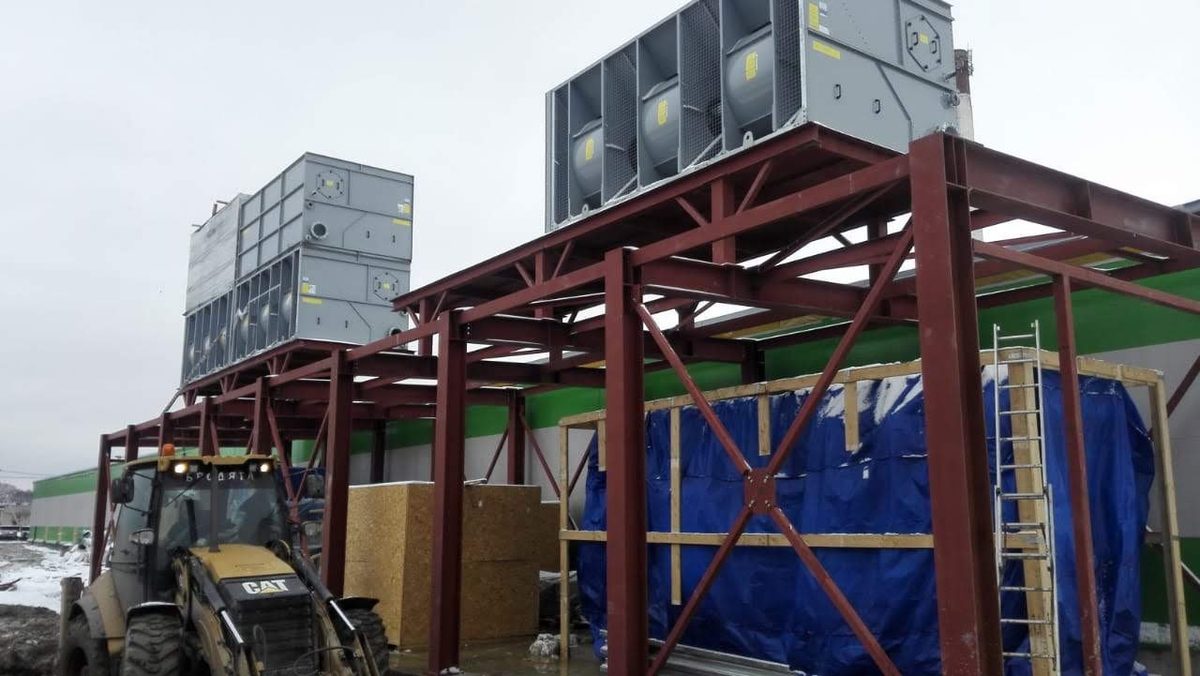
Vyborzhets is a full-cycle mushroom complex: more than 30,000 tonnes of compost per year and up to 10,000 tonnes of champignons per year. Two chillers with a total capacity of 3.8 MW serve air conditioning in the warm season, with NCT VR series cooling towers.
What does a model feasibility study for a greenhouse show?
The calculation is a model (tariff RUB 10/kWh, gas RUB 9/m³), not an offer.
| Indicator | Value |
|---|---|
| Costs: grid and chiller, RUB million/year | 426.4 |
| Costs: trigeneration, RUB million/year | 143.0 |
| Savings, RUB million/year | 283.4 |
| Payback of the difference in capital expenditure | 2.0 years |
Capital expenditure is about RUB 603.8 million versus about RUB 24.0 million for chillers. The gap is large because few chillers are needed, while the engines need to be large. If the grid has to be connected (grid connection fee of RUB 294.5 million), the payback will be 1.0 year. The range across tariffs and gas prices is from 1.5 to 3.9 years. Cooling from waste heat covers 100 % of the annual demand. The full calculation is on the page feasibility study for a greenhouse.
Note: the real complex reports a payback of 5 years, while the model gives 2.0 years. These two periods cannot be compared, because their assumptions differ. The model shows the order of magnitude, not a forecast for your project. How the schemes with engines work is shown on the page about gas engines, and typical mistakes on the page trigeneration mistakes. Cold Energy (NCT) supplies both the gas engines and the cooling for the packing area.
Send your lighting, heat and cooling loads to the feasibility study or estimate the figures in the calculator.
What our customers say
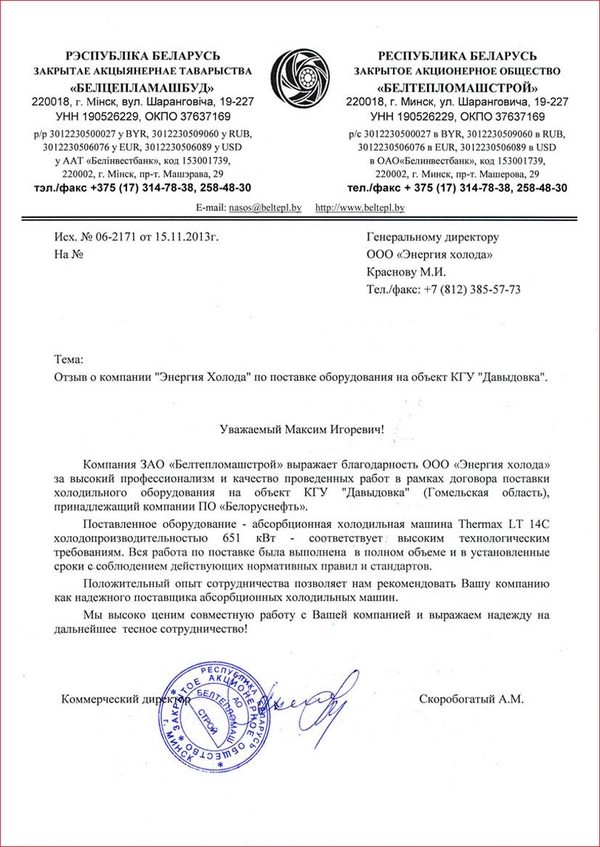
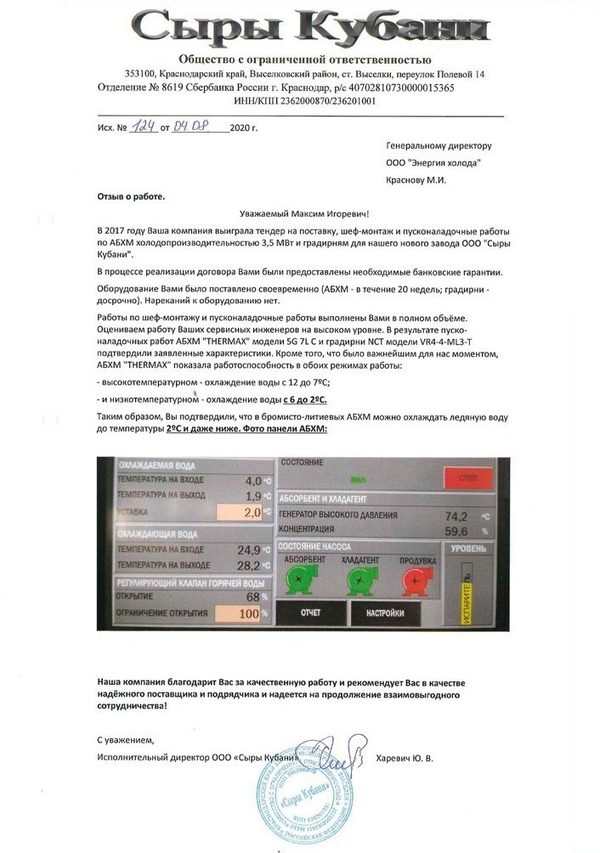
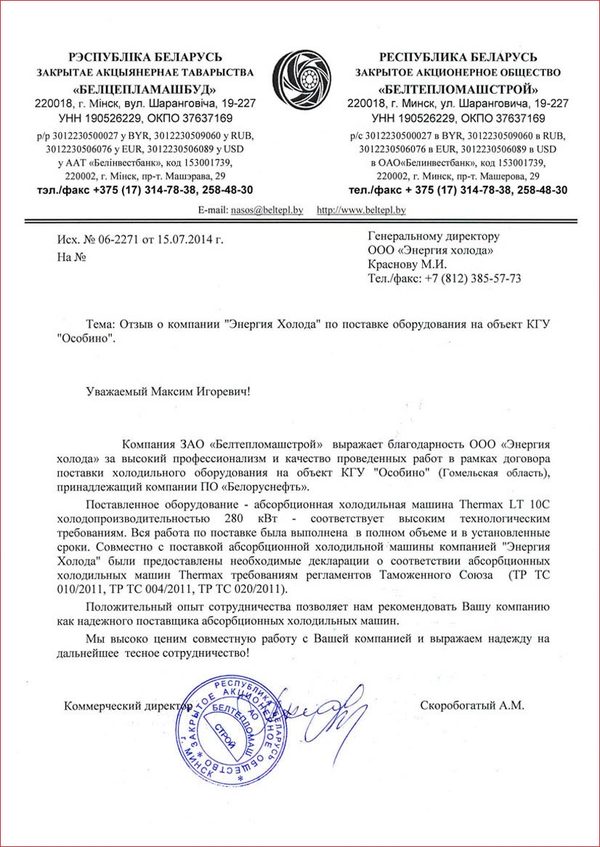
150 letters of thanks · 350+ major projects · 1,000+ customers · in business since 2011. These are real letters from customers; many others are on the references page.

Let us calculate trigeneration for your site
An engineer will put together the scheme and select the equipment, and you get a feasibility study. Free of charge, no obligation.