

Trigeneration with a gas engine
In brief. A gas engine with an absorption chiller gives electricity, heat and cooling from the same gas. About 40 % electricity and 40–45 % heat, 80–85 % in total versus 35–40 % for a gas engine without heat recovery.
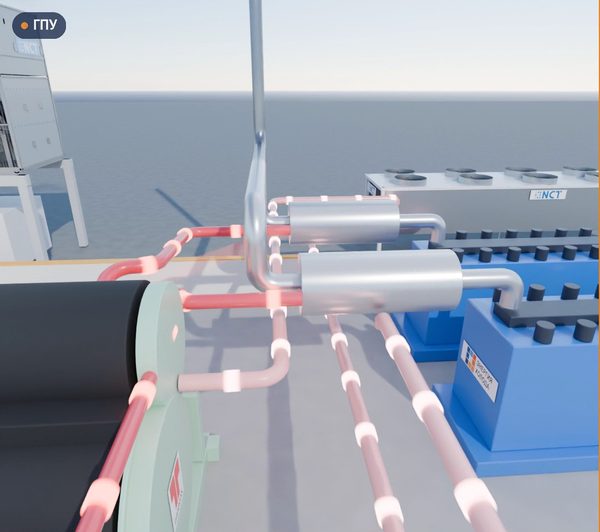
Trigeneration (CCHP) with a gas engine generator set works like this: the gas-fired engine generates electricity, and its heat is taken by a lithium bromide absorption chiller, which turns it into chilled water. From 1 MW of gas you get about 400 kW of electricity and about 450 kW of heat, 80–85 % in total. A gas engine without heat recovery uses 35–40 % of the fuel.
A comparison with other engines is on the page "Types of trigeneration", and the chiller design is in the article on the operating principle.
How much heat does a gas engine give?
The heat comes in two streams at different temperatures. The figures are from the catalog of technologies of the US EPA (2017).
| Heat source | Temperature | Share | What it is suitable for |
|---|---|---|---|
| Engine jacket water | hot water at about 90–110 °C, up to 130 °C with ebullient cooling | up to 30 % of fuel energy | single-effect LT and 5G chillers, heating |
| Exhaust gas | about 380–540 °C | 30–50 % of available heat | double-effect exhaust-fired chillers, heat recovery steam generator |
Together they give about 80 % of the fuel energy. The low-temperature circuit, from which steam cannot be obtained, accounts for 45–55 % of the engine heat.
This has a consequence. Hot water suits a single-effect chiller with a coefficient of performance (COP, how many kW of cooling you get from 1 kW of heat) of 0.65–0.80. Exhaust suits a double-effect chiller with a COP of 1.40–1.45, and from the same portion of heat it gives almost twice as much cooling.
What gas engine trigeneration schemes are there?
The choice depends on what the site needs: only cooling or heat as well, and how strictly the engine is limited in back pressure.
The classic: a gas engine and a hot-water absorption chiller
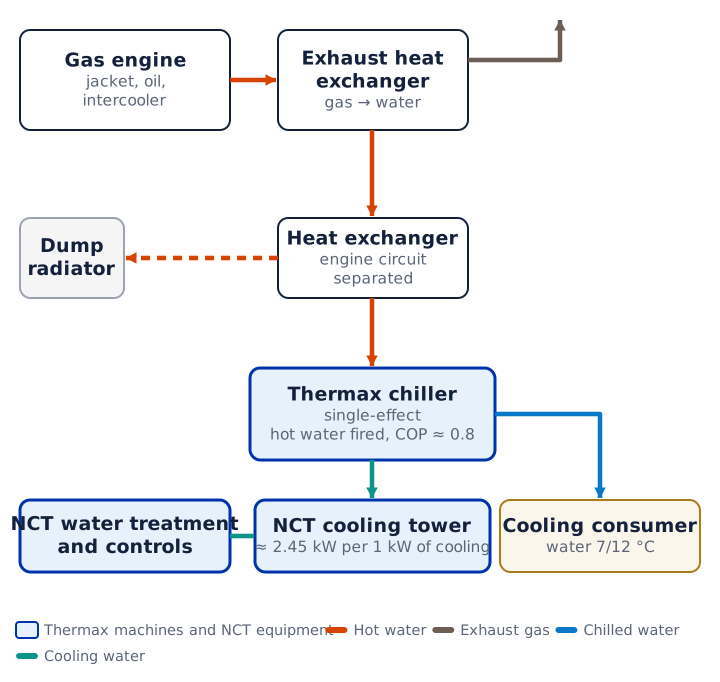
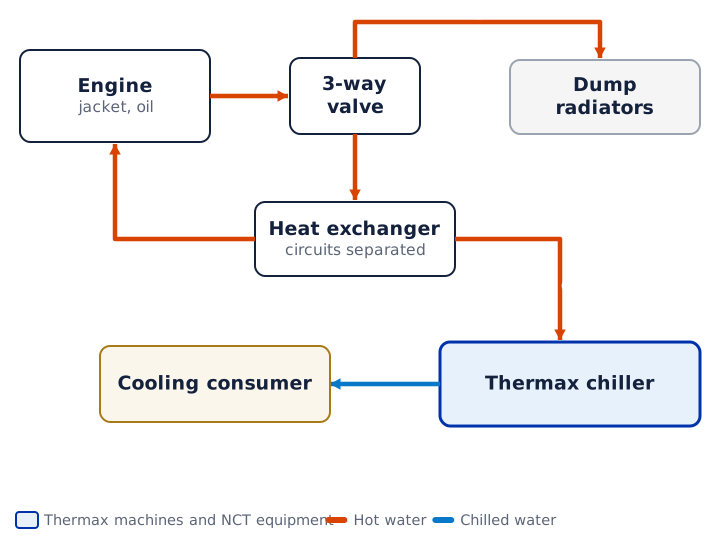
The engine jacket and the exhaust heat exchanger heat water to about 90 °C. Through a heat exchanger, it goes to the Thermax chiller, which supplies the consumer with 12/7 °C water and rejects heat to an NCT cooling tower. The excess is removed by emergency radiators. For the engine, this is the easiest scheme.
The price of simplicity: 1 MW of cooling needs about 1.4 MW of heat, and the cooling tower rejects 2.45 kW for every kW of cooling, twice as much as for a chiller with a COP of 5.
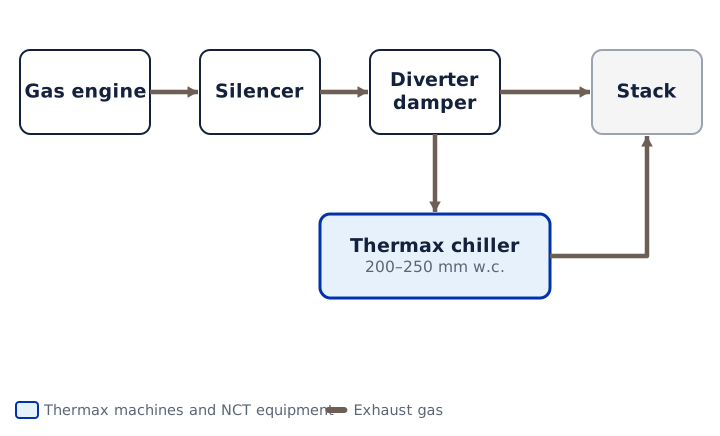
Exhaust straight into the chiller
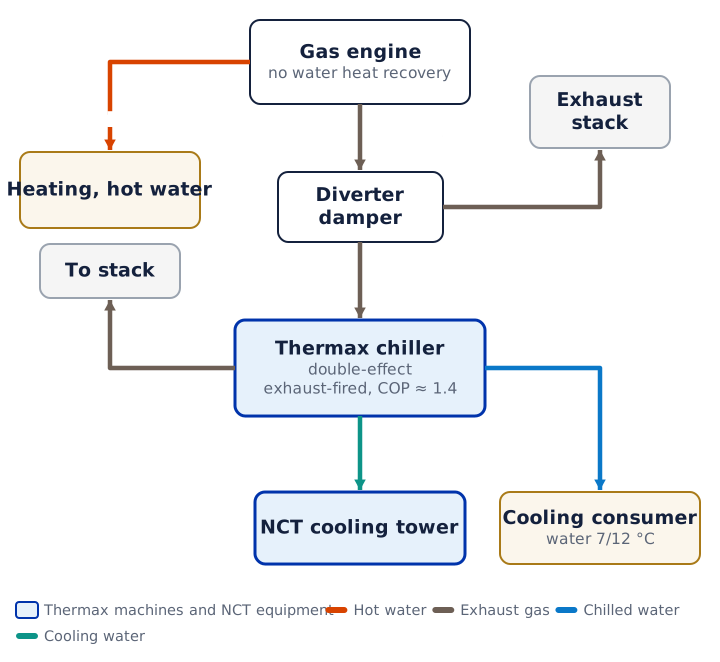
The exhaust is fed through a diverter damper into a double-effect 2D series chiller. If cooling is not needed, the damper sends the gas to the bypass, and the engine runs as usual. The jacket water goes to heating in the meantime. You can order a gas engine without the hot water recovery module and feed exhaust at about 400 °C into the chiller, but this takes experience: sometimes there is a lot of gas and little cooling demand, and the excess has to be sent to the bypass.
Trigenie: exhaust and jacket water in one chiller
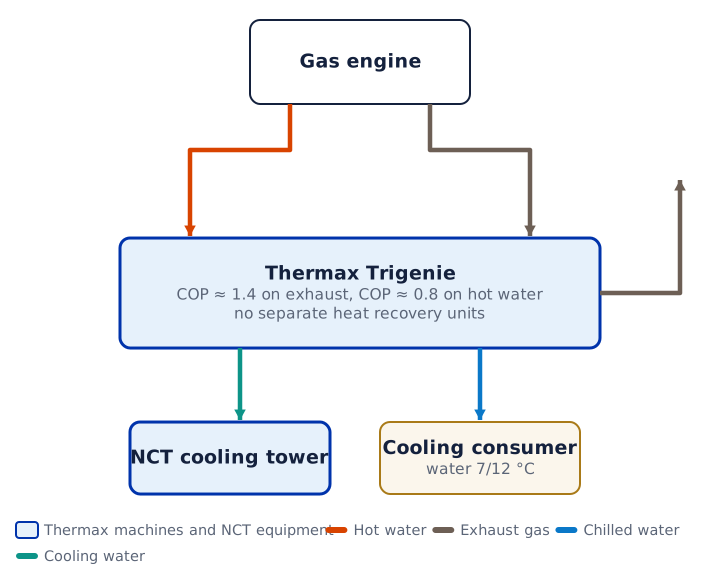
The Thermax Trigenie chiller takes the exhaust with a COP of about 1.4 and the jacket hot water with a COP of about 0.8. A separate generator for hot water gives better heat recovery at engine part load. One chiller can run on the exhaust of three engines without mixing the gases. According to the manufacturer, it recovers 12–15 % more exhaust heat than conventional heat exchange equipment.
Gas path: where back pressure is calculated
The chiller's gas-side pressure drop of 200–250 mm H2O is added to the exhaust ducts, damper and silencer. The total must not exceed the engine's allowable back pressure from its data sheet: the engine has priority. When the chiller stops or power is lost, the damper goes to bypass.
What about the jacket water circuit?
The return temperature to the engine is held by a three-way valve, and the engine circuit is separated from the chiller circuit by a heat exchanger. If the chiller does not take the heat, the valve sends it to the emergency radiators, and the engine keeps running.
Hot water modes differ between projects: 90/79, 88/80 or 90/75 °C. The control valve is installed at the chiller inlet: a valve at the outlet violates the manufacturer's instructions and leads to a warranty dispute.
Where does this scheme work?
Examples from our projects, among many others in the "Projects" section.
| Site | Engines | Thermax absorption chiller | Feature |
|---|---|---|---|
| Greenhouse complex, Sverdlovsk Region | 10 JMS 624 and 4 JMC 320, island mode | 2 × LT 12 C of 400 kW each, 8.5/3.5 °C | the first trigeneration plant for a greenhouse complex in Russia |
| Mikran research and production company, Tomsk | 1.7 MW gas engines | 2 × 5G 4L C of 1,100 kW each | transition period and low load |
| Omega Tower, Minsk | 2 Bosch gas engines | LT 18C, 500 kW | cooling for three buildings |
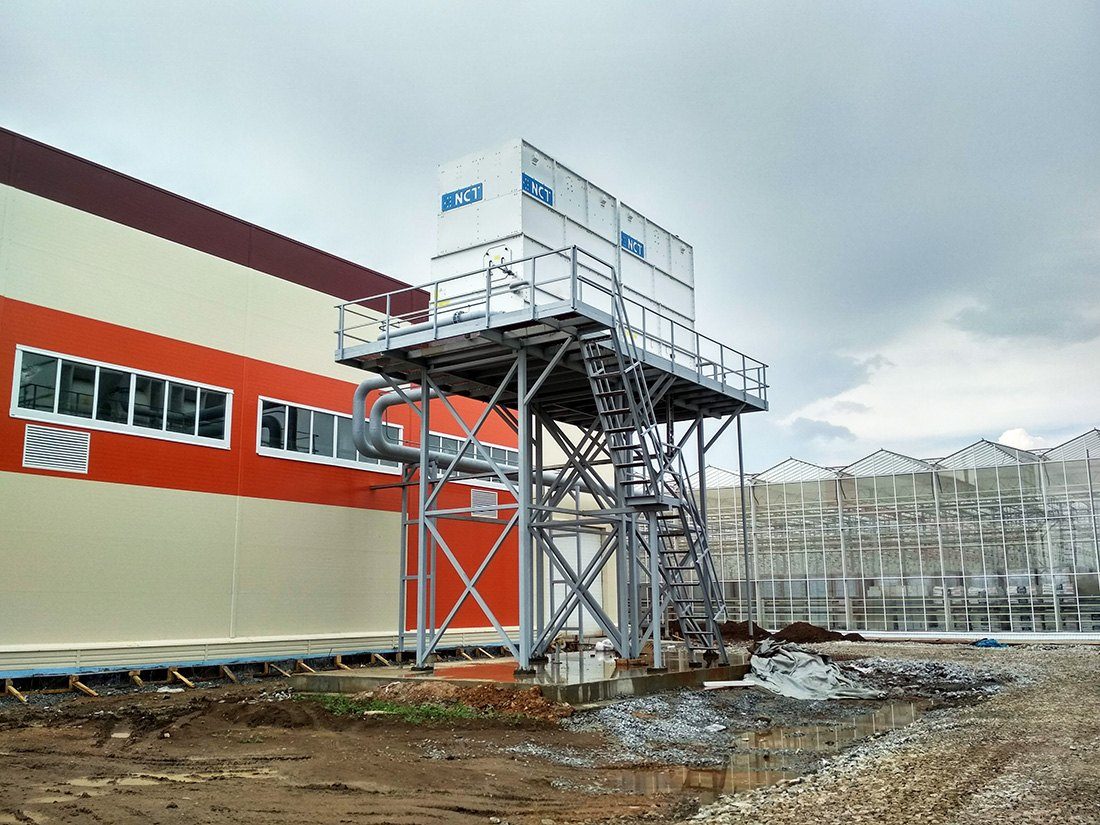
Teplichnoye. Island mode without the grid: the substation is far away, an electric chiller did not fit the available capacity, and the packing area needs water down to 3.5 °C. LT 12 C chillers were installed on waste water from the gas engines and the boiler house. The energy efficiency of the complex is up to 92 %, and the payback is 5 years. More: greenhouse complex.
Mikran. The main difficulty was coordinating the operation of the plant and the chillers during the transition period and at low load. The generator tubes in these chillers are stainless steel. Site page.
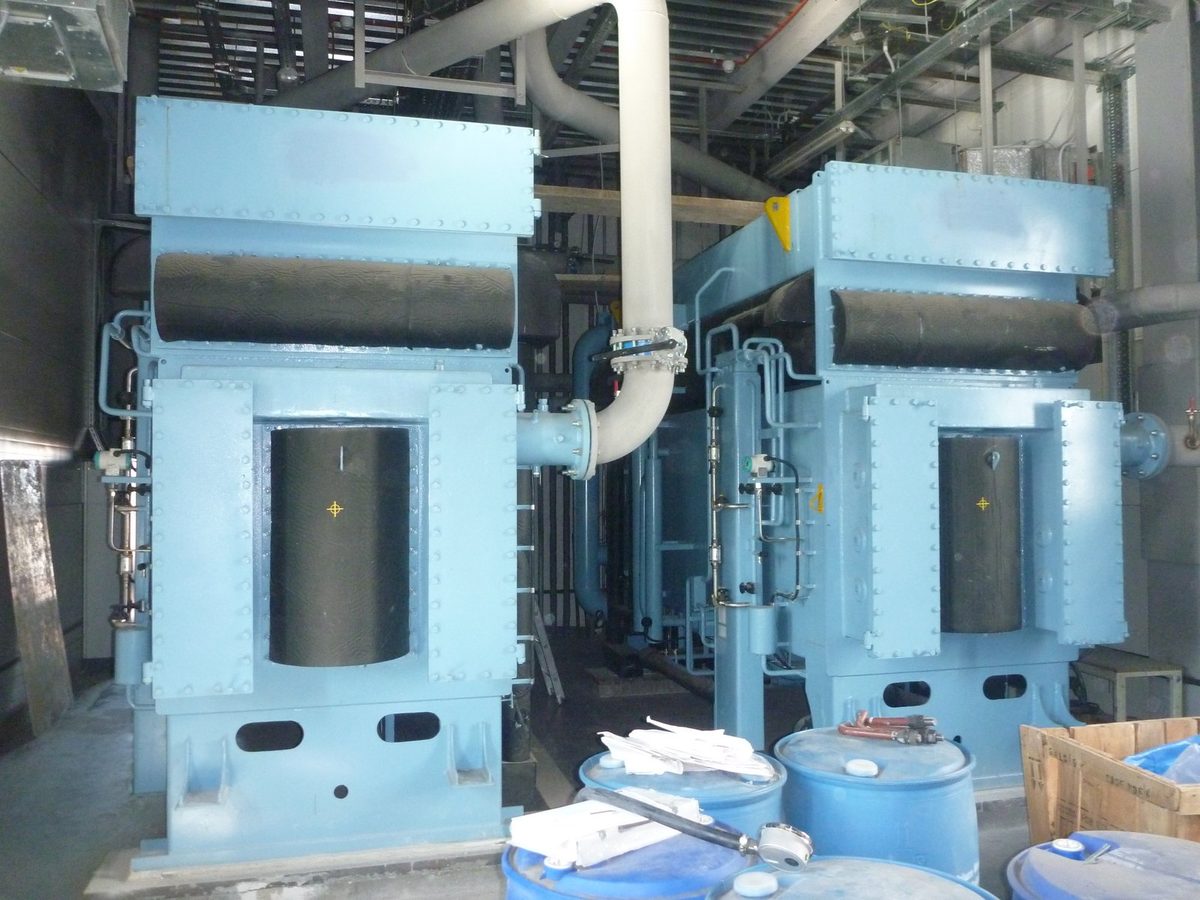
Heat for the chiller does not have to come directly from the engine. At the Smolensk academy, there is an MTU gas engine on site, but the hot water for two 5G 4L C chillers comes from the academy's boiler house.
As an example, without our participation. Moscow Region Government House: three Thermax LT 42 T chillers running on the heat of four Jenbacher JMS 620 engines with a total of 12 MW, started up in 2006. The site was built without Cold Energy; we show it only as an example of how the chillers work. Site page.
When does a gas engine with cooling not pay back?
-
Cooling is below 300 kW: at this level, a chiller is expensive per kW.
-
Cooling and heat are needed for less than 2,000 hours per year. The norm is 3,000–4,000 hours or more.
-
The engine capacity was selected by electricity, not by heat. In a survey of gas CHP owners in the UK (DECC, 2014), older schemes showed weak financial results precisely because of this.
-
The cooling tower and pumps were sized "as for a chiller": in the first hot summer, the chiller does not hold its capacity.
All the interfaces between generation and cooling are covered on the page "Why trigeneration does not pay back". If the engine and the cooling are split between different contractors, nobody owns these interfaces. Cold Energy (NCT) supplies gas engines: the gas engine, the cooling circuit with Thermax chillers, NCT chillers, cooling towers and dry coolers, and the interface between them can be ordered from one company. NCT equipment in general: colden.ru.
What a gas engine with cooling will give at your site is shown by a feasibility study, and you can make an estimate in the calculator.
Sources
- EPA, Catalog of CHP Technologies, September 2017: https://www.epa.gov/sites/default/files/2015-07/documents/catalog_of_chp_technologies.pdf
- DECC (UK), Factors affecting the uptake of gas CHP, December 2014: https://assets.publishing.service.gov.uk/media/5a7ef55240f0b62305b843e9/Factors_affecting_the_uptake_of_gas_CHP_Final_v6.pdf
- Thermax absorption chiller catalog, Thermax materials on Trigenie (manufacturer's data).
Frequently asked questions
What pressure drop is acceptable on the heat exchanger of an exhaust-fired absorption chiller? Will the engine get back pressure?
Engine heat exchangers allow about 500 mm H2O. If the chiller is designed for 500, the limit will be exceeded together with the bends, up to the point of damaging the pistons. That is why Thermax allows 250 mm for the chiller, and the rest is left for the duct run.
Why does a gas engine data sheet show several exhaust gas temperatures, and which one should be used to size the absorption chiller?
Because at lower load, less combustion energy goes into mechanical work and more into heat. The bmep 13.5 mark corresponds to 75 % load, and bmep 9 to 50 %. The calculation should be based on the real operating profile, not on a single line.
What our customers say
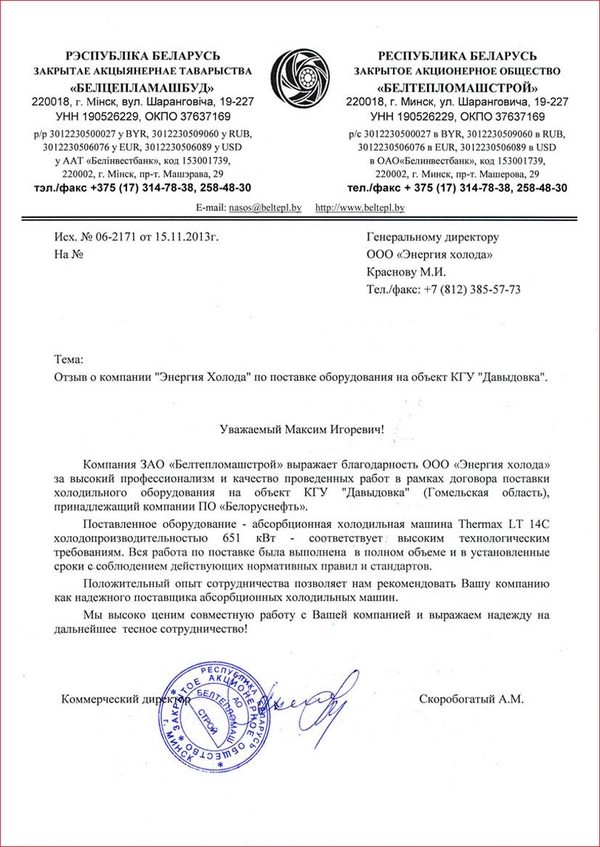
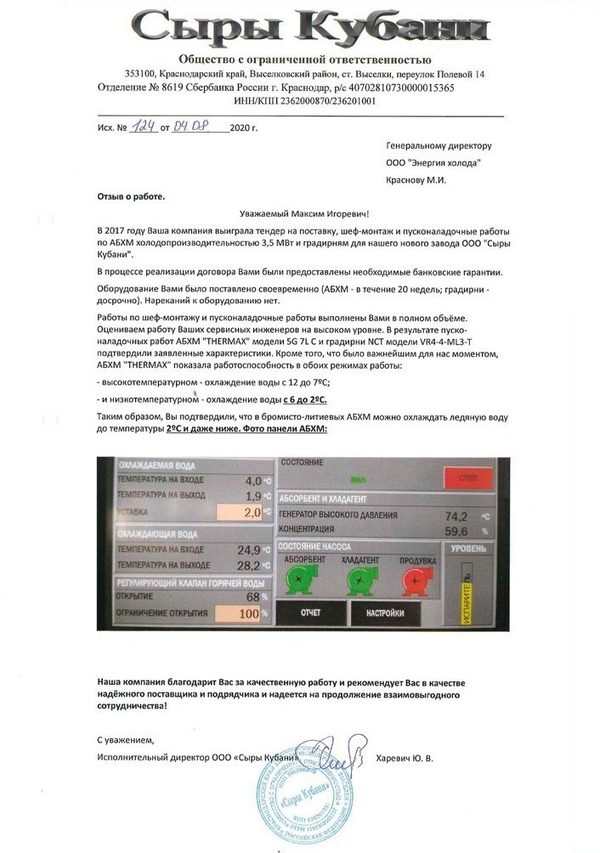
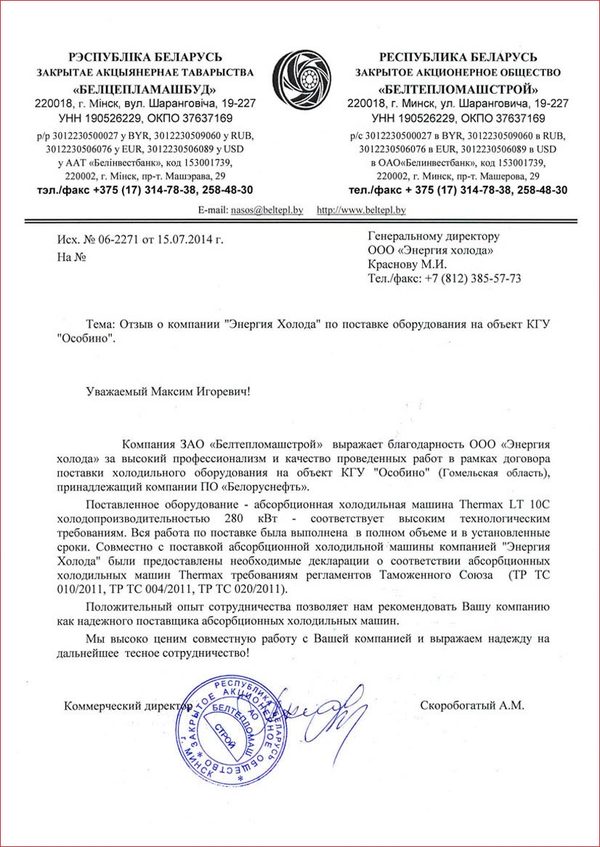
150 letters of thanks · 350+ major projects · 1,000+ customers · in business since 2011. These are real letters from customers; many others are on the references page.

Let us calculate trigeneration for your site
An engineer will put together the scheme and select the equipment, and you get a feasibility study. Free of charge, no obligation.