

Trigeneration on a Gas Turbine
In brief. A turbine gives off almost all its heat in the exhaust at 430–590 °C. It is sent to an exhaust-fired machine (COP about 1.4) or to a heat recovery steam generator, and the cooling can be fed to the inlet of the turbine itself.
A gas turbine suits trigeneration (CCHP) where megawatts of electricity and a steady year-round load are needed. In a turbine, heat is taken from the exhaust, and it is hot: about 430–480 °C in small industrial machines and up to 590 °C in large ones. It can be fed straight into an exhaust-fired lithium bromide absorption chiller (COP about 1.4), passed through a heat recovery steam generator to make steam, and the cooling from the absorption machine can be sent to the inlet of the turbine itself to give it back its capacity in hot weather.
For a comparison with other engines, see the page "Types of trigeneration"; for smaller machines, up to 10 MW, a gas engine is more often the right choice.
How does a gas turbine differ from a gas engine?
According to the EPA technology catalog (2017):
| Parameter | Gas turbine | Gas engine |
|---|---|---|
| Electrical efficiency | 24–36 % | 27–41 % |
| Overall efficiency with heat recovery | 66–71 % | 77–80 % |
| Typical capacity | 0.5–300 MW, economical from 5 MW | up to 10 MW |
| Part load | poor | acceptable |
Other figures: start-up time from 10 minutes to an hour (about 10 seconds for a gas engine), 25,000–50,000 operating hours before overhaul, availability 93–96 %. The electricity to heat ratio is 0.6–1.1.
For trigeneration this means: a turbine is installed where it runs close to full load and heat is always needed. If the load fluctuates, turbine efficiency drops faster than that of a reciprocating engine, and the cooling becomes irregular.
What gas turbine schemes are there?
Exhaust straight into the machine
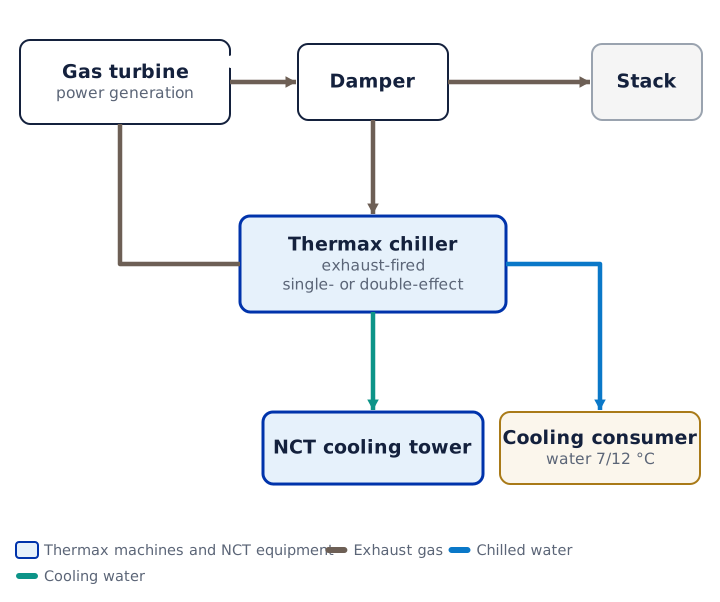
Turbine exhaust is fed through a damper into a double-effect exhaust-fired Thermax machine. When little cooling is needed, the gas goes to the bypass and the turbine runs as usual. The machine supplies chilled water to the consumer and rejects heat to an NCT cooling tower. The machine's gas-side resistance of 200–250 mm H2O has to be added to the flue duct and silencer and compared with the turbine's allowable back pressure: the turbine has priority.
Heat recovery steam generator: steam and hot water
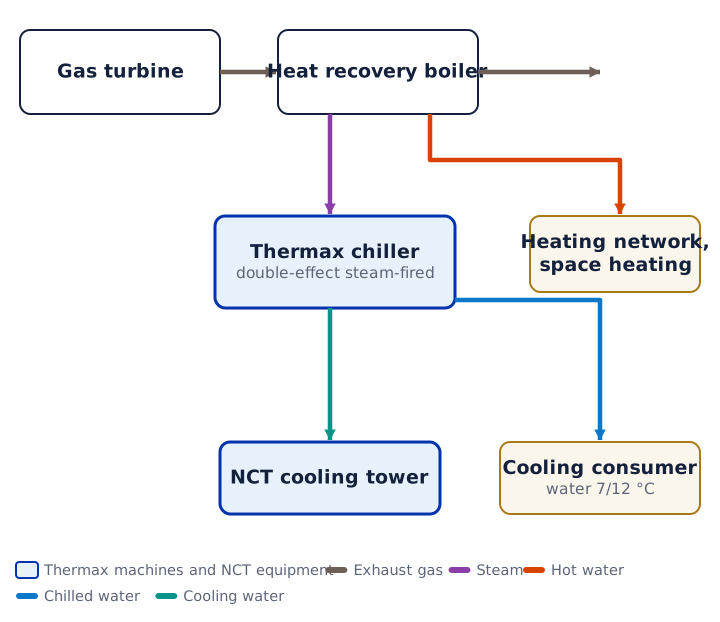
A heat recovery steam generator is installed after the turbine. It provides steam for a steam-fired Thermax machine and hot water for the heating network. One source covers both heat and cooling. More about this scheme on the page "Steam". A double-effect steam machine gives a COP of 1.30–1.45; it needs dry saturated steam at 1.4–9.9 bar.
Cooling at the turbine inlet
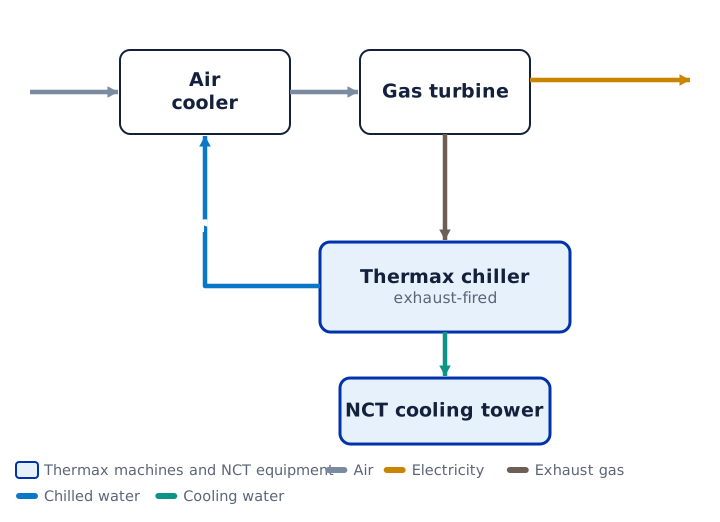
In hot weather a gas turbine loses capacity. The exhaust drives an absorption machine, and its chilled water cools the air at the compressor inlet. In summer the electrical output rises thanks to the turbine's own waste heat.
Our site: the ZhGTES gas turbine power plant
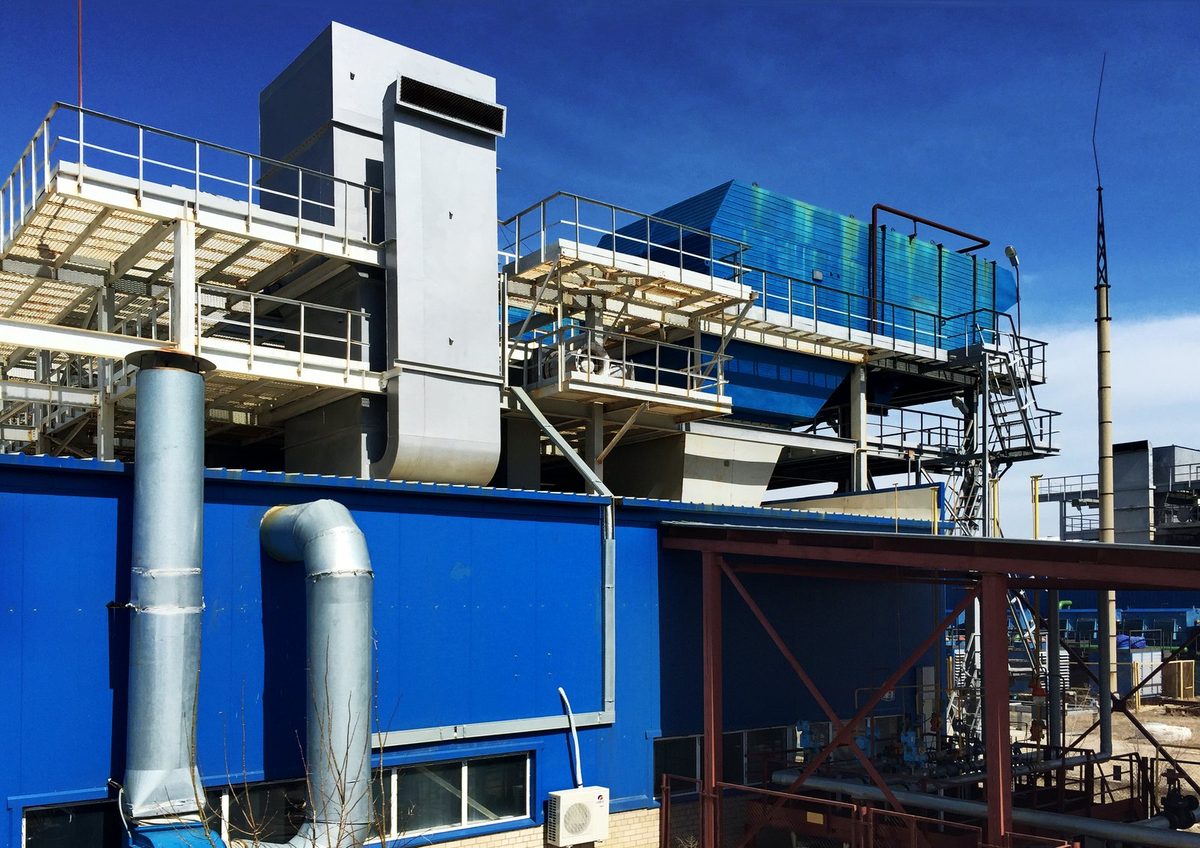
The Zhanazhol gas turbine power plant (ZhGTES) in Kazakhstan (Aktobe) has a total capacity of 110 MW and runs on associated petroleum gas. We supplied an exhaust-fired Thermax 2D 5M C machine with a cooling capacity of about 3.2 MW, water 15/8 °C. It cools the air at the inlet of the gas turbine units: output rises and stops depending on the outdoor air temperature. Our scope: supply, installation supervision, commissioning. We do not state a figure for the capacity gain, as we have no measurements.
The video "Thermax absorption chiller installed at a gas turbine power plant in Kazakhstan" is on Rutube (in Russian). Site card: ZhGTES.
What examples are there worldwide?
| Site | Turbine | What was done | Result |
|---|---|---|---|
| Domain, Austin, USA, 2004 | Solar Centaur 50, 4.5 MW | exhaust-fired double-effect chiller of about 2,500 tons, no heat recovery steam generator | overall efficiency at full load over 80 %, 74 % on average according to monitoring |
| California State University, Fullerton, USA | Solar Mercury 50, about 4.5 MW | 2 × 1,310 tons, about 9.2 MW of cooling, exhaust at 375 °C | exhaust gives 56 % of the cooling, supplementary gas firing another 44 % |
| 29 Palms military base, USA | Solar Mercury 50, 4.6 MW | hot water at 176.6/160 °C via an exhaust heat exchanger, 2 × 650 tons | savings of 1.6 million kWh per year |
| BYU-Idaho University, USA | 4.5 MW gas turbine | heat recovery steam generator, 1,000-ton steam turbine chiller | up to 45 % of the exhaust goes to bypass on hot days |
Domain cools about 1 million sq ft (roughly 93,000 m²). For comparison, the average efficiency of a power plant with transmission over the grid in the same report is 32 %. At the Fullerton campus, trigeneration cost USD 22 million, and the campus generates about half of its own electricity. Turbine and cooling capacity at Fullerton are given with a small discrepancy in different documents, so the figures are rounded.
BYU-Idaho is in the table as a lesson: up to 45 % of the exhaust is dumped on hot days and 22 % over a normal year. It is in summer that there is not enough heat load, and for the surplus a steam turbine chiller was chosen instead of an absorption one, while the budget grew from USD 2.5 million to more than USD 3.3 million.
What do you need to know before the project?
-
Delivery time. According to Wood Mackenzie data for 2025, the average delivery time for a gas turbine is almost 5 years from order, with a reduction expected from 2027. If the turbine has not been bought yet, the schedule is driven by it, not by the cooling.
-
Back pressure. The sum of the resistances of the machine, flue ducts, damper and silencer must not exceed what the turbine allows according to its datasheet. Exhaust data are taken from the turbine datasheet at 100, 75 and 50 % load.
-
Bypass. The damper must go to bypass when the machine stops and when power is lost: the turbine has priority.
-
Backup. The machine needs about 30 minutes to reach operating mode; it survives a power loss of up to 3 minutes, and a longer one requires a dilution cycle. If cooling is needed without interruption, an NCT chiller or a storage tank is included.
All these interface points are described on the page "Why trigeneration fails to pay back". Cold Energy (NCT) is responsible for the cooling circuit and its interface with the turbine; we take the exhaust data from the turbine datasheet. Exhaust-fired machines are described on the Thermax absorption chiller and Trigenie pages.
Want to know what turbine inlet cooling would give at your plant? Order a feasibility study or run the numbers in the calculator.
Sources
- EPA, Catalog of CHP Technologies, September 2017: https://www.epa.gov/sites/default/files/2015-07/documents/catalog_of_chp_technologies.pdf
- ORNL, Berry et al., Advanced absorption chiller converts turbine exhaust to air conditioning, ISHPC 2005: https://webarchive.library.unt.edu/web/20080920092112id_/http://www.ornl.gov/sci/engineering_science_technology/cooling_heating_power/pdf/ISHPC-095-2005.pdf
- Merrick (BYU-Idaho), Elsner (RMH Group), From Cogen to Trigen, APPA RMA 2019: https://rma.appa.org/wp-content/uploads/2019/09/RMA-2019_1-4-From-Cogen-to-Trigen.pdf
- Manufacturing Dive, 24 February 2026 (Wood Mackenzie, Jefferies): https://www.manufacturingdive.com/news/natural-gas-equipment-generation-bottleneck-data-centers/813087/
- Thermax materials on trigeneration projects (Fullerton, 29 Palms).
Frequently asked questions
Can an old absorption chiller be replaced with a new exhaust-fired one with a backup burner?
Yes, the factory selects such a machine from the site data. A burner is needed if the turbine may be down while cooling is still required. The old flue duct is rechecked, since it was designed for a different machine. The gas consumption and electrical power of the burner (0.75–15 kW depending on the model) are written into the specification from the start; otherwise you may be refused the allocation after the design is already done.
How much can we cool the air at the turbocompressor intake if we have surplus steam?
First the cooling is calculated: a double-effect machine takes dry saturated steam at about 1.08 kg/h per 1 kW, so one ton per hour gives roughly 0.9 MW (calculated). With steam up to 3.5 bar you get half as much. How many degrees this cooling removes depends on the air flow. You need the initial and target temperatures, and the steam pressure and flow. Superheat must not exceed 10 °C.
What our customers say
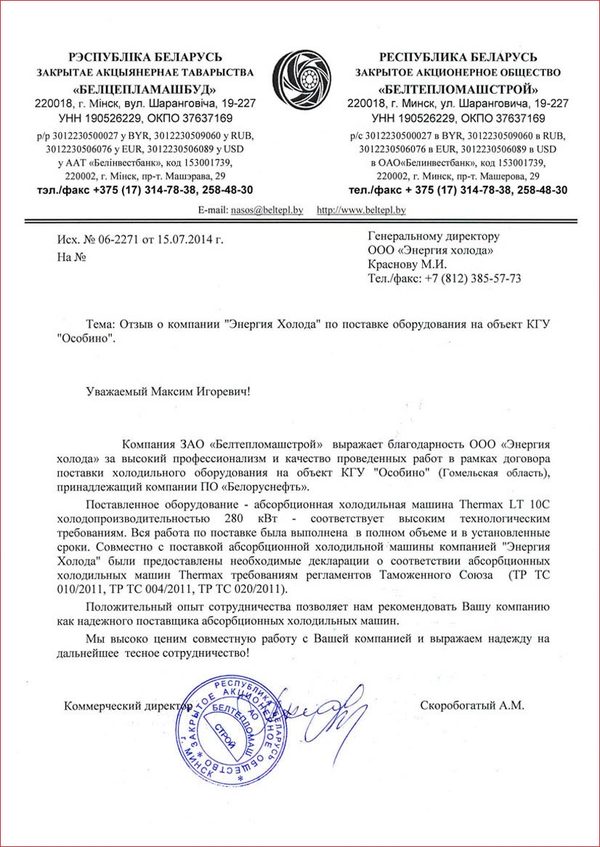
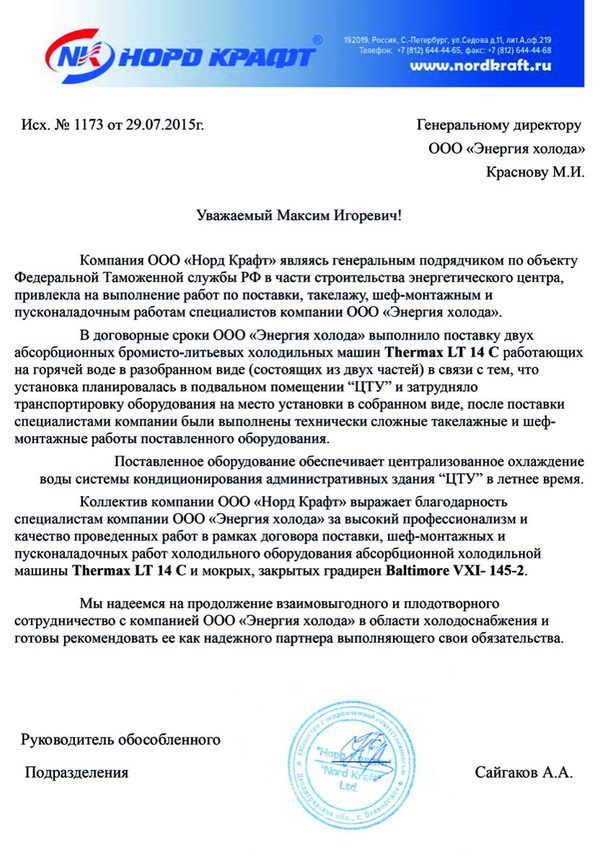
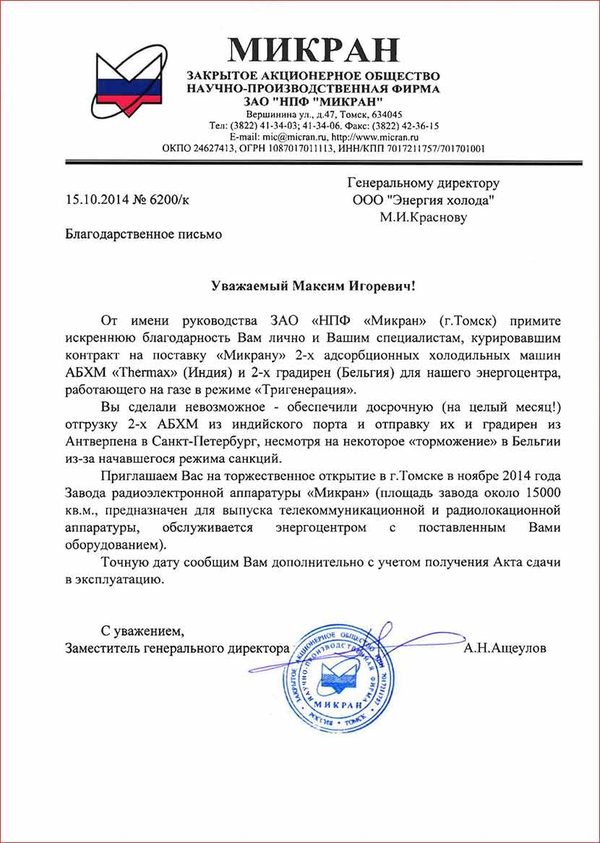
150 letters of thanks · 350+ major projects · 1,000+ customers · in business since 2011. These are real letters from customers; many others are on the references page.

Let us calculate trigeneration for your site
An engineer will put together the scheme and select the equipment, and you get a feasibility study. Free of charge, no obligation.