

Steam, heat recovery steam generator and steam-fired absorption chiller
In brief. If a plant needs steam, the engine or turbine exhaust goes to a heat recovery steam generator, and the steam drives a steam-fired absorption chiller. A double-effect machine gives a COP of 1.30–1.45, which is about 0.9 MW of cooling per ton of steam per hour.
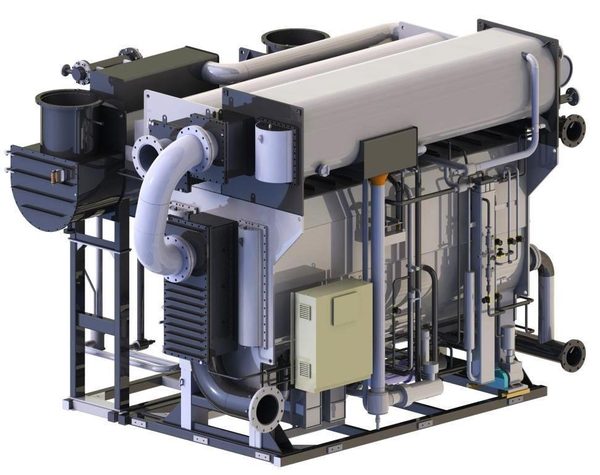
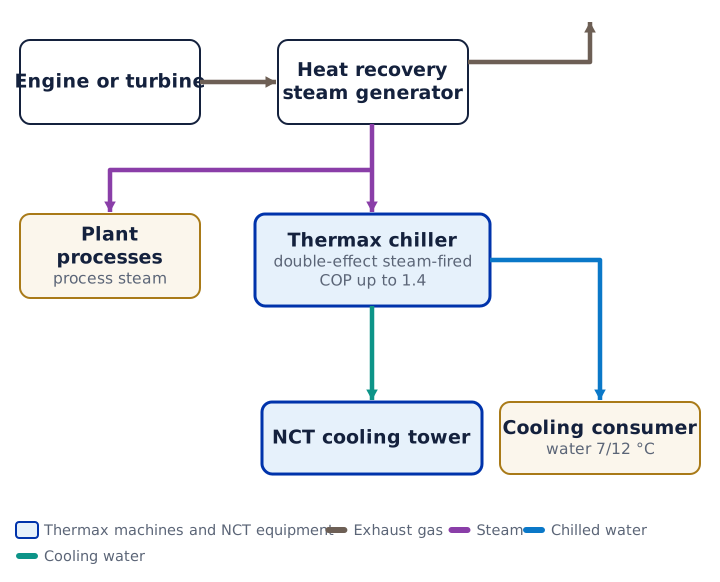
Steam trigeneration (CCHP) works like this: the engine or turbine exhaust goes to a heat recovery steam generator, and its steam is split between the plant's processes and a steam-fired lithium bromide absorption chiller. The scheme is needed when the plant requires steam anyway. A double-effect Thermax steam machine gives a coefficient of performance (COP, how much cooling from 1 kW of heat) of 1.30–1.45, which means one ton of steam per hour turns into roughly 0.9 MW of cooling. A low-pressure single-effect machine gives half as much.
The overall picture by engine type is on the "Types of trigeneration" page. How to make cooling from hot water without steam is covered on the gas engines and gas turbines pages.
Where does the steam come from and when is it needed?
A gas engine generator set can produce steam only from the exhaust: according to the EPA catalog, gas engine exhaust gives steam up to 400 psig (about 28 bar), while the jacket heat is low-temperature and cannot produce steam. A gas turbine produces steam with a high-pressure heat recovery steam generator. A steam turbine runs in back-pressure or extraction mode and needs a boiler itself.
The practical conclusion: steam is justified if the processes already consume it. If not, it is simpler to use the engine jacket hot water (single-effect machine) or the exhaust directly (exhaust-fired double-effect machine): you will not have to build a boiler just for cooling.
What steam schemes are there?
Gas engine: steam from a heat recovery steam generator
The engine exhaust passes through a heat recovery steam generator. The steam goes to the plant's processes and to a double-effect Thermax steam machine. This suits a plant that needs steam.
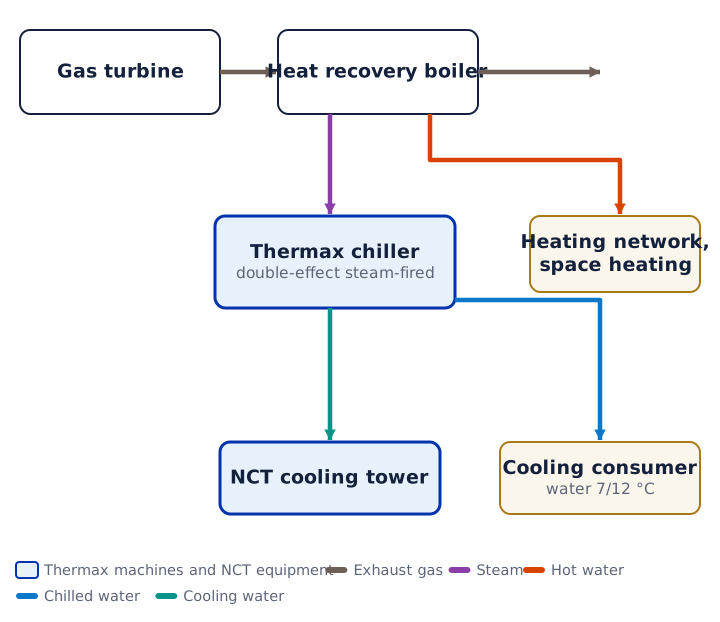
Gas turbine: heat recovery steam generator, steam and district heating
A heat recovery steam generator is installed after the turbine. It supplies steam to a Thermax steam machine and hot water to the heating network. This way one source covers both heat and cooling.
What Thermax steam machines are there?
| Series | Capacity, kW | COP | Steam |
|---|---|---|---|
| SS, single-effect | 440–6,689 | up to 0.75 | up to 3.5 bar |
| SD, double-effect | 426–6,654 | up to 1.43 | 3–10 bar (gauge) |
| 2B, double-effect | 422–8,793 | 1.30–1.45 | 1.4–9.9 bar, rated 8 kgf/cm² |
| Triple-effect | 350–3,500 | 1.8 | 10–25 bar |
Steam consumption: about 1.08 kg/h per 1 kW of cooling for a double-effect machine, about 2.4 kg/h for a single-effect one. Chilled water is standard down to +1 °C (down to −2 °C with glycol), cooling water from 10 °C. Details on the series are on the Thermax absorption chillers page.
What is required of the steam and condensate?
A steam machine is more demanding of its piping than a hot water machine. Typical design mistakes:
-
The steam is not dry. Dry saturated steam with a dryness fraction of 0.99 is needed, while boilers give 0.95–0.97. At 0.95, about 4.2% of the heat is lost, and the valve seat operates at its limit. A separator with its own steam trap is needed upstream of the strainer and valve.
-
Superheat above 10 °C. A desuperheater with automatic control is needed; otherwise there is erosion and the operating mode is disrupted.
-
The steam trap is sized by the nozzle diameter. It should be sized for the steam flow with a 1.5 times margin and installed at least 0.3 m below the generator outlet, with a vacuum breaker. Otherwise condensate accumulates in the generator and causes water hammer.
-
Condensate is dumped to the sewer. An example from the method: 3,499 kg/h of condensate at 90 °C versus make-up at 10 °C is a loss of 326 kW of heat and 3.5 tons of treated water per hour. Condensate is returned. Returning it at 130 °C instead of 90 °C increases steam consumption by about 8%.
-
Start-up. The steam valve is opened gradually over the first 10 minutes. With a 21 kPa drop across an unrestricted valve, the machine takes 50% more steam than rated, and the boiler house must be warned.
Steam above 0.07 MPa falls under pressure equipment rules (FNP ORPD), which are separate Rostekhnadzor requirements. The other mistakes at the interface between generation and cooling are covered on the "Why trigeneration does not pay off" page. Cold Energy (NCT) is responsible for the cooling circuit and its interface with the heat source.
Where do we have a steam-fired machine in operation?
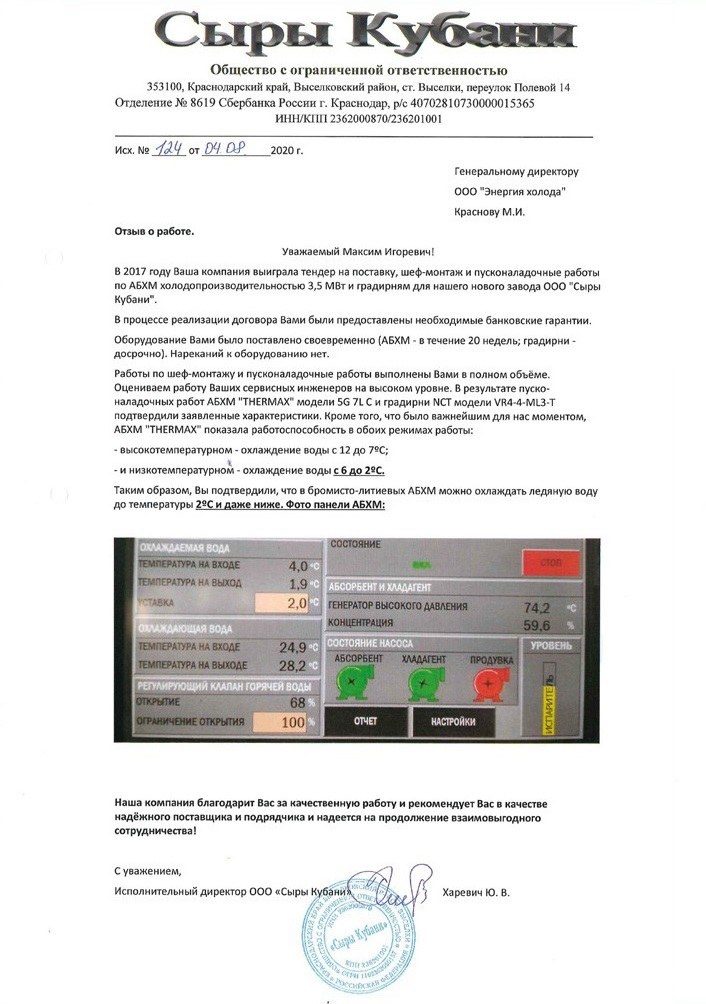
The Syry Kubani cheese plant in Krasnodar Territory, one of our many facilities: a steam-fired Thermax absorption chiller, 3,500 kW, 12/7 and 6/2 °C modes. The plant needs chilled water for its processes. The plant's letter confirms an outlet temperature down to 2 °C and the characteristics stated at commissioning; the machine was delivered in 20 weeks. The plant's energy center has four MTU gas engines of 1,948 kW each. Where the steam comes from is not described here. Project card and video on Rutube (in Russian).
What steam examples are there worldwide?
| Facility | Steam source | Machines | Result |
|---|---|---|---|
| Moser Baer, India | heat recovery steam generators on Wartsila engines | steam and jacket water machines, about 21 MW of cooling | named in Thermax materials as one of the largest in India |
| Doherty engineering office, Canada | 4.6 MW gas turbine, 8 bar steam | 180 tons on hot water and 370 tons on steam | plant efficiency about 90%, savings of 3,373 MWh per year |
| Forum district, Barcelona | steam from a waste incineration plant | two machines of 4.5 MW of cooling each | district cooling, not trigeneration in the classic sense |
In Barcelona, 4 electric chillers work together with the steam machines, and a 20 MW gas boiler serves as a backup. A 5,000 m³ chilled water tank smooths out the peaks. The project dates from 2004; the data are stated by the operators themselves. A steam machine does not have to sit on an engine: any cheap steam will do.
Want to find out whether your plant has steam for cooling? Order a feasibility study or calculate it in the calculator. Steam machines, NCT equipment and piping are collected on colden.ru.
Sources
- EPA, Catalog of CHP Technologies, September 2017: https://www.epa.gov/sites/default/files/2015-07/documents/catalog_of_chp_technologies.pdf
- DOE, Absorption Chillers for CHP Systems, DOE/EE-1608, May 2017: https://www.energy.gov/sites/prod/files/2017/06/f35/CHP-Absorption%20Chiller-compliant.pdf
- Construction21, Districlima, Barcelona: https://www.construction21.org/espana/city/h/districlima-urban-network-of-heat-and-cold-in-barcelona-and-sant-adria-de-besos.html
- Thermax absorption chiller catalog; Thermax materials on trigeneration projects (Moser Baer, Doherty).
What our customers say
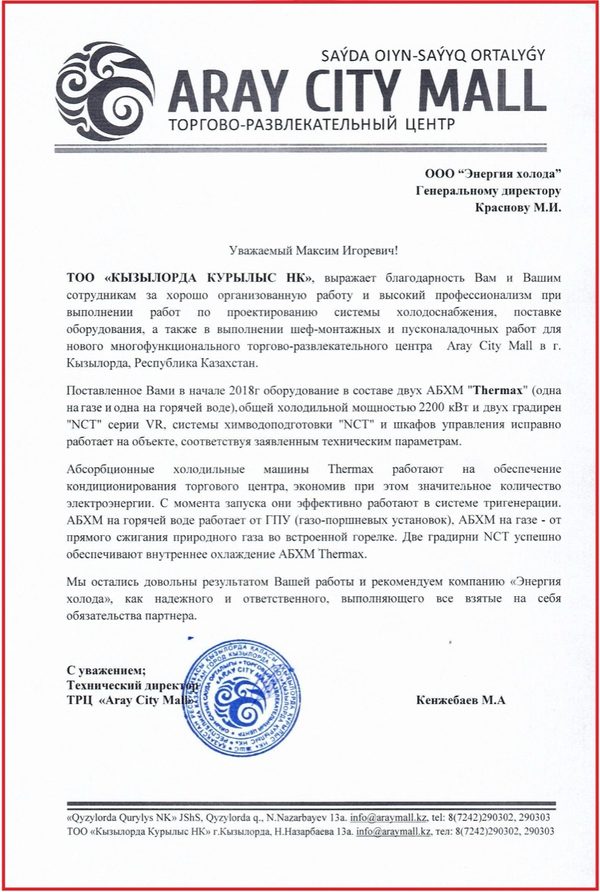
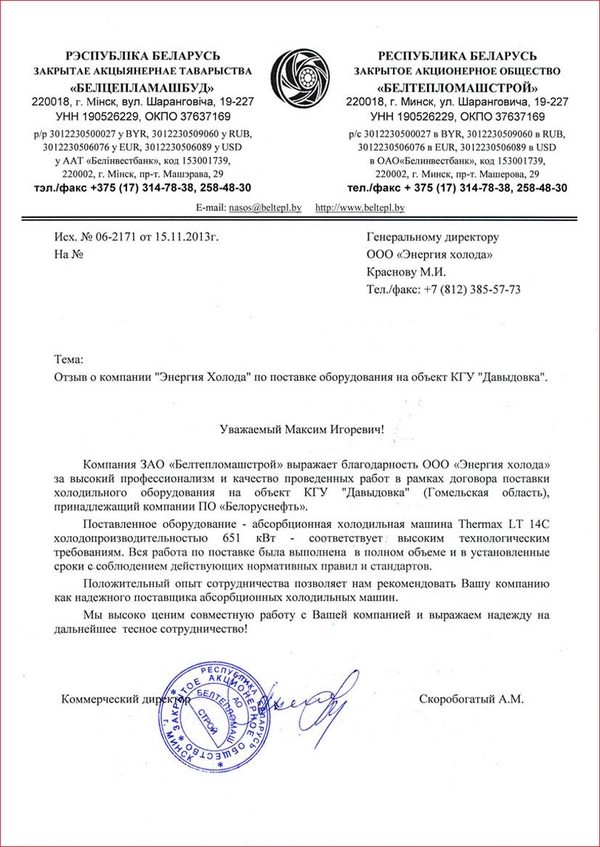
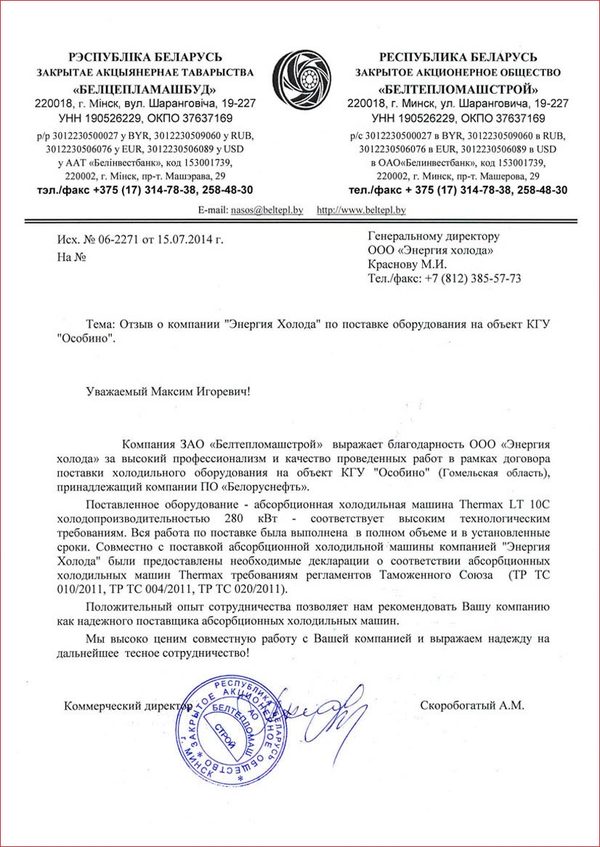
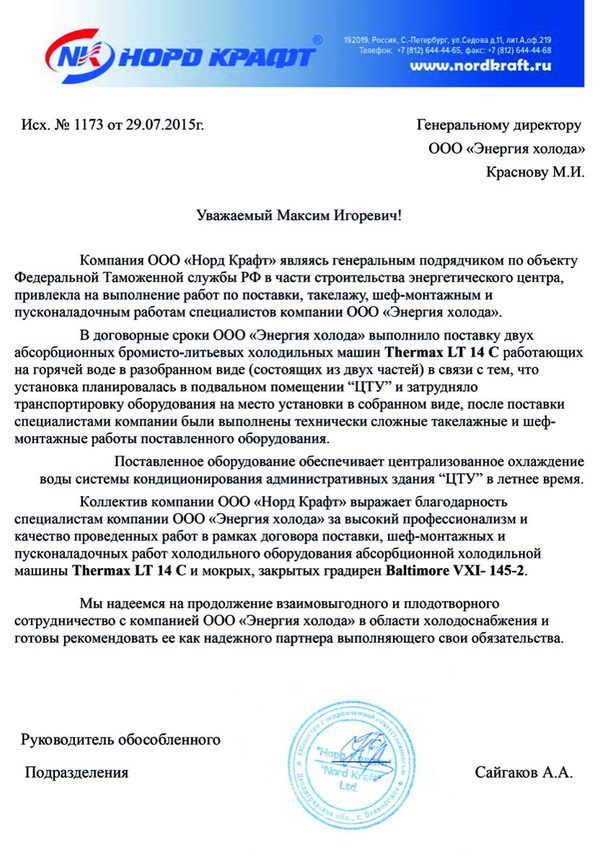
150 letters of thanks · 350+ major projects · 1,000+ customers · in business since 2011. These are real letters from customers; many others are on the references page.
Let us calculate trigeneration for your site
An engineer will put together the scheme and select the equipment, and you get a feasibility study. Free of charge, no obligation.