

Diesel power plant with heat recovery and cooling
In brief. A diesel plant can also make cooling. The exhaust goes to a heat recovery boiler, and hot water or steam drives an absorption chiller. This scheme is needed where there is no gas but the power plant runs many hours.
A diesel power plant can also produce cooling: the engine exhaust goes to a heat recovery boiler, and hot water or steam drives a lithium bromide absorption chiller. It suits sites where there is no gas and the power plant runs many hours a year. The technology catalog of the US Environmental Protection Agency (EPA) classifies diesel engines as reciprocating engines: their electrical efficiency and total efficiency with heat recovery are the same as for gas engine generator sets, 27–41 % and 77–80 %. High-speed diesels are made up to 4 MW, low-speed diesels up to 80 MW.
First look at the "Types of trigeneration" page with its comparison of engines. If you have gas, read about gas engines: the schemes there are more detailed.
How does a diesel-based scheme work?
Diesel generator sets send their exhaust to heat recovery boilers. Hot water or steam goes to Thermax chillers. Engine jacket water can also drive one of the chillers. Heat that would otherwise be lost becomes cooling.
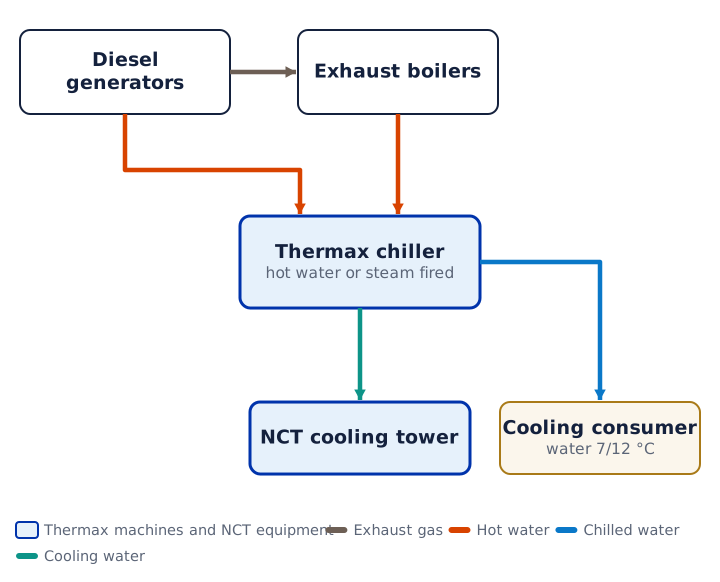
The chiller is selected for the type of heat. Hot water: single-effect LT and 5G with a COP of 0.65–0.80. Steam: double-effect SD and 2B with a COP of 1.30–1.45. The consumer gets chilled water, and the chiller's heat is rejected by an NCT cooling tower or dry cooler.
What are the pros and cons of diesel?
According to the EPA catalog, diesel engines have both strengths and weaknesses.
| Pros | Cons |
|---|---|
| low engine cost | relatively high emissions |
| good load following | the engine has to be cooled even when the heat is not used |
For trigeneration (CCHP) the last point is decisive: if cooling is not needed, the heat still has to go somewhere, so the scheme must have emergency radiators.
What examples are there around the world?
These are Thermax projects based on its materials, as examples among many others.
| Site | Engines | Heat for the chillers | Cooling |
|---|---|---|---|
| Moser Baer, India (optical discs) | 5 Wartsila engines | steam from heat recovery boilers and jacket water | about 21 MW, process and air conditioning |
| IT park in Bangalore, India | Wartsila and Caterpillar, 5 engines in total | hot water from five heat recovery units | 2 chillers of 1,200 tons each, about 8.4 MW |
| Business park in Jeddah, Saudi Arabia | 8 diesels of 2 MW each | jacket and exhaust, hot water at 104/87.8 °C | 3 chillers of 700 tons each, about 7.4 MW |
| Infosys IT campus, India | 3 diesels of 1.6 MW each | hot water at 175/155 °C from a heat recovery unit | 395 tons, about 1.4 MW |
In Jeddah the savings compared with electric chillers came to 5.1 million kWh per year and 5,300 t less CO2 per year. At Infosys: savings of 2.3 million kWh per year and 3,200 t less CO2. In Thermax materials, Moser Baer is named as one of the largest installations of its kind in India, and the IT park in Bangalore received an Asian Power Awards 2007 award as the "Best Decentralized Plant." The fuel is called diesel in some documents and heavy fuel oil in others, so the exact fuel type is not stated on this page. The figures for Moser Baer are taken from the project table, not from the text of the same document, which gives a different, much larger capacity.
How to read the Infosys scheme?
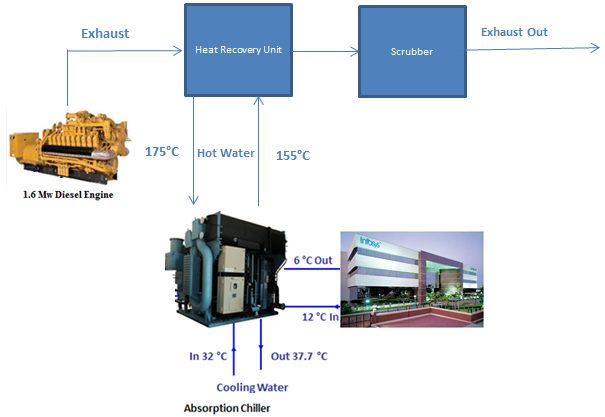
The scheme is taken from Thermax project materials and labeled in English. The exhaust of a 1.6 MW diesel engine goes to the Heat Recovery Unit, then to the Scrubber and to the stack (Exhaust Out). Hot Water leaves the unit at 175 °C and returns at 155 °C. It heats the Absorption Chiller. Cooling Water goes to the chiller at 32 °C and returns at 37.7 °C. Chilled water goes to the building: on the scheme, 12 °C at the inlet and 6 °C at the outlet.
When is diesel not suitable?
If gas is available nearby, look at the schemes on the gas engines page: diesel has higher emissions. Diesel is justified when there is no gas, but a power plant is needed anyway and runs many hours. The guideline for the absorption part is the same: cooling of 300 kW or more and 3,000–4,000 hours a year or more; with fewer than 2,000 hours it does not pay back. Mistakes at the interface between the engine and the cooling are covered on the "Why trigeneration does not pay back" page, and Cold Energy (NCT) is responsible for this interface and the cooling circuit. The list of Thermax chillers is on the Thermax absorption chillers page, and a feasibility study will calculate the payback for your operating hours.
Want to check whether the heat of your diesel plant can give you cooling? Order a feasibility study or run the numbers in the calculator.
Sources
- EPA, Catalog of CHP Technologies, September 2017: https://www.epa.gov/sites/default/files/2015-07/documents/catalog_of_chp_technologies.pdf
- Thermax materials on trigeneration projects (Moser Baer, IT park in Bangalore, CES Energy, Infosys).
Frequently asked questions
Can the heat of diesel generator sets be used in an absorption chiller to cool computing equipment?
Yes, but computing loads come with a condition: the chiller takes about 30 minutes to reach its operating mode, and the racks cannot wait that long. You need a chilled water storage tank or a backup chiller for 5–20 % of the load nearby. If the racks can take warmer water than usual, the chiller can be smaller: every degree above 7 °C adds capacity.
What our customers say
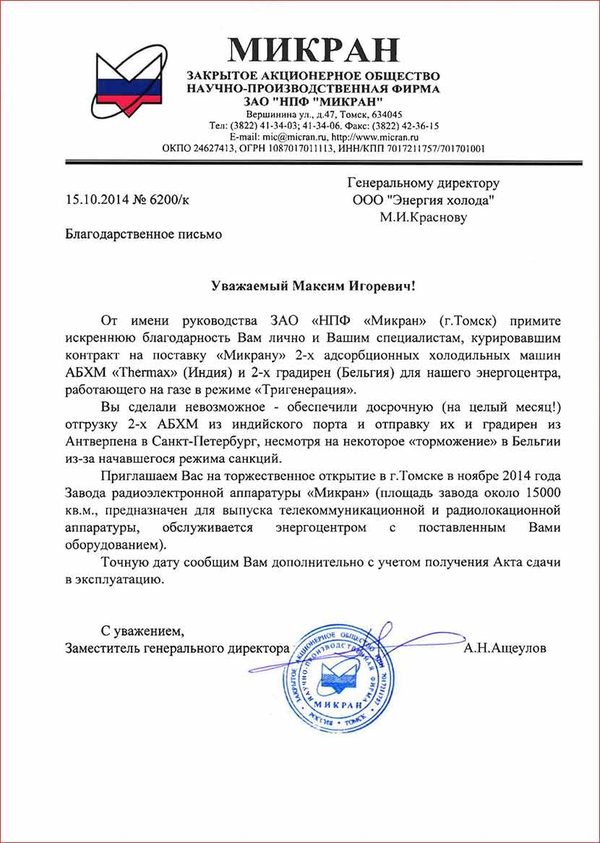
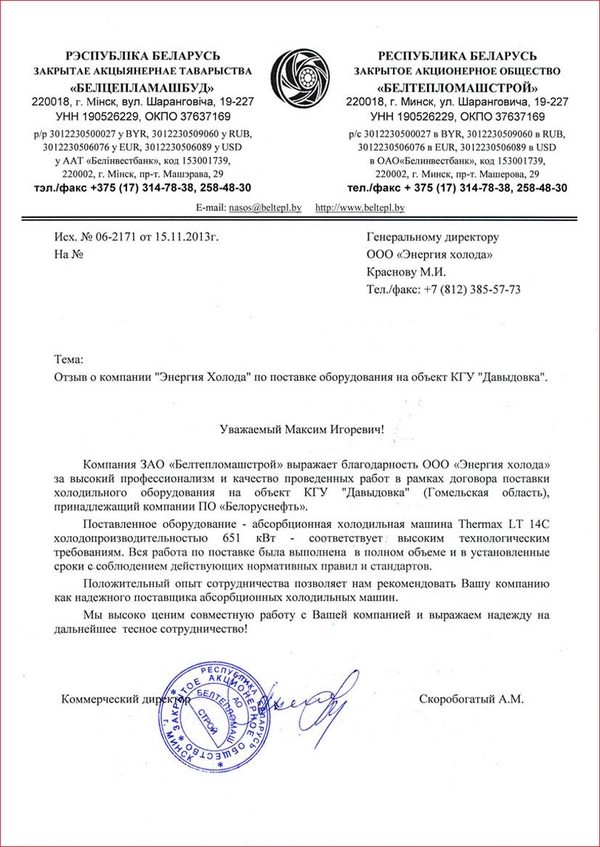
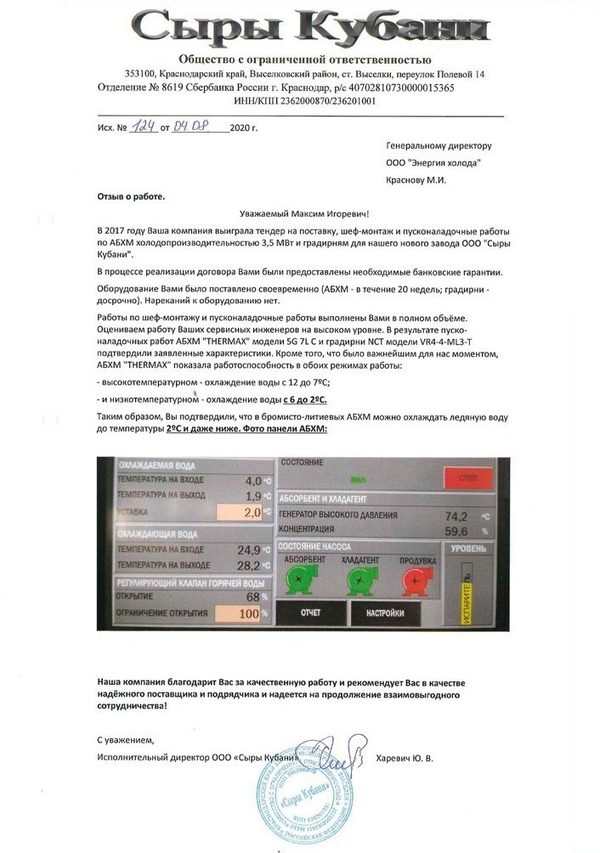
150 letters of thanks · 350+ major projects · 1,000+ customers · in business since 2011. These are real letters from customers; many others are on the references page.

Let us calculate trigeneration for your site
An engineer will put together the scheme and select the equipment, and you get a feasibility study. Free of charge, no obligation.