

Fuel cells and trigeneration
In brief. A fuel cell produces electricity at 30–63% efficiency, but only high-temperature types give heat suitable for an absorption chiller. There are few examples worldwide, and they are expensive.
A fuel cell converts gas into electricity without combustion and with a high electrical efficiency: 30–63% according to the catalog of the US Environmental Protection Agency (EPA, 2017). Total efficiency with heat recovery is 55–80%, and commercial units range from 0.2 to 2.8 MW. For trigeneration (CCHP), something else is decisive: different fuel cells give different heat, and not all of it is suitable for a lithium bromide absorption chiller. A comparison with other prime movers is on the "Types of trigeneration" page.
What heat does a fuel cell give?
According to the EPA catalog, fuel cells produce hot water or low-pressure steam (less than 30 psig, that is about 2 bar gauge). PEMFC and DMFC cells deliver water below 200 °F (about 93 °C), which is "low-quality" heat. High-temperature SOFC and MCFC cells produce steam up to about 150 psig (about 10 bar).
This leads to the main limitation. The ICF report for ORNL (DOE, 2009) states that PEM fuel cells are not suitable for driving even a single-effect absorption chiller: the temperature is not high enough. For cooling, high-temperature types are chosen. Exhaust at 380 °C, as in the Munich installation below, is already suitable for an exhaust-fired chiller.
How does a fuel cell differ from other prime movers?
| Indicator | Fuel cell |
|---|---|
| Start-up time | 3 hours – 2 days |
| Part-load operation | good |
| Operating hours before overhaul | 32,000–64,000 |
| Availability | more than 95% |
| Capital costs | USD 5,000–6,500 per kW of electrical capacity (typical US site) |
In terms of capital costs, fuel cells are the most expensive of all prime mover types in the EPA catalog, and their maintenance costs of USD 0.032–0.038 per kWh are higher than those of the others. The long start-up means the unit cannot be restarted quickly after a shutdown. In the US, fuel cells account for about 0.1% of cogeneration capacity: 155 sites (ICF database, 2014).
What international examples are there?
| Site | Installation | Cooling | What is known |
|---|---|---|---|
| T-Systems data center, Munich | MTU HotModule fuel cell, 245 kW | one exhaust-fired chiller, about 144 kW | exhaust at 380 °C, data center independent of the public grid |
| Verizon telecom facility, Garden City, USA, 2005 | 7 fuel cells of 200 kW each | absorption chillers | about 80% of the electrical, 75% of the heating and one third of the cooling load; savings of USD 680 thousand a year |
| University of California San Diego campus | 2.8 MW fuel cell | absorption chiller of about 300 tons | data from a university slide |
In Munich, the fuel is indirectly obtained from biogas from plants around the city. The Verizon project notes that the high cost of the fuel cells "softened" the economic effect. The telecom facility is about 292 thousand sq ft (roughly 27 thousand m²).
There are no fuel cell projects among our projects on the site.
When does it make sense?
When a site needs independence from the public grid and a round-the-clock load, like a data center or a telecom facility, and the budget allows. In other cases, see the gas engines and microturbines pages. The interface with cooling here is the same as with engines: trigeneration mistakes are covered separately, and Cold Energy (NCT) is responsible for the cooling circuit with Thermax chillers.
Want to evaluate such a scheme for your site? Order a feasibility study or calculate it with the calculator.
Sources
- EPA, Catalog of CHP Technologies, September 2017: https://www.epa.gov/sites/default/files/2015-07/documents/catalog_of_chp_technologies.pdf
- ICF for ORNL, Opportunities for CHP in Data Centers, March 2009: https://www.energy.gov/sites/prod/files/2013/11/f4/chp_data_centers.pdf
- UCSD slide (Dilliott, 2022): https://deepdecarbon.ucsd.edu/_files/d2i_5-4-22_john-dilliott.pdf
- Thermax materials on the Munich project.
What our customers say
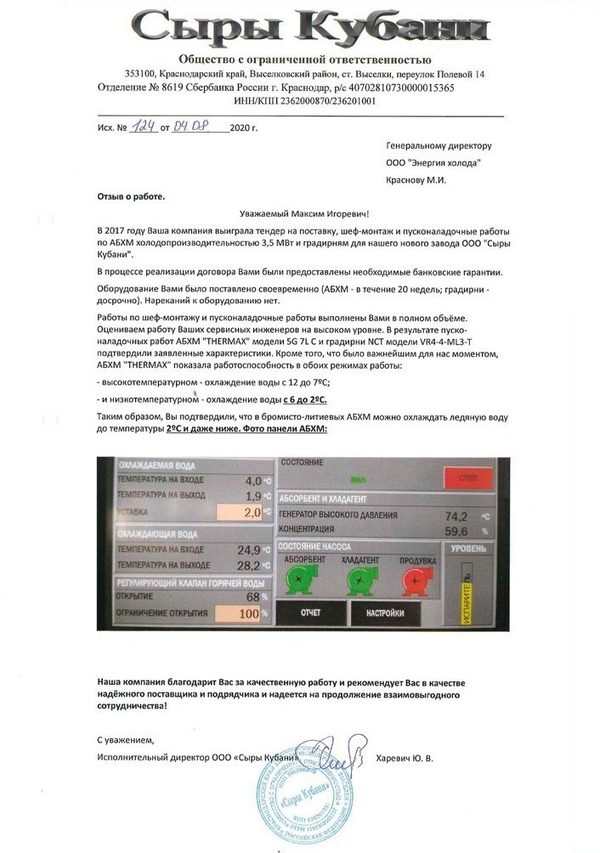
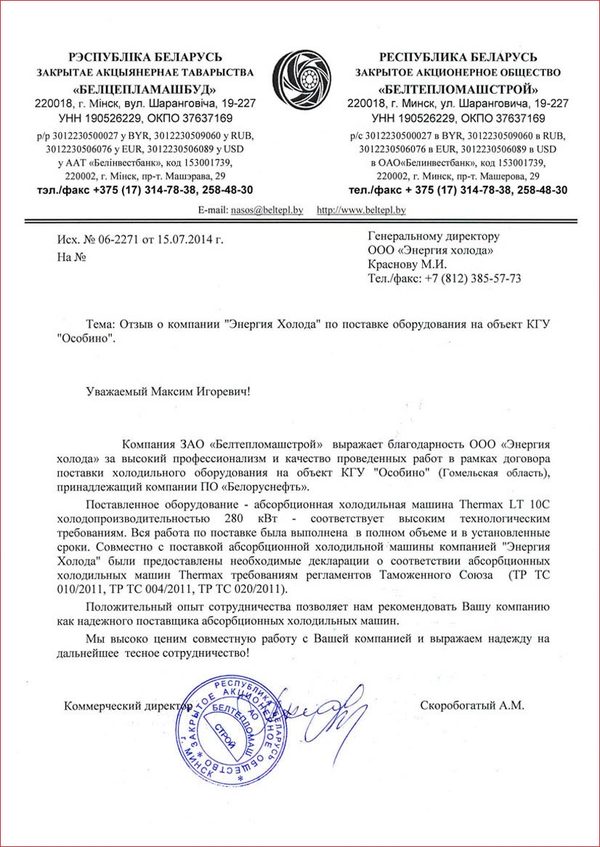
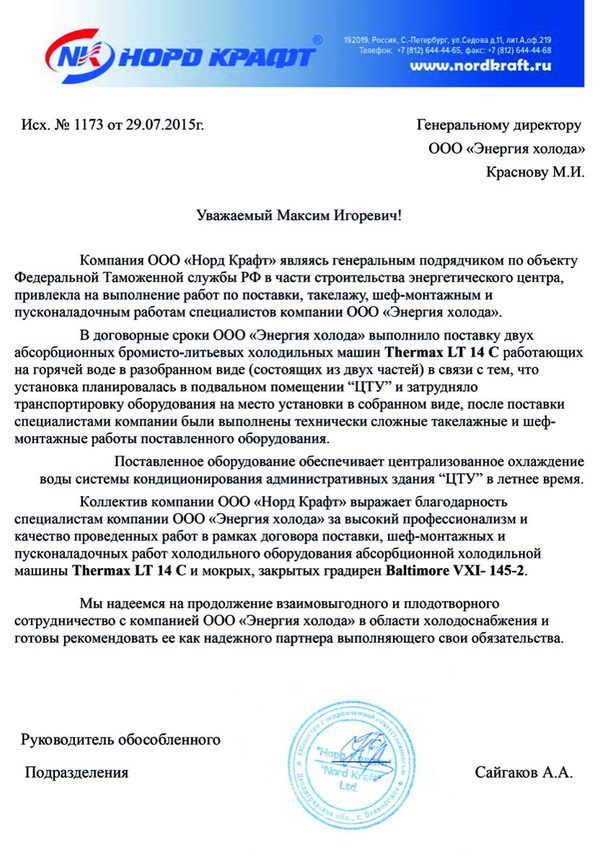
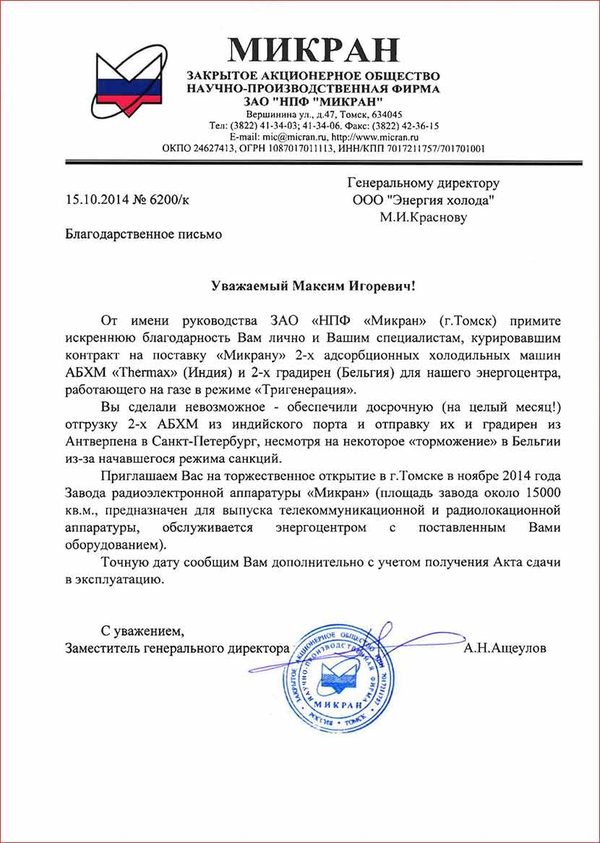
150 letters of thanks · 350+ major projects · 1,000+ customers · in business since 2011. These are real letters from customers; many others are on the references page.
Let us calculate trigeneration for your site
An engineer will put together the scheme and select the equipment, and you get a feasibility study. Free of charge, no obligation.