

Trigeneration on biogas, coal mine gas and associated petroleum gas
In brief. Biogas, coal mine gas and associated petroleum gas fuel a gas engine or turbine, and the heat goes to cooling. The difference lies in gas cleaning and in the fact that part of a biogas plant's heat returns to the digester.
Biogas, coal mine methane and associated petroleum gas can be used as engine fuel, and the engine heat can be turned into cooling. The scheme is the same as on natural gas: the engine produces electricity, and the heat goes to a lithium bromide absorption chiller. The difference is in the fuel. It has to be cleaned, and at a biogas plant part of the heat first returns to the bioreactor, and only the remainder goes to cooling.
The main schemes for natural gas are described on the gas engines page, and a general overview of engines is on the "Types of trigeneration" page. The examples here are international: there are no biogas projects among our projects on the site.
How does the fuel differ from natural gas?
| Fuel | What is known | What to consider |
|---|---|---|
| Biogas (landfill gas, gas from wastewater treatment plants) | according to the EPA catalog, the heating value is about 11–26 MJ/m³ (calculated from 300–700 Btu/scf), pressure is about atmospheric | the gas has to be compressed and cleaned of siloxanes and other impurities; the plants cost more |
| Coal mine methane | the EPA catalog names microturbines as suitable for landfill gas, biogas and coal mine methane | the catalog gives no separate efficiency or cost figures |
| Associated petroleum gas | fuel of the ZhGTES gas turbine power plant, according to the reference list | gas analysis is mandatory |
| Gasifier gas (wood chips, sawdust) | example: a hospital in India | gas analysis |
Thermax direct-fired chillers (2V series) also run on biogas, as well as on liquefied gas, propane, kerosene and diesel: they have a dual-fuel burner. For the other schemes, the questionnaire records which gas it is (natural, associated, biogas), its pressure, and a composition analysis if the gas is not natural gas.
How does the biogas scheme work?
After cleaning, the biogas goes to a gas engine generator set. Part of the heat returns to the bioreactor, and the rest goes to the Thermax chiller. Cooling is produced from heat that would otherwise be lost.
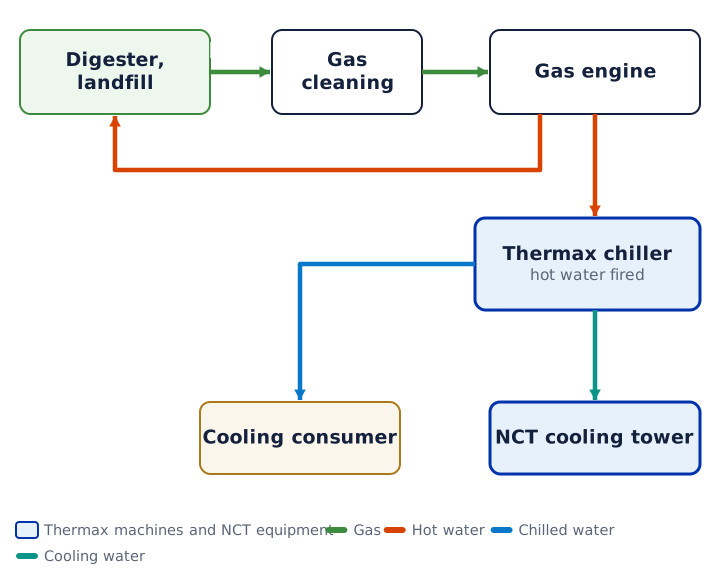
Below are three schemes from the Thermax catalog. They show what a consumer can get from the same plant.
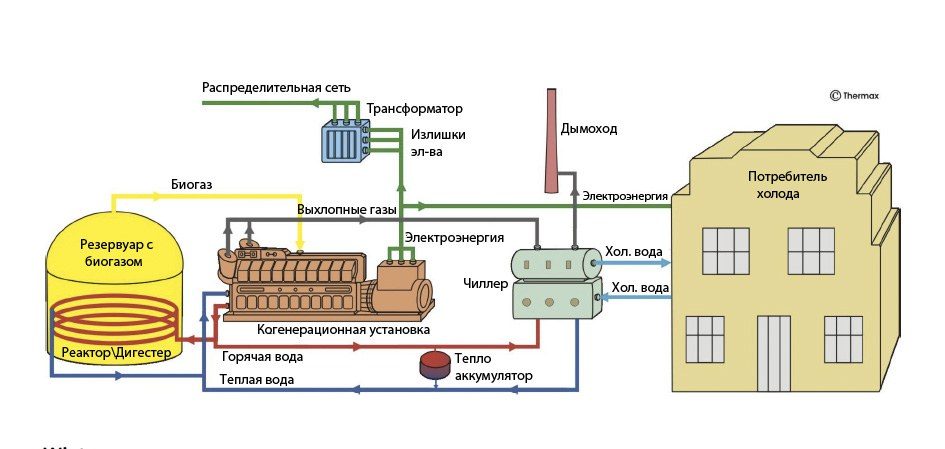
Option 5: chilled water to the consumer
Biogas from the storage tank goes to the engine. The engine jacket water heats the reactor (digester) and the chiller, and the chiller delivers chilled water to the consumer. Surplus electricity goes to the grid through a transformer. This is the basic option for a site that needs cooling.
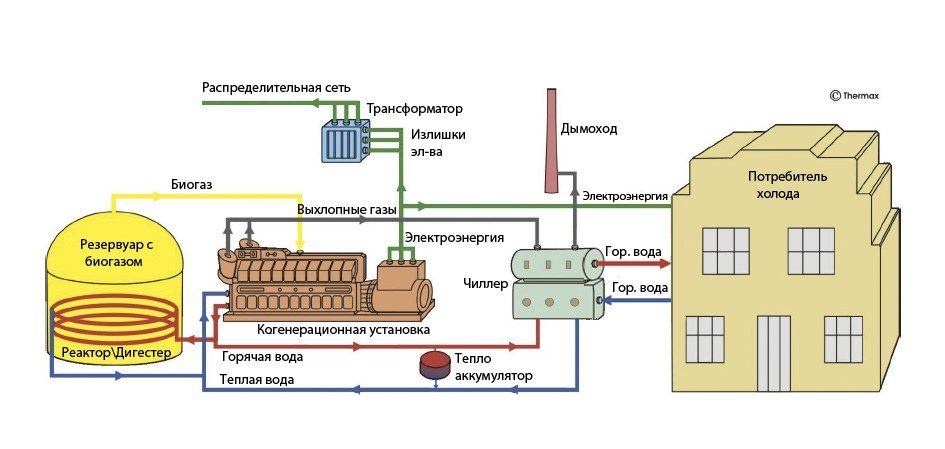
Option 6: hot water from the chiller
The same engine and reactor, but the consumer receives hot water: the chiller runs in heating mode. This is done when the consumer needs heat, not cooling.
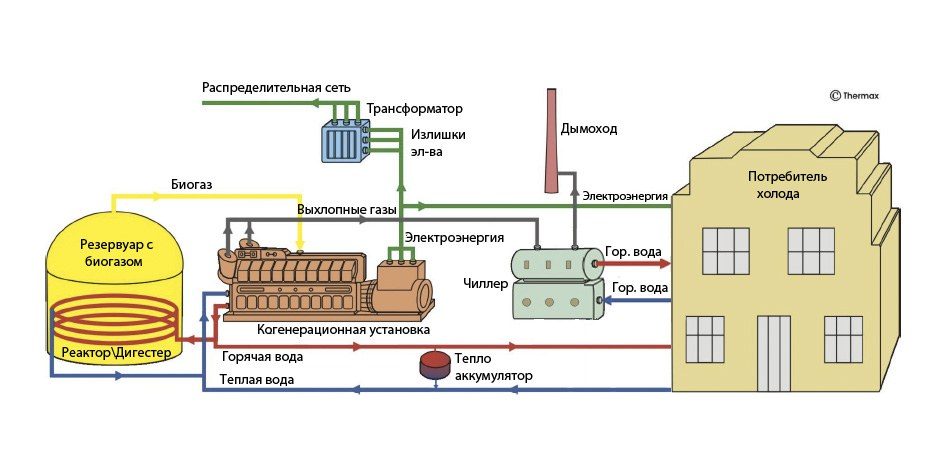
Option 7: hot water directly
Hot water goes to the consumer both from the chiller and directly from the jacket water circuit: part of the heat does not pass through the chiller at all.
What international examples are there?
| Site | Fuel and engines | Cooling | Special feature |
|---|---|---|---|
| HuaiNan coal mine, China | coal mine methane, 2 Deutz engines of 1.4 MW each | one 860-ton chiller, about 3 MW, on exhaust and jacket water | air conditioning of the mine at a depth of 1,000 m; engine heat is fully recovered |
| Hospital near Kolkata, India | gas from wood chip and sawdust gasifiers, 6 engines of 250 kW each | two chillers on exhaust and jacket water | 300-bed hospital, ministry subsidy, surplus electricity to the grid |
| Stücki business park, Basel, Switzerland | several biofuel power units | a 3,500 kW double-effect chiller and a 3,000 kW single-effect chiller | cooling under an energy service contract |
Temperatures at the HuaiNan mine: exhaust about 525 °C, jacket water 85 °C. At the Indian hospital, 480 and 89 °C. Thermax documents describe the gas source for the hospital as biogas in some places and as gasifier gas in others, and the chiller capacity differs between the table and the text, so we do not give the capacity.
What should be checked before the project?
-
Gas composition and pressure. Siloxanes and other impurities require fuel cleaning, and biogas at atmospheric pressure has to be compressed. The gas analysis goes into the questionnaire at the first step.
-
How much heat is left. Part of the heat goes to heating the reactor, so less reaches the chiller than with natural gas. The calculation is based on what remains.
-
Operating hours. The threshold for an absorption chiller is the same as elsewhere: from 300 kW of cooling and 3,000–4,000 hours a year or more. Below 2,000 hours it does not pay off.
-
The same interfaces between engine and cooling: exhaust back pressure, return temperature, crystallization when power is lost, and others. They are covered on the "Why trigeneration does not pay off" page.
If the engine and the cooling are split between different contractors, these interfaces belong to no one. The chillers are described on the Thermax absorption chillers page, and all schemes are collected in the atlas.
Want to check whether your biogas heat is enough for cooling? Order a feasibility study or calculate it with the calculator.
Sources
- EPA, Catalog of CHP Technologies, September 2017: https://www.epa.gov/sites/default/files/2015-07/documents/catalog_of_chp_technologies.pdf
- Thermax absorption chiller catalog and Thermax materials on trigeneration projects (HuaiNan, India, Basel).
What our customers say
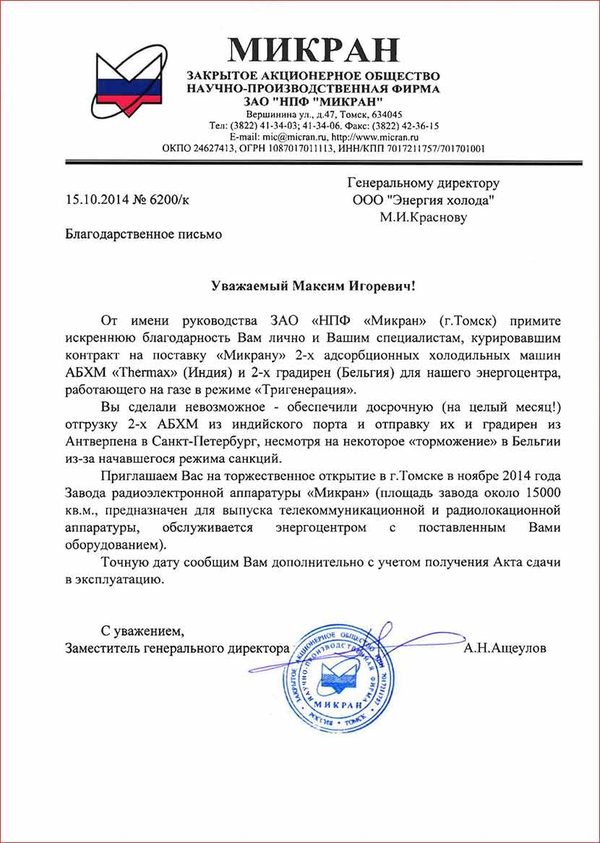
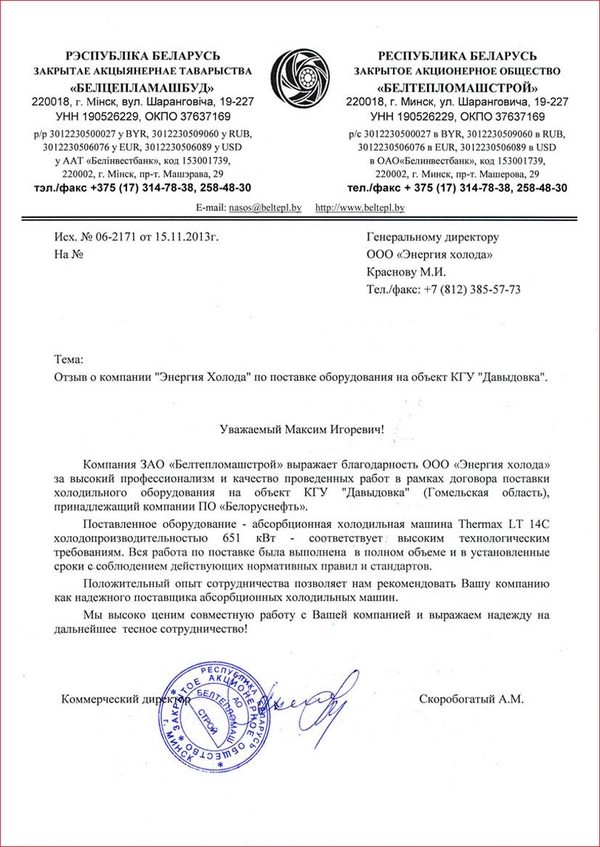
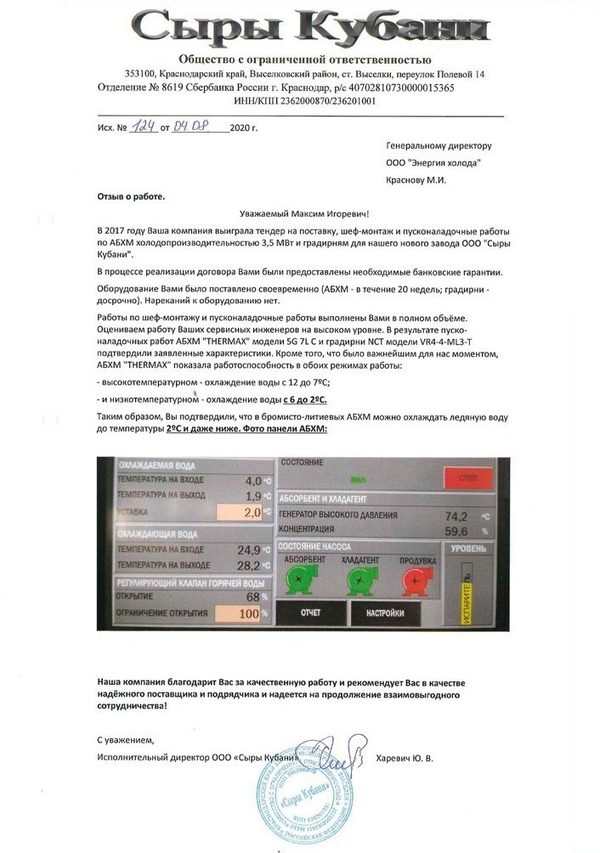
150 letters of thanks · 350+ major projects · 1,000+ customers · in business since 2011. These are real letters from customers; many others are on the references page.

Let us calculate trigeneration for your site
An engineer will put together the scheme and select the equipment, and you get a feasibility study. Free of charge, no obligation.