

Data center cooling with trigeneration
In brief. A data center needs cooling and power all year round, so a model with 5 MW of cooling gives a payback of the difference in capital costs of 2.1 years. But a gas engine failure deprives the data center of both power and cooling at once, and without a grid feed, chillers and a chilled water storage tank the scheme is dangerous.
A data center is a good fit for trigeneration (CCHP) in two cases: the grid cannot supply the required electrical capacity, or electricity is too expensive. It needs cooling and power all year round, operating hours are high, and the gas engine heat has a consumer. The main drawback is different: when the gas engine generator set stops, the data center loses both electricity and heat for the chiller at the same time. That is why backup has to be considered before the feasibility study.
Why does a data center suit trigeneration?
A data center's load is almost flat. The model calculation for 5 MW of cooling gives 6,130 full-load hours a year, and the electrical load without cooling is 3,850 kW around the clock. This is the case where the engine does not stand idle and the heat is not wasted: in summer and in winter, the lithium bromide absorption chiller receives the same heat.
The second reason is simple. An entire absorption chiller plant (chiller, pumps, cooling tower) draws 46–130 kW of electricity per MW of cooling, a vapor-compression chiller 180–350 kW. For a data center with limited electrical capacity on site, these are kilowatts freed up for racks.
International data agree. In an ICF report for Oak Ridge National Laboratory (ORNL), absorption chillers are called the typical "cooling" part of cogeneration (CHP) plants in data centers, and the list includes 18 installations at data centers and telecom facilities in the US, from 5 kW to 11.45 MW.
What are the drawbacks of the scheme for a data center?
There are several, and all of them come down to reliability.
-
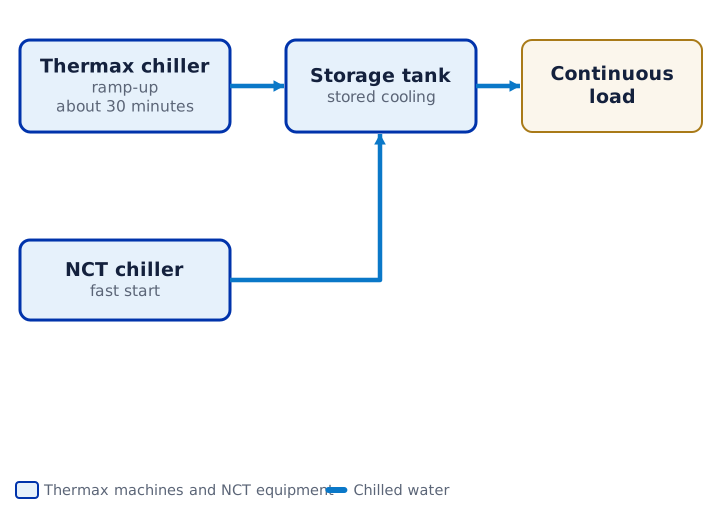
An absorption chiller takes about 30 minutes to reach its operating mode. A data center cannot wait that long, so a chilled water buffer and a backup chiller for about 5–20% of the load are needed.
-
Cooling towers are sized for the sum of cooling and heat, which is 2.3–2.5 times the cooling capacity, so they take up much more space than in a vapor-compression scheme.
-
The peak cooling load falls on a few days a year, so selection is based on seasonal efficiency, not on the rated point.
-
If the data center is designed for warm-water liquid cooling, the water at the rack inlet can be up to 45 °C. Then no compressor is needed at all, and the question of an absorption chiller disappears along with it.
-
An energy center needs a site and a gas permit. According to Wood Mackenzie data for 2025, the lead time for gas turbines was almost five years from order. We found no open data for reciprocating engines.
One more caveat from the International Energy Agency: for reliable on-site generation, a data center needs to build 30–70% more capacity than demand. Standby engines do not produce heat, so the heat load is calculated only for the part of the capacity that actually runs.
What happens if a gas engine fails or the power goes out?
A gas engine failure knocks out electricity and heat at once. The data center is left without power from its own plant, and the absorption chiller without heating water. The diagram shows how this is covered.
Data center scheme with backup
The gas engines power the IT load, and their heat goes to the Thermax chillers. There are three safeguards against failure: a grid feed, a second heat source, and NCT chillers sized for the full load with a chilled water storage tank.
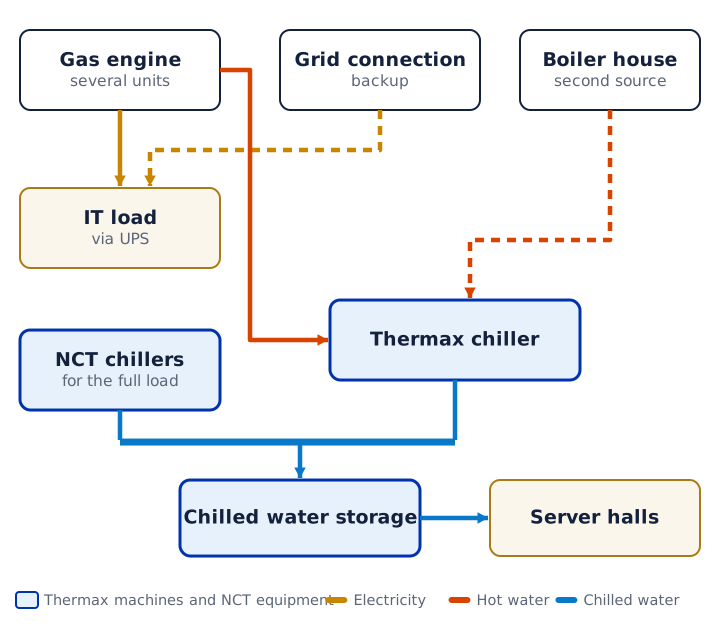
The grid feed remains as backup when the engines stop, and at that moment the absorption chiller can be supplied from a boiler house. Redundancy requirements (N+1, 2N) and the allowable time without cooling are taken from the data center questionnaire. An engine failure and loss of cooling is exactly the interface where trigeneration breaks. Cold Energy (NCT) is responsible for the Thermax chillers, cooling towers, water treatment, pumps, controls and the NCT backup chiller.
Chilled water storage tank for the transition
While the chiller reaches its operating mode or switches to another heat source, the load is carried by a chilled water storage tank. Its volume is calculated from the allowable time without cooling in the questionnaire.
Absorption chiller for the base, electric chiller for the peak
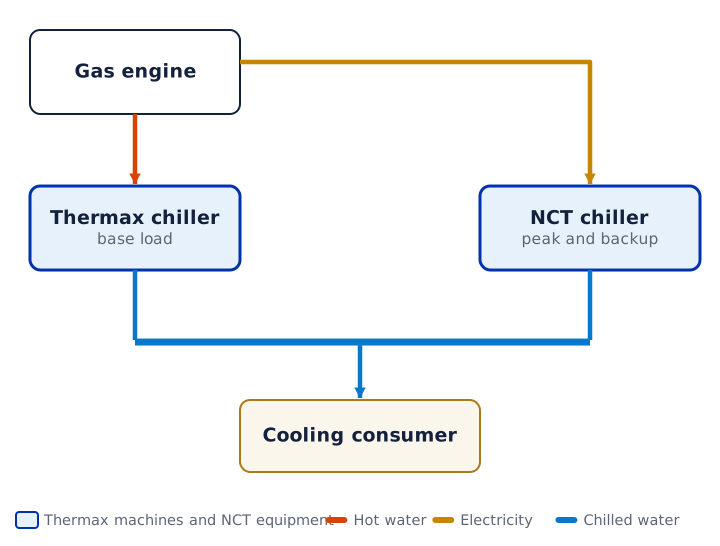
The absorption chiller runs continuously on the base load using engine heat, and an NCT chiller comes on for the peak and serves as backup. Both machines feed a common chilled water header.
Which of our projects are close to data centers?
Our example of cooling for server rooms from generation heat: the Central Customs Administration building in Moscow. It is an administrative building, not a data center, but part of the cooling from its chillers goes to server rooms, and the site lacked electrical capacity. The second site is close from a different angle: the customer has strict reliability requirements. The task at the interface between engine and cooling is the same there. And many others in the projects section.
| Site | Generation | Cooling | What we did |
|---|---|---|---|
| Central Customs Administration building, Moscow | 5 Capstone C200 microturbines | 2 × LT-14 C, 500 kW each | Supply, installation supervision, commissioning |
| Mikran plant, Tomsk | 1.7 MW gas engine | 2 × 5G 4L C, 1,100 kW each | Supply, installation supervision, commissioning |
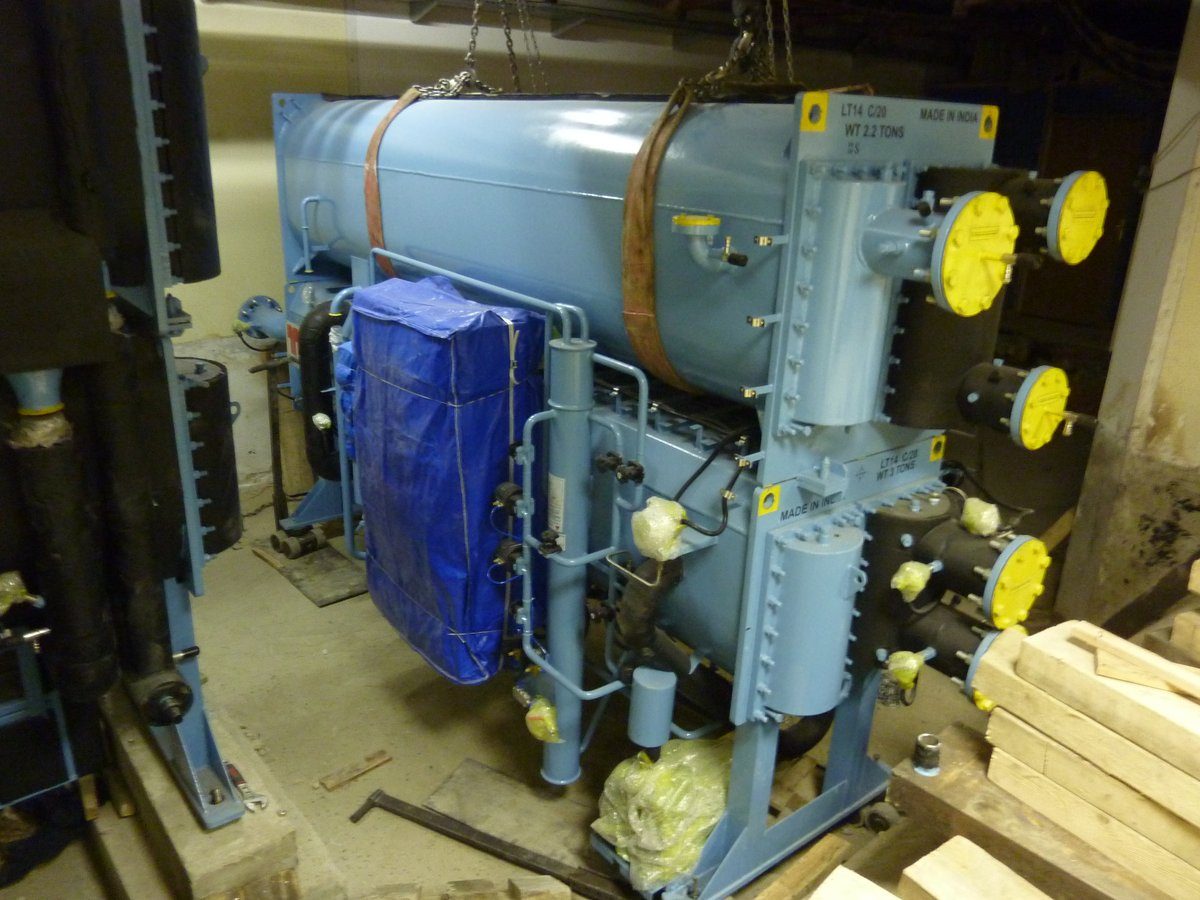
The Central Customs Administration building in the historic center of Moscow lacked electrical capacity, so it was decided to produce cooling from microturbine heat, including for the server rooms. The chillers were delivered in sections and assembled in a basement with narrow passages, around 2015. At Mikran, the main task was to coordinate the gas engine plant and the absorption chillers during transient periods and at low load.
A letter from the owner of the Mikran energy center dated 15 October 2014 confirms that two absorption chillers and two cooling towers were delivered a month ahead of schedule.

What data center examples are there worldwide?
International experience is more modest in size than what tens of megawatts require, but it shows how the scheme works.
| Site | Generation | Cooling from heat | Result |
|---|---|---|---|
| IBM data center, Syracuse, USA | 12 Capstone C65 microturbines | 2 absorption chillers | Fully supplies the data center with energy |
| T-Systems, Munich | 245 kW fuel cell | 1 absorption chiller, 144 kW | The server room does not depend on the public grid |
| Verizon, Garden City, USA | 7 fuel cells of 200 kW each | Absorption chillers | 80% of the electrical and one third of the cooling load |
In Syracuse, the project cost USD 12.4 million, it can run independently of the grid, and the claimed reduction in energy consumption compared with a conventional data center is about 50%. These are the project authors' words; we have not seen independent verification. All projects in the table are small, closer to 1 MW than to 30. Among our data there is no analog on the scale of tens of megawatts.
What does the model feasibility study for a data center show?
A model with 5 MW of cooling (tariff RUB 10/kWh, gas RUB 9/m³) gives the following. All figures are model figures; this is not an offer.
| Indicator | Value |
|---|---|
| Costs: grid and chiller, RUB million/year | 399.5 |
| Costs: trigeneration, RUB million/year | 139.5 |
| Savings, RUB million/year | 260.0 |
| Payback of the difference in capital costs | 2.1 years |
Capital costs for trigeneration are about RUB 694.3 million versus about RUB 150.0 million for chillers. If the grid connection has to be made from scratch (grid connection fee RUB 259.3 million), the payback is 1.1 years. At other tariffs and gas prices, it ranges from 1.5 to 4.1 years. On-site electricity costs RUB 3.72/kWh, and cooling from waste heat covers 97% of the annual demand; the chiller makes up the rest.
The model has no separate line for gas engine and cooling backup. In a real project it adds to capital costs, and the customer sets their size. The full calculation and assumptions are on the feasibility study for a data center page.
The cost of backup cannot be named in advance: it depends on how much downtime is acceptable. Send us the allowable time without cooling and the power feed scheme, and we will calculate the options in a feasibility study or in the calculator. You can compare with alternatives on the schemes pages and in the section on NCT chillers.
Sources
- ICF for ORNL, Opportunities for CHP in Data Centers, 2009: energy.gov
- Campus Technology, Syracuse U Constructs Green Data Center, 2009: campustechnology.com
- IEA, Key Questions on Energy and AI, 2026: iea.org
- Manufacturing Dive, 24 February 2026, based on Wood Mackenzie data: manufacturingdive.com
- T-Systems and Syracuse projects: Thermax materials
Frequently asked questions
Is gas engine heat enough for all the cooling of a 30 MW data center?
No. With water at 95/75 °C, the plant delivers about 30.2 MW, and single-effect chillers will make 22–24 MW of cooling from it. For 30 MW you need 38–43 MW of heat, or a 6–8 MW vapor-compression chiller. The 12/7 °C circulation flow will be about 5,200 m³/h. Water from the cooling towers at a 22 °C wet-bulb temperature will be 26–27 °C, and the towers have to be sized for 52–55 MW.
How do you provide N+1 redundancy for a gas engine and absorption chiller combination?
After a failure, the standby unit takes about 5 minutes to reach rated output, and all that time the chiller gets less heat. The dip is covered by a 10–15% margin on the engines and a gas-fired hot water boiler house. Selection requires the exhaust temperature and flow, the jacket water schedule (for example, 93/78 °C) and the capacity of each circuit.
What happens to an absorption chiller if the power goes out?
The chiller survives an outage of up to 3 minutes. If it lasts longer, a dilution cycle is needed; without it, the solution may crystallize. That is why an uninterruptible power supply or a backup feed is provided specifically for the chiller, not only for the racks.
What our customers say
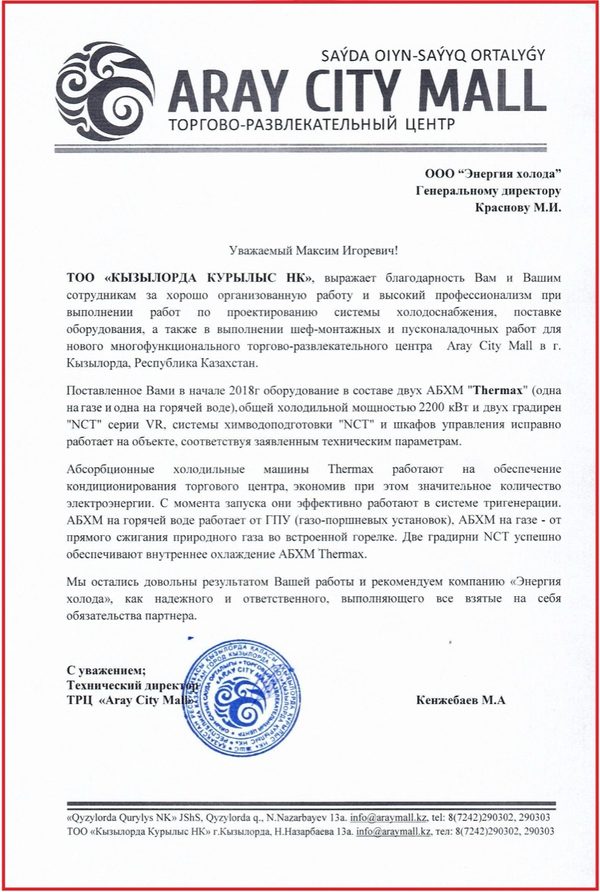
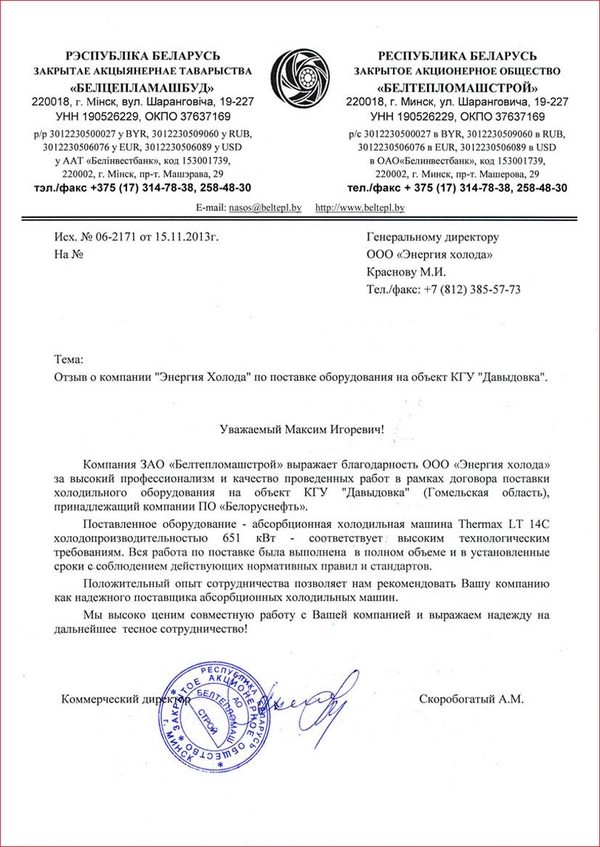
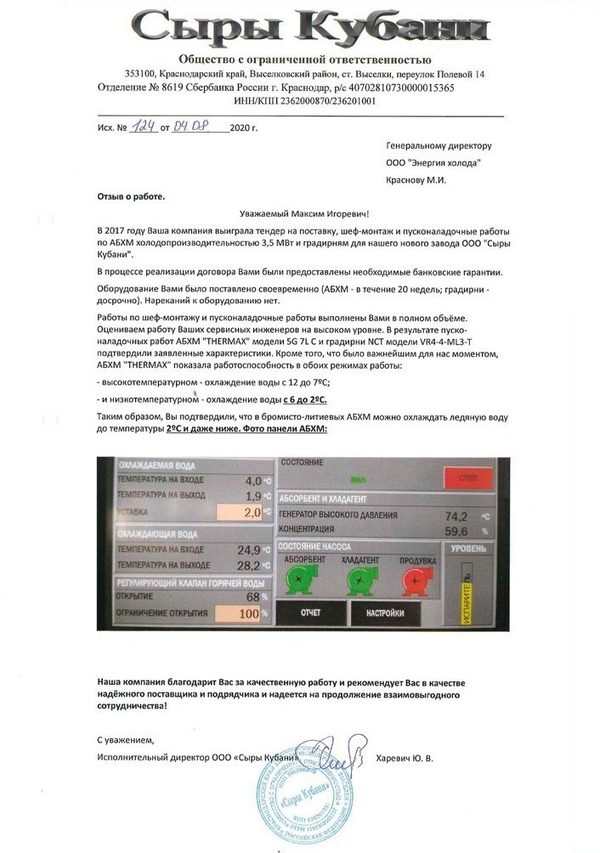
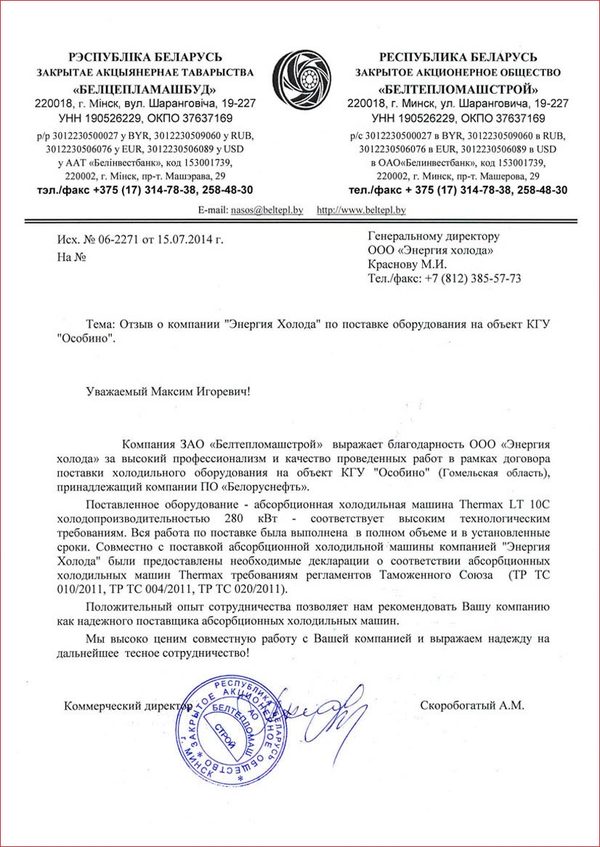
150 letters of thanks · 350+ major projects · 1,000+ customers · in business since 2011. These are real letters from customers; many others are on the references page.
Let us calculate trigeneration for your site
An engineer will put together the scheme and select the equipment, and you get a feasibility study. Free of charge, no obligation.