

Trigeneration Feasibility Study for a Pharmaceutical Plant
In brief. For a pharmaceutical plant with 2,860 kW of cooling, the model gives savings of RUB 123.7 million a year and a payback of 2.3 years with the grid connection in place. Cooling from waste heat covers 80 % of demand. This is a model calculation and a reference point.
For a pharmaceutical plant with 2,860 kW of cooling and an electrical load of 1,800 kW, the model gives a payback of 2.3 years with the grid connection in place and 1.2 years if the capacity had to be connected. Here waste heat covers 80 % of the annual cooling, and a chiller makes up the rest.
This is a model calculation and a reference point, not an offer. The main savings come from own-generated electricity. The rules of the model are collected on the page how to calculate payback.
What site did we calculate?
Cooling of 2,860 kW at 5,000 full-load hours (process lines and staff areas), electrical load excluding cooling of 1,800 kW and 8,000 hours a year. The baseline is a chiller with a seasonal COP of 4. In winter the engine gives 600 kW of heat to space heating for 4,000 hours.
What did we get?
| Item | Value |
|---|---|
| Peak cooling | 2,860 kW |
| Full-load cooling hours | 5,000 h/year |
| Electrical load excluding cooling | 1,800 kW, 8,000 h/year |
| Reference chiller, seasonal COP | 4.0 |
| Winter heat | 600 kW, 4,000 h/year |
| Gas engine output | 15.6 million kWh/year |
| Required generating capacity | about 2,300 kW |
| Gas | 4.2 million m³/year |
| Own electricity | RUB 3.72/kWh vs RUB 10 from the grid |
| Cooling from waste heat | 80% of annual demand |
| Costs: grid and chiller | RUB 183.2 million/year |
| Costs: trigeneration | RUB 59.5 million/year |
| Savings | RUB 123.7 million/year |
| Capex: trigeneration | about RUB 365.4 million |
| Capex: chillers | about RUB 85.8 million |
| Payback of the difference, grid capacity available | 2.3 years |
| Payback if a grid connection is needed | 1.2 years (connection fee RUB 129.4 million) |
Cooling from waste heat is 80 %: at this load the engine heat is not enough, and a chiller powered by the same gas engines makes up the remainder. For a hybrid scheme this is normal operation. Electricity costs RUB 3.72/kWh versus RUB 10, most of the savings come from it, and cooling gives the engine heat a job in the warm season and takes load off the chillers.
What happens at a different tariff and gas price?
| Gas, RUB/m³ | Power RUB 7.5 | Power RUB 10 | Power RUB 12 |
|---|---|---|---|
| 7 | 3.2 years | 2.1 years | 1.7 years |
| 9 | 3.5 years | 2.3 years | 1.8 years |
| 12 | 4.2 years | 2.5 years | 1.9 years |
The range is 1.7 to 4.2 years. The most conservative cell, a tariff of RUB 7.5 and gas at RUB 12, gives 4.2 years.
What assumptions are in the calculation?
Tariff RUB 10/kWh, gas RUB 9/m³, water RUB 50/m³, gas engine efficiency 40 % electrical and 45 % thermal, gas engine service RUB 1.3/kWh. Investments are based on the 2026 model benchmarks: RUB 78,000 per kW of generation, RUB 65,000 per kW of cooling, RUB 30,000 per kW for the baseline chiller. The benchmarks are replaced by the price from the commercial proposal.
What does the calculation not take into account?
- A separate chiller as backup. Process lines tolerate interruptions in cooling poorly, and an absorption chiller needs about 30 minutes to reach operating mode. Backup will have to be included, and it costs money.
- Process temperature modes. If water below the usual 7 °C is needed, the machine is selected for that mode, and this changes the price.
Which of our sites is similar?
The Aktivny Komponent pharmaceutical plant in Pushkin: two Jenbacher J320 gas engines, heat from the engine jackets, two TAC L5 E3 machines of 1,430 kW each, 2,860 kW in total, 12/7 °C mode. In operation since June 2020. We do not publish savings figures for this site: they are not in the public data. We have about 15 trigeneration sites; this is one of them, and many others are collected in the projects section. The sector's tasks are described on the page about pharmaceuticals.
What next?
A real calculation needs monthly cooling profiles, the water mode and the tariff. Send them through the feasibility study request or rough out the figures in the calculator.
Frequently asked questions
Will an absorption chiller pay back?
An absorption chiller costs more than an electric chiller, but heat is usually cheaper than electricity or free, and connecting an extra electrical kilowatt is expensive in itself: for example, 1,000 kW of capacity costs RUB 20 to 100 million at rates of RUB 20,000 to 100,000 per kilowatt. If the calculated payback is over five years, choosing an absorption chiller is questionable. Large facilities with their own gas-fired absorption chillers, which work for heating in winter instead of a boiler house, sometimes turn out cheaper than electric ones. The decision is made only on the basis of a feasibility study.
What our customers say
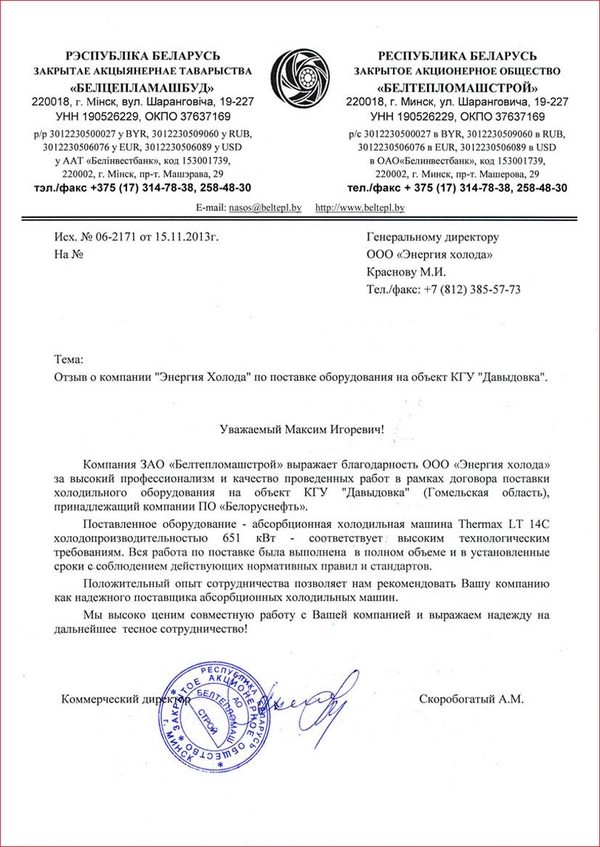
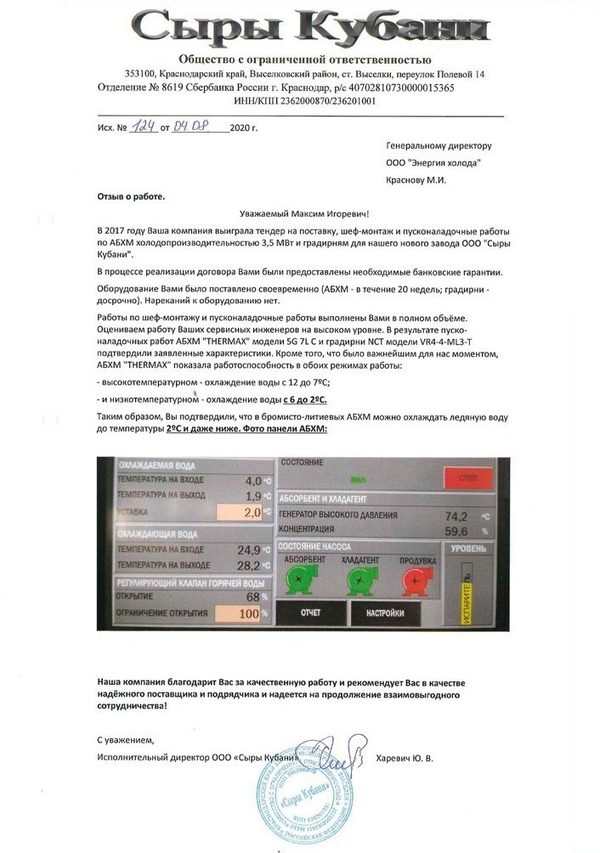
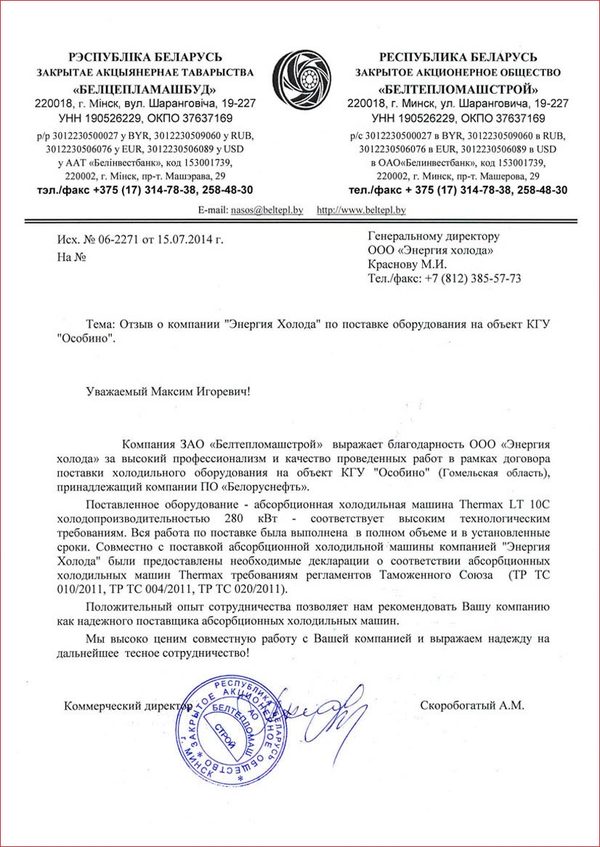
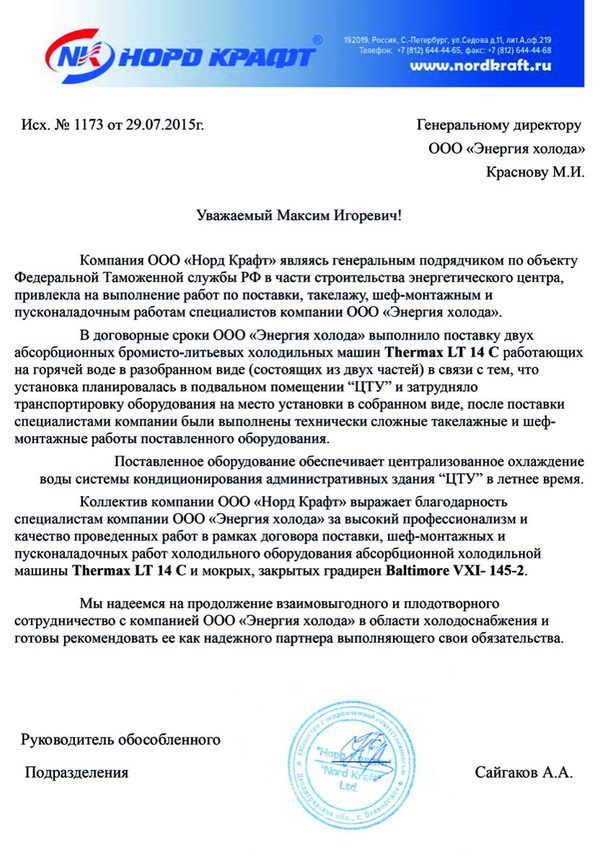
150 letters of thanks · 350+ major projects · 1,000+ customers · in business since 2011. These are real letters from customers; many others are on the references page.
Let us calculate trigeneration for your site
An engineer will put together the scheme and select the equipment, and you get a feasibility study. Free of charge, no obligation.