

Trigeneration for pharmaceutical production
In brief. Pharma uses cooling for lines and rooms all year round, so trigeneration pays back in 2.3 years in a model with 2.9 MW of cooling. The limit of the scheme: waste heat covers about 80 % of the demand, a chiller makes up the rest, and backup is always needed.
A pharmaceutical plant suits trigeneration (CCHP) because it needs cooling almost continuously: for process lines and for rooms where people are present at all times. The electrical load is also steady. In a model with 2.9 MW of cooling, the difference in capital expenditure pays back in 2.3 years. The limitation is straightforward: in this model, waste heat covers about 80 % of the cooling, a chiller makes up the rest, and any cooling outage costs more than an air conditioning outage in an office.
How does pharma differ from other industries?
Here cooling is tied to the process: it goes to the process lines and to staff rooms, and it cannot wait until tomorrow. In the model, the cooling load is 2,860 kW for 5,000 hours per year, and the electrical load is 1,800 kW for 8,000 hours per year. In winter, 600 kW of heat remain for space heating for 4,000 hours.
The hours here are higher than for a shopping mall but lower than for a data center. That is why the model gives an intermediate result: 2.3 years versus 2.1 for a data center and 2.9 for a shopping mall. The main benefit, as everywhere, comes from own electricity: RUB 3.72/kWh in the model versus RUB 10 from the grid.
What are the downsides of the scheme?
-
Waste heat does not fully cover the cooling. In the model, it covers 80 % of the annual demand, and a chiller covers the rest. It is needed for the peak and backup anyway.
-
The engine and the chiller are linked. If the engine stops, there is no heating water. For pharma, this means a second heat source or a chiller for the full load is needed, and that adds capital expenditure.
-
The water in the circuit needs monitoring. One millimeter of scale on a heat exchanger reduces capacity by about 14 %, and energy consumption rises by up to 20 %. That is why water treatment is part of the project from the start.
-
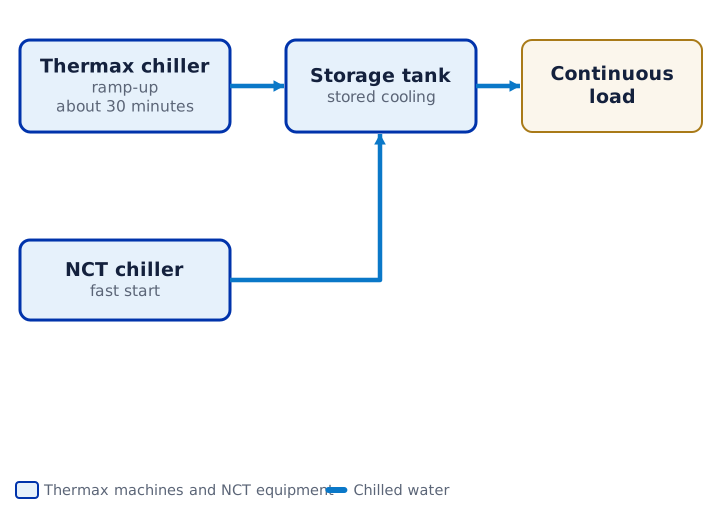
Reaching operating mode takes about 30 minutes. For an uninterrupted load, the chiller needs a chilled water tank or a chiller that carries the process during start-up.
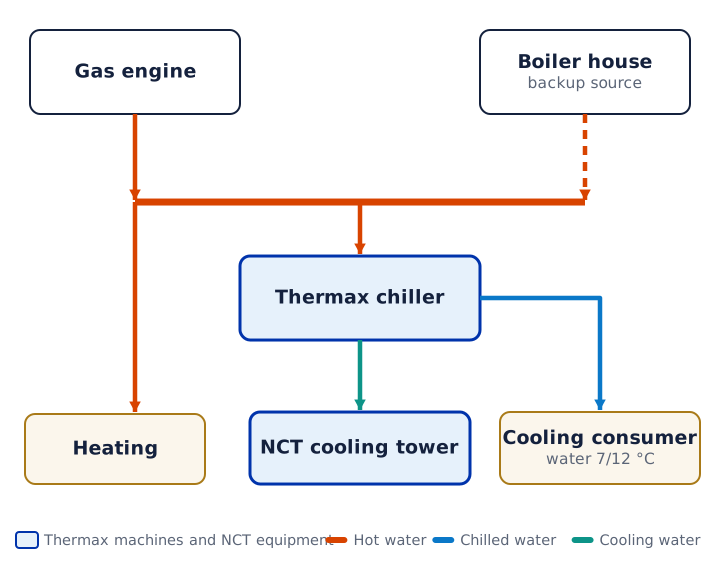
Two heat sources
So that cooling does not depend on the engine alone, the hot water header is fed from the gas engine and from the boiler house. The chiller gets heat even when the engine is stopped.
Chilled water tank for the changeover
While the chiller switches from one source to another, the continuous load is carried by a chilled water storage tank.
What is our site in pharma?
It is a plant producing active pharmaceutical ingredients in Pushkin near St. Petersburg: a 13,000 m² site with a production capacity of 330 tonnes per year. The equipment was ordered under an investment contract for a new production line and modernization. In operation since June 2020.
| Parameter | Value |
|---|---|
| Generation | 2 Jenbacher J320 gas engines |
| Heat source | Water from the engine jackets |
| Cooling | 2 Thermax TAC L5 E3 absorption chillers of 1,430 kW each, 12/7 °C |
| Our work | Detailed design documentation (cooling, cooling controls and electrical sections), supply, installation supervision, commissioning |
On our side, there are also two NCT VR3S series cooling towers, two NCT W2C water treatment units, two NCT pump stations and a control system. The cooling goes to the process lines and to rooms permanently occupied by staff. This is one of many other sites; details are in the projects section.
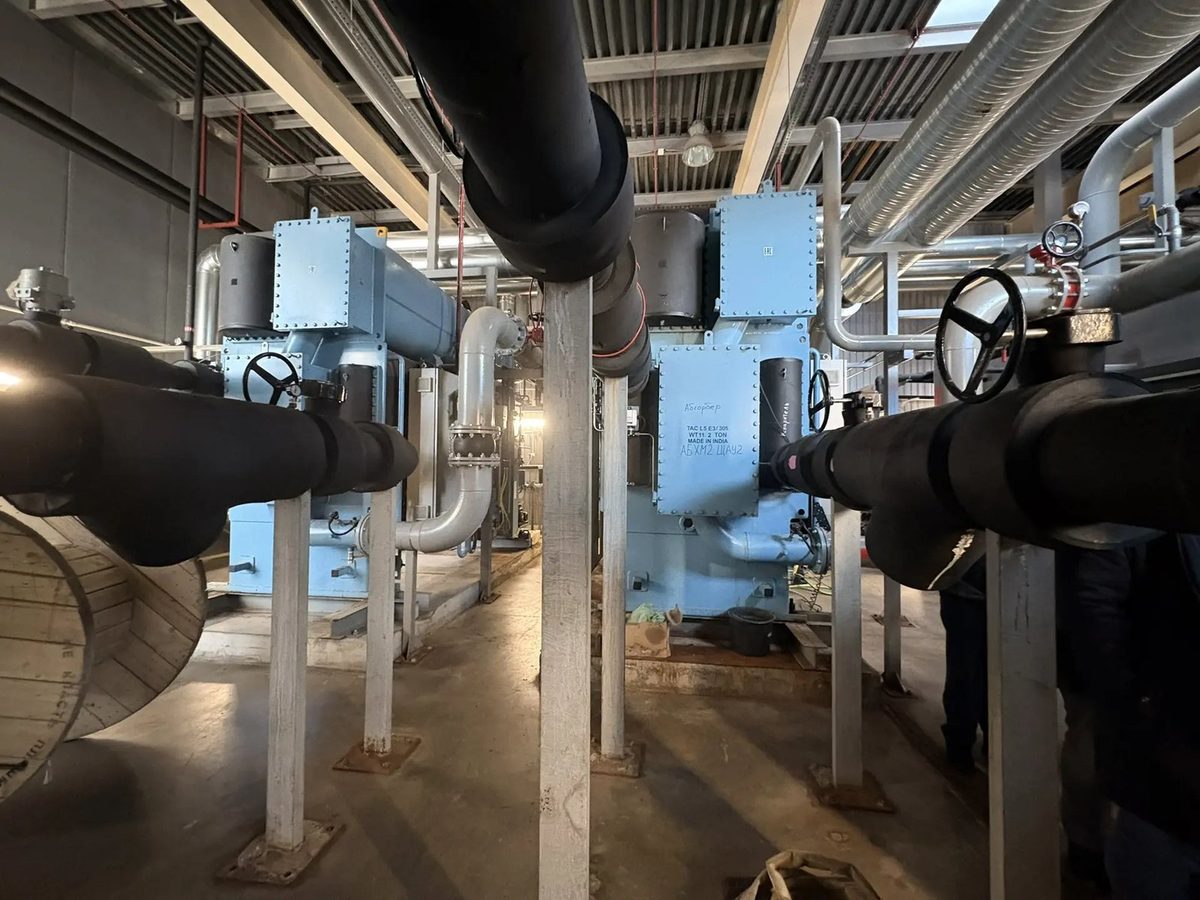
 Trigeneration complex at a pharmaceutical plant (in Russian)
What pharma projects are there worldwide?
Two Indian examples from Thermax materials.
| Site | Generation | Cooling from heat | Purpose |
|---|---|---|---|
| Zydus Cadila (India) | 3 GE Jenbacher gas engines of about 1 MW each | 3 absorption chillers, 3,058 kW in total | Process and comfort cooling |
| Sun Pharmaceuticals (India) | 3 gas engines of 1.4 MW each | 2 absorption chillers, 1,652 and 844 kW | Process cooling |
At Zydus Cadila, engine exhaust at about 427 °C and jacket water at 87 °C go to the chillers simultaneously, and the stated result is lower operating costs and uninterrupted power supply. At Sun Pharmaceuticals, a heat recovery steam generator producing 2,917 kg of steam per hour was added, and the claimed emission reduction is 12,280 tonnes of CO2 per year. These figures come from the manufacturer's presentations; we have not seen any independent verification.
What does a model feasibility study for pharma show?
The calculation is a model (tariff RUB 10/kWh, gas RUB 9/m³), not an offer.
| Indicator | Value |
|---|---|
| Costs: grid and chiller, RUB million/year | 183.2 |
| Costs: trigeneration, RUB million/year | 59.5 |
| Savings, RUB million/year | 123.7 |
| Payback of the difference in capital expenditure | 2.3 years |
Capital expenditure is about RUB 365.4 million versus about RUB 85.8 million for chillers. If the grid has to be connected (grid connection fee of RUB 129.4 million), the payback is 1.2 years. At different gas prices and tariffs, it ranges from 1.7 to 4.2 years. The detailed calculation is on the page feasibility study for pharma.
Where the engine and the cooling get in each other's way is covered on the page trigeneration mistakes. If they are split between different contractors, nobody owns the interface. The equipment is described in the section Thermax absorption chiller.
If you want to check your site, submit a request for a feasibility study or try the calculator.
Sources
- DOE, Absorption Chillers for CHP Systems, DOE/EE-1608, 2017: energy.gov
- Zydus Cadila and Sun Pharmaceuticals projects: Thermax materials
Frequently asked questions
What happens to an absorption chiller if power is lost, and what should be done with the engine exhaust?
Without backup power, there is a high risk of solution crystallization, especially in double-effect chillers and at a high heating medium temperature. In a short outage, a fast restart and built-in dilution algorithms help. There is an option of uninterruptible power for a normal shutdown, which is calculated individually. On an exhaust-fired chiller, the damper is powered from the engine: if the chiller stops or the power is lost, the exhaust goes around it.
What our customers say
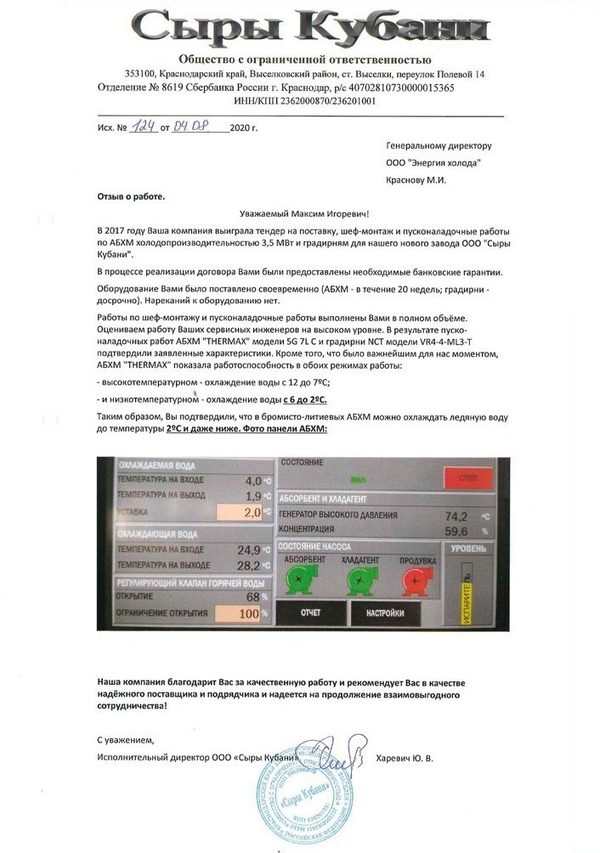
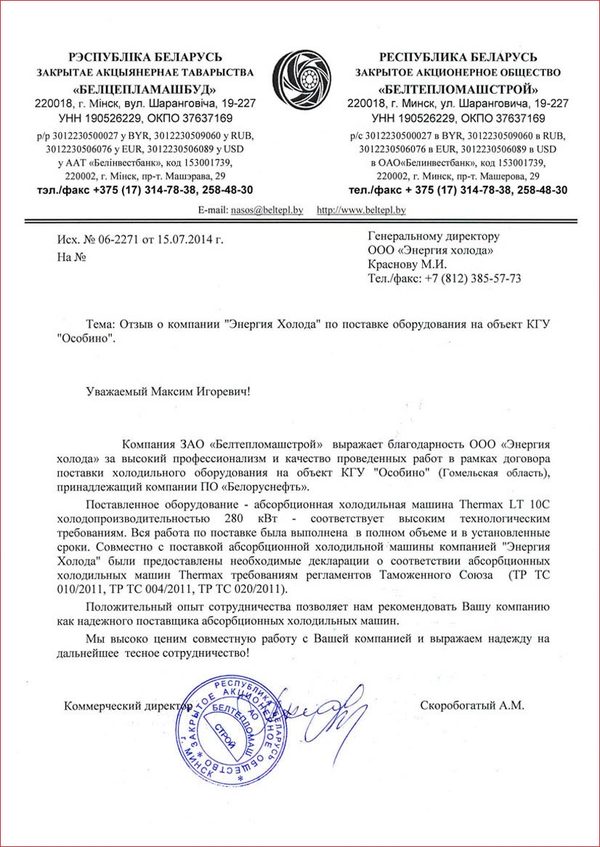
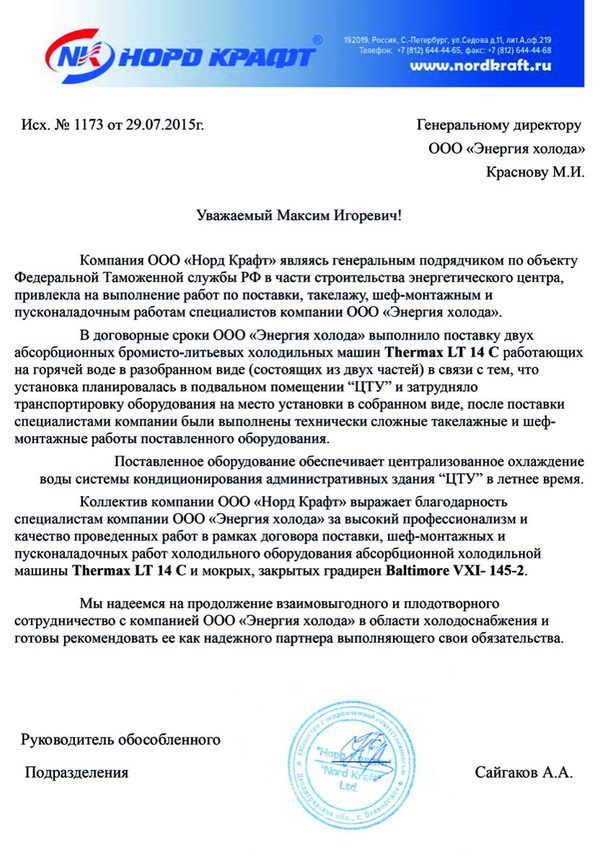
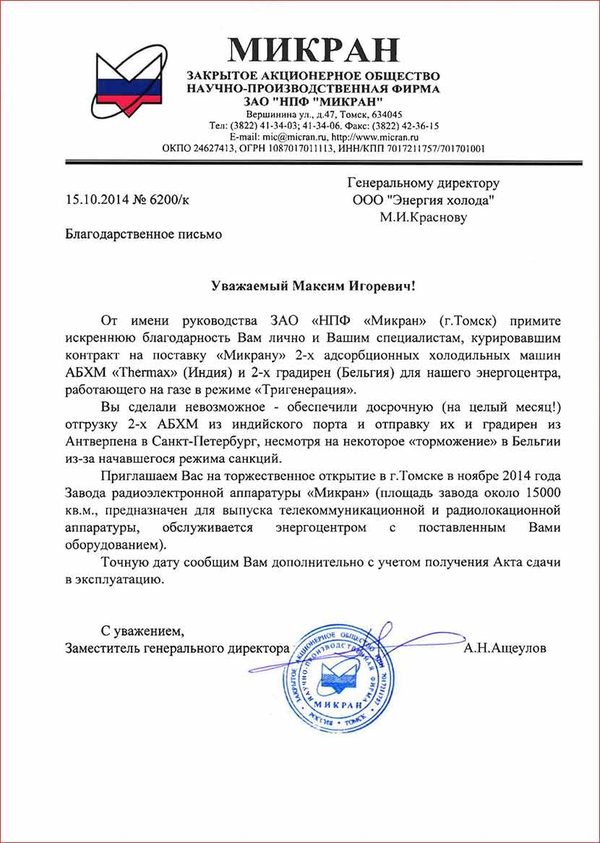
150 letters of thanks · 350+ major projects · 1,000+ customers · in business since 2011. These are real letters from customers; many others are on the references page.
Let us calculate trigeneration for your site
An engineer will put together the scheme and select the equipment, and you get a feasibility study. Free of charge, no obligation.