

Trigeneration for dairy plants and food production
In brief. A dairy or food plant is an almost ideal consumer: cooling is needed all year round, and in winter the heat goes to space heating. In a model with 2 MW of cooling, the difference in capital costs pays back in 2.2 years. There are two difficulties: ice water below +3.5 °C requires a non-standard chiller, and an engine shutdown stops the cooling.
Dairy plants and other food production sites are a good fit for trigeneration (CCHP): they need cooling both in summer and in winter, and a gas engine gives both electricity for the lines and heat for the chillers and space heating. In a model calculation for 2 MW of cooling, the difference in capital costs pays back in 2.2 years. There are limitations too: if water colder than +3.5 °C is needed, the chiller is built to order, and if the engine stops without backup, the cooling stops.
How does food production differ from other industries?
Here cooling is part of the process. It is used for storing milk and raw materials and for pasteurizers, and it is needed all year round. The electrical load is also almost never off: in the model, 1,800 kW without cooling, 8,000 hours a year.
In winter less cooling is needed, and the engine heat goes to space heating. In summer the same heat is turned into cooling. As a result, the heat does not have to be released to the atmosphere, and that is what trigeneration relies on.
The dairy industry also has a special temperature requirement: ice water is often needed.
What are the limitations of the scheme?
-
The standard minimum outlet temperature is +1 °C (−2 °C with glycol), while for the LT and 5G series hot water chillers it is 3.5 °C. Anything lower is a non-standard mode or a special design; −5 °C is possible only with double-effect chillers.
-
The engine and the chiller are linked. If the engine stops, there is no cooling. A continuous process needs a second heat source or a chiller for the peak and backup.
-
An absorption chiller takes about 30 minutes to reach its operating mode. For processes that cannot be interrupted, a chilled water buffer or a chiller is installed alongside.
-
The scheme does not suit small plants. Below 300 kW of cooling and 2,000 hours a year, a lithium bromide absorption chiller does not pay off, and with hot water heat of around 300 kW, the justification is usually insufficient.
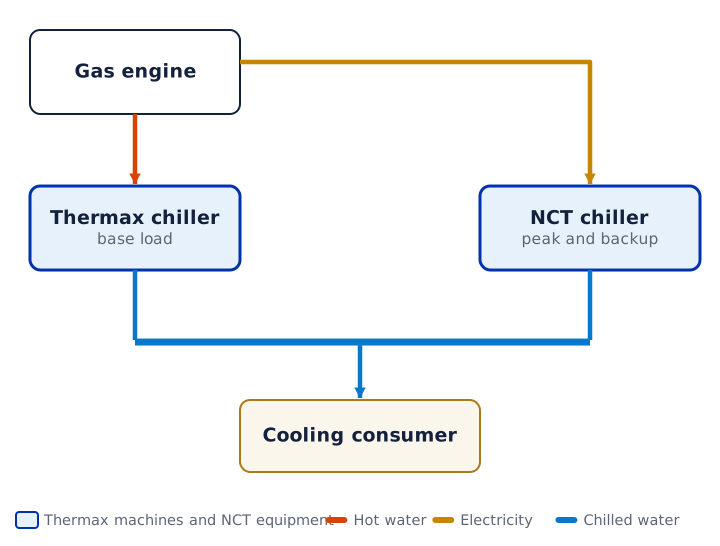
The absorption chiller holds the base, the electric chiller takes the peak
A hybrid is convenient at a food plant: the absorption chiller covers the base load using engine heat, and an NCT chiller takes the peak and serves as backup. Both machines are connected to a common chilled water header.
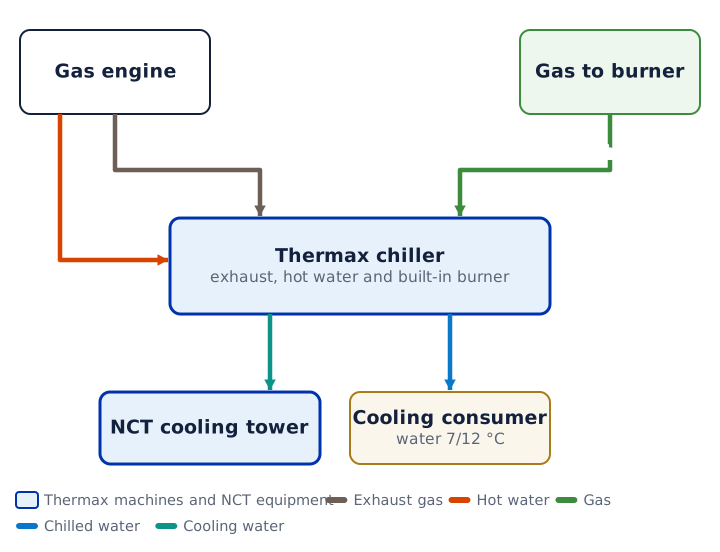
A gas burner for when the engine is stopped
If the engine heat is not always enough, an exhaust-fired chiller with a built-in burner is chosen (hot water chillers have no burner). It makes up the heat from gas while the engine is stopped, and the consumer does not lose cooling.
Which food industry projects do we have?
The table shows examples, among many other projects in the projects section.
| Site | Generation | Cooling | What we did |
|---|---|---|---|
| Syry Kubani cheese plant, Vyselki (Krasnodar Territory) | 4 MTU engines, 1,948 kW each | Steam-fired Thermax absorption chiller, 3,500 kW | Supply, installation supervision, commissioning |
| Döhler food ingredients plant, Lobnya | Energy center with gas engines | TZC L5 G4, 1,500 kW | Design documentation, supply, installation supervision, commissioning |
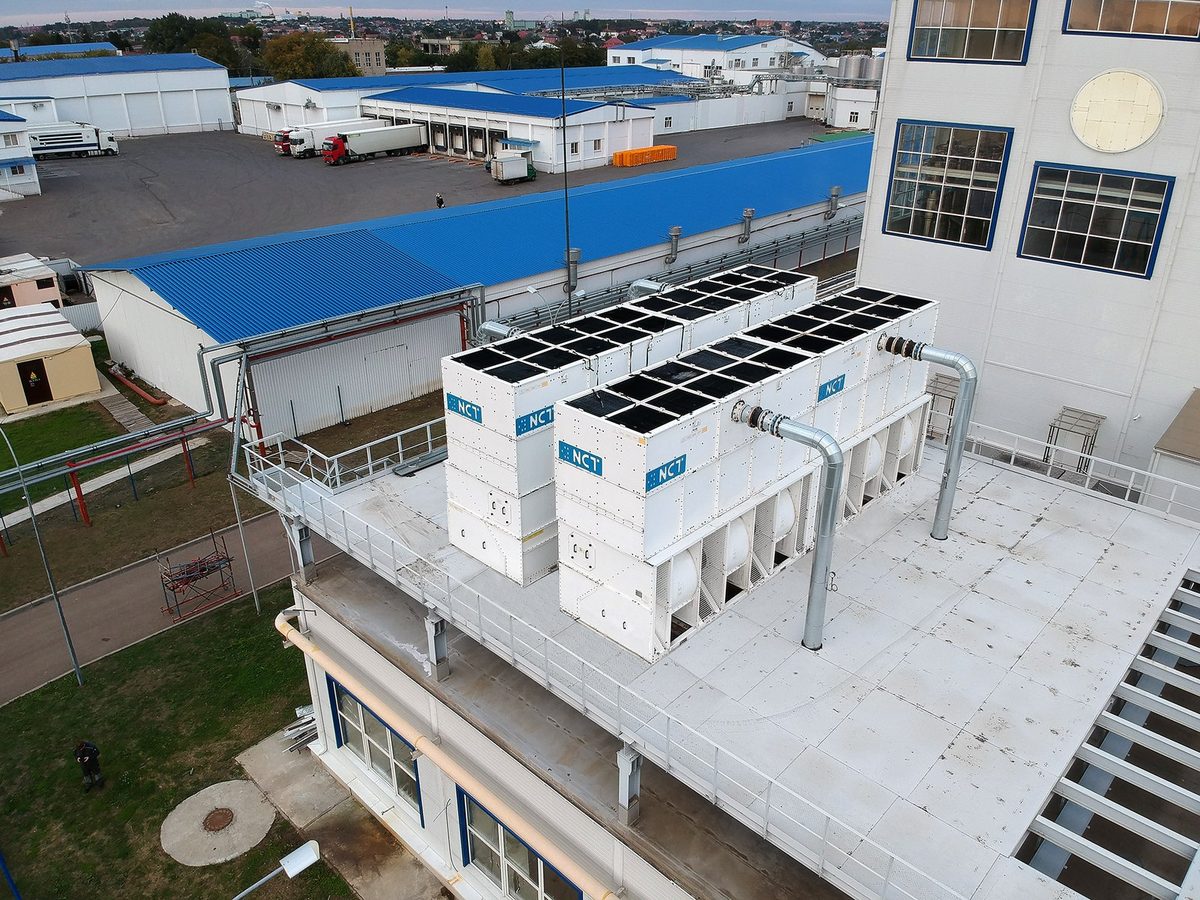
Syry Kubani is a dairy plant processing 600 tonnes of milk per day. The chiller operates at 12/7 and 6/2 °C. NCT VR4 series cooling towers with a built-in basin and heating were delivered ahead of schedule, and the absorption chiller in 20 weeks. A letter from the plant's executive director confirms on-time delivery and an outlet temperature down to 2 °C.
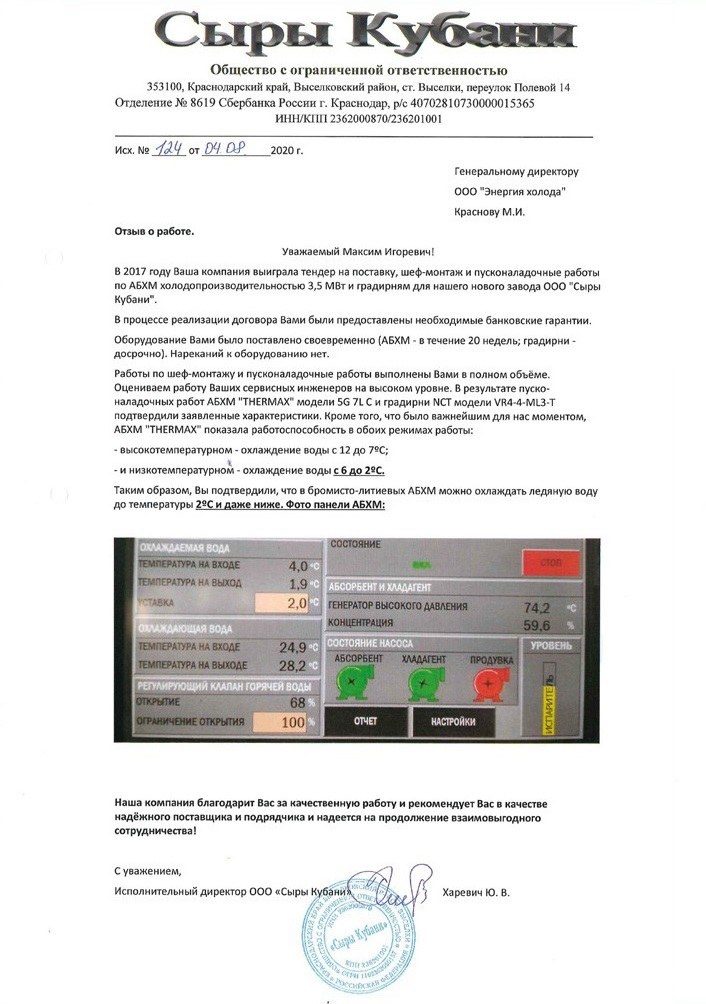
 NCT cooling towers and a Thermax absorption chiller at the Syry Kubani plant (in Russian)
At Döhler, the cooling goes to pasteurizers used in the production of fruit concentrates. Here we supplied a hot water absorption chiller, two NCT cooling towers, two dry coolers with free cooling, plate heat exchangers, water treatment and pump skids. The entire cooling side was selected by one company, so the interface with the energy center is not split between suppliers. This is how Cold Energy (NCT) works with Thermax chillers and NCT equipment.
What does international experience show?
Two examples from Thermax materials: one confectionery, the other chemicals and dairy processing.
| Site | Generation | Cooling | Effect |
|---|---|---|---|
| Cadbury, Ikeja (Lagos, Nigeria) | Rolls-Royce 3.7 MW | 1 absorption chiller, 2,317 kW | 2,400 t less CO2 per year |
| Calibre Chemicals, Vapi (India) | Cummins 315 kW, 3 Deutz engines of 580 kW each | 2 absorption chillers, 404 and 562 kW | Solved problems with electricity and gas supply |
At Cadbury, the cooling goes to the process and air conditioning, and the water temperature is 6 °C. At Calibre, the choice was driven by power and gas supply interruptions in the region. There is no independent verification of these data.
What does the model feasibility study for a dairy plant show?
A model with 2 MW of cooling (tariff RUB 10/kWh, gas RUB 9/m³). This is a model calculation, not an offer.
| Indicator | Value |
|---|---|
| Costs: grid and chiller, RUB million/year | 163.3 |
| Costs: trigeneration, RUB million/year | 53.5 |
| Savings, RUB million/year | 109.8 |
| Payback of the difference in capital costs | 2.2 years |
Capital costs are about RUB 298.8 million versus about RUB 60.0 million for chillers. If a grid connection is needed, the payback shortens to 1.1 years (grid connection fee RUB 115.9 million). At other gas prices and tariffs, it lies between 1.6 and 4.1 years. Waste heat covers 100% of the annual cooling demand, and in winter 800 kW of heat goes to space heating.
The full calculation and assumptions are on the feasibility study for a dairy plant page. The chiller design and series are covered on the Thermax absorption chillers page, and heat rejection on the NCT cooling towers page.
You can have your scheme calculated in a feasibility study or first estimate it in the calculator. The colden.ru website covers all the equipment for a plant's cooling circuit.
Sources
- DOE, Absorption Chillers for CHP Systems, DOE/EE-1608, 2017: energy.gov
- Cadbury and Calibre Chemicals projects: Thermax materials
Frequently asked questions
Can a hot water absorption chiller produce water at about +3 °C?
Yes. A low-temperature hot water chiller with a +3 °C outlet is selected by the factory as a non-standard unit. It cannot be supplied from stock. A non-standard tube material may be required, and this affects cost and weight. That is why it is better to state the outlet temperature in the first inquiry, not after the series has been chosen.
What if there is no hot water?
The concept includes a backup vapor-compression chiller for the period without hot water. If the cooling is transmitted over hundreds of meters, a 5/14 °C schedule is used, and modular open cooling towers are installed with the absorption chiller. The choice between chillers and absorption chillers is made at the feasibility study stage.
What our customers say
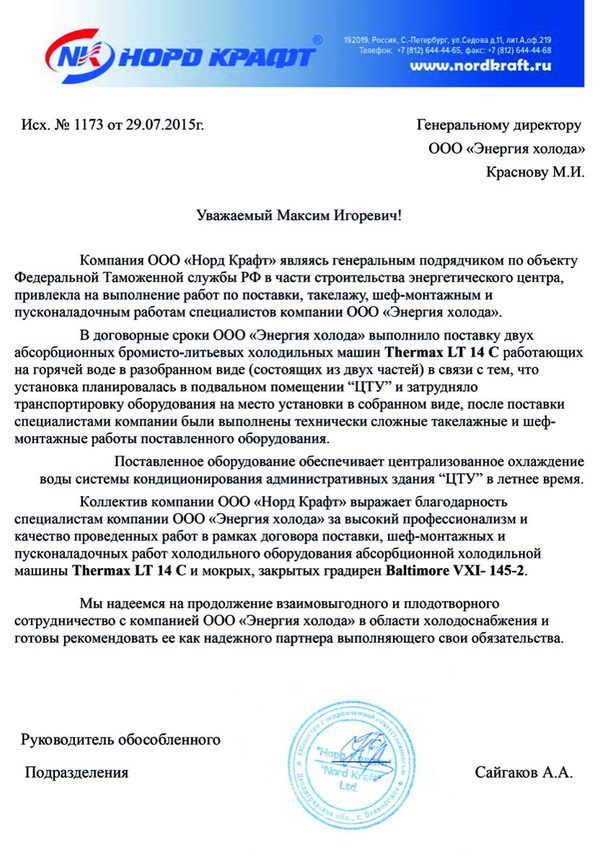
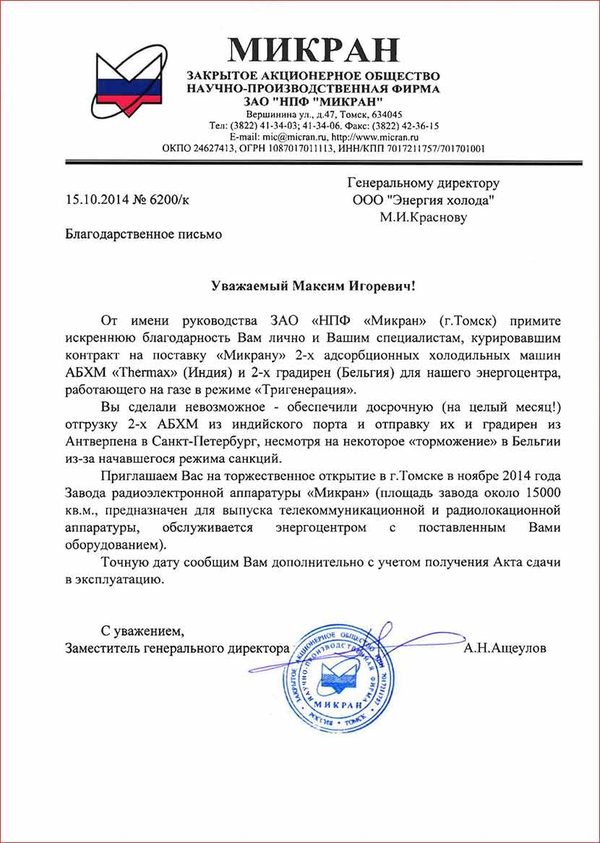
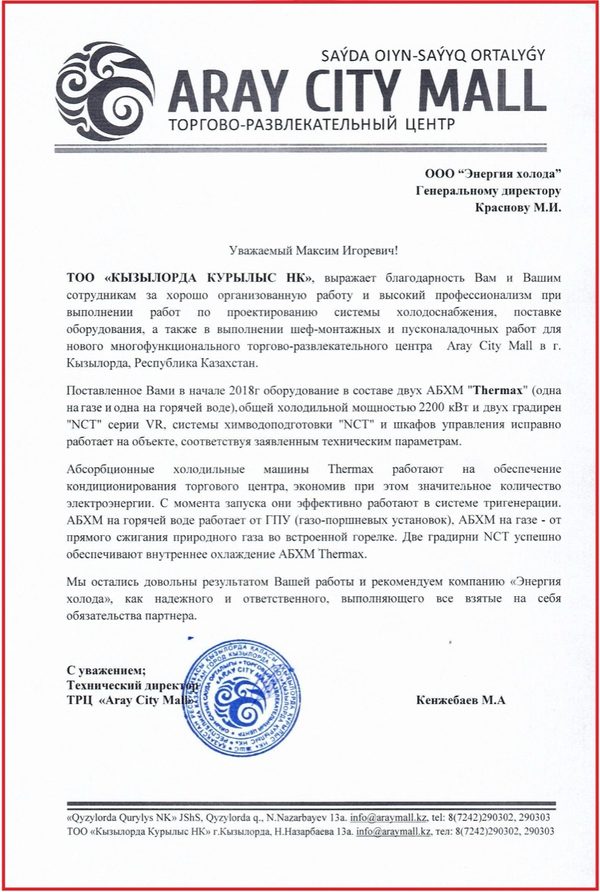
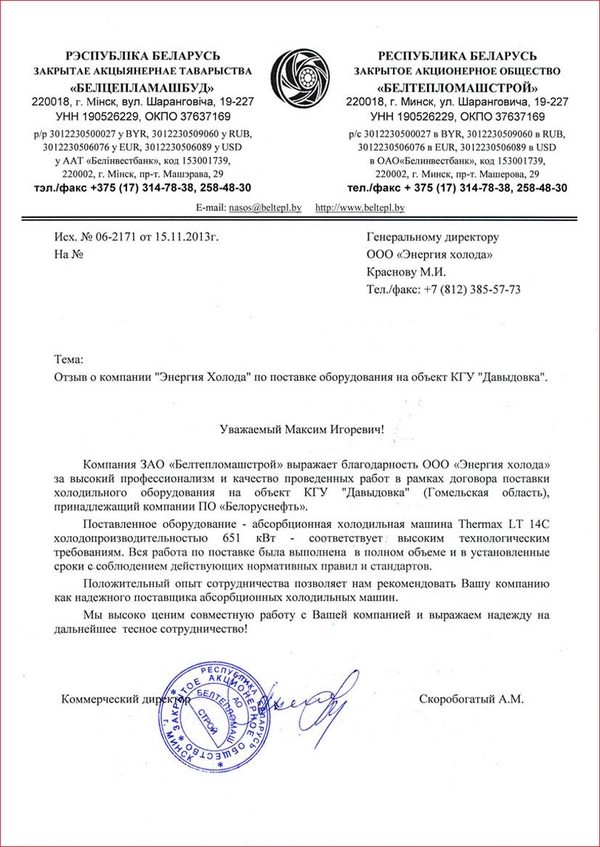
150 letters of thanks · 350+ major projects · 1,000+ customers · in business since 2011. These are real letters from customers; many others are on the references page.
Let us calculate trigeneration for your site
An engineer will put together the scheme and select the equipment, and you get a feasibility study. Free of charge, no obligation.