

Trigeneration feasibility study for a dairy plant
In brief. For a dairy plant with 2 MW of cooling and 3,456 load hours, the model gives savings of RUB 109.8 million per year and a payback of 2.2 years with the grid already in place. This is a model calculation and a guide.
For a dairy plant with a cooling peak of 2,000 kW and an electrical load of 1,800 kW, the model gives a payback of 2.2 years with the grid already in place and 1.1 years if the capacity had to be connected. The plant consumes electricity and process cooling all year round, and in winter the engine heat goes to space heating.
The calculation is a model, a guide based on typical prices, and the main savings come from own electricity. How it works is described on the page how to calculate payback.
What site did we calculate?
Cooling of 2,000 kW at 3,456 full-load hours per year, an electrical load without cooling of 1,800 kW for 8,000 hours per year. We compare with a chiller with a seasonal COP of 4. In winter, the engine gives 800 kW of heat for space heating for 4,000 hours, and the boiler house no longer burns this gas.
What was the result?
| Item | Value |
|---|---|
| Peak cooling | 2,000 kW |
| Full-load cooling hours | 3,456 h/year |
| Electrical load excluding cooling | 1,800 kW, 8,000 h/year |
| Reference chiller, seasonal COP | 4.0 |
| Winter heat | 800 kW, 4,000 h/year |
| Gas engine output | 14.7 million kWh/year |
| Required generating capacity | about 2,200 kW |
| Gas | 4.0 million m³/year |
| Own electricity | RUB 3.72/kWh vs RUB 10 from the grid |
| Cooling from waste heat | 100% of annual demand |
| Costs: grid and chiller | RUB 163.3 million/year |
| Costs: trigeneration | RUB 53.5 million/year |
| Savings | RUB 109.8 million/year |
| Capex: trigeneration | about RUB 298.8 million |
| Capex: chillers | about RUB 60.0 million |
| Payback of the difference, grid capacity available | 2.2 years |
| Payback if a grid connection is needed | 1.1 years (connection fee RUB 115.9 million) |
Waste heat covers 100 % of the annual cooling demand. Own energy costs RUB 3.72/kWh versus RUB 10 from the grid, and most of the savings come from it. Cooling gives the engine heat a use in the warm part of the year and takes load off the electric chillers.
What happens at a different tariff and gas price?
| Gas, RUB/m³ | Power RUB 7.5 | Power RUB 10 | Power RUB 12 |
|---|---|---|---|
| 7 | 3.1 years | 2.0 years | 1.6 years |
| 9 | 3.4 years | 2.2 years | 1.7 years |
| 12 | 4.1 years | 2.4 years | 1.8 years |
The range is from 1.6 to 4.1 years. If the tariff falls to RUB 7.5 and gas rises to RUB 12, the period will be 4.1 years, which is at the limit of what customers usually accept.
What assumptions are in the calculation?
Tariff RUB 10/kWh, gas RUB 9/m³, water RUB 50/m³, gas engine efficiency 40 % and 45 %, gas engine service RUB 1.3/kWh. Investment is based on the company's 2026 model benchmarks: RUB 78,000 per kW of generation, RUB 65,000 per kW of cooling, RUB 30,000 per kW of chiller in the baseline. These are benchmarks, not prices; in a project, they are replaced by the price from a commercial proposal.
What does the calculation not take into account?
- Steam. If the plant needs steam for pasteurization and washing, a heat recovery steam generator or a steam scheme will be required, and that is a different cost. More about the scheme on the page about steam.
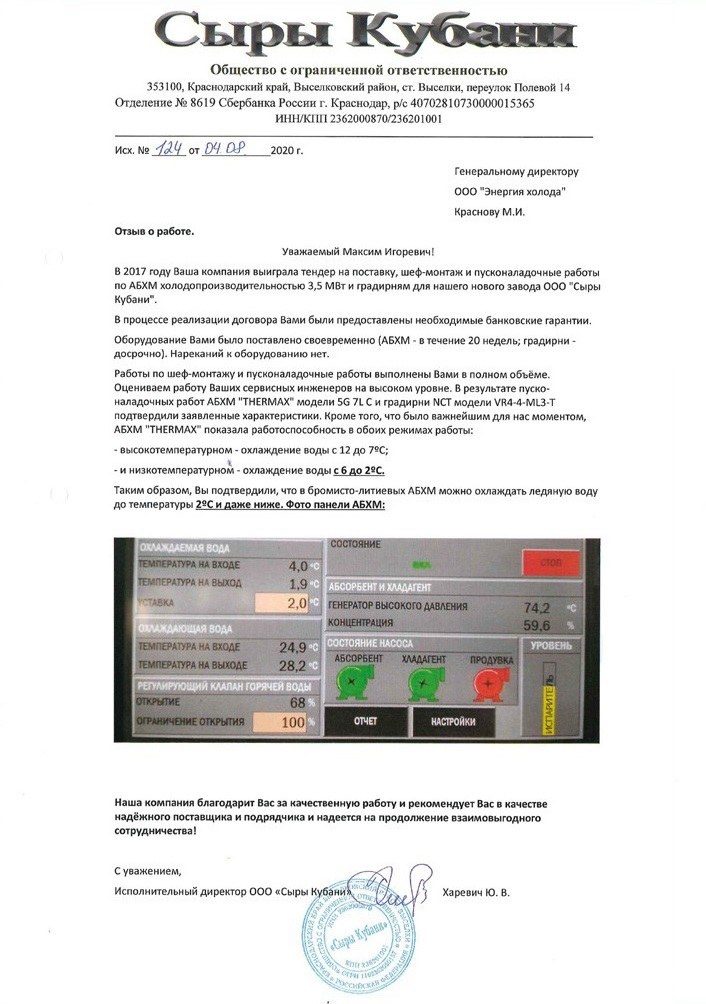
- Water temperature. If the process needs water below the usual 7/12 °C, the chiller is selected for that mode, as at Syry Kubani cheese plant (6/2 °C).
- Milk seasonality and maintenance shutdowns. The equivalent 3,456 hours are an average.
- Redundancy according to the plant's own standards.
Which of our sites is similar?
Syry Kubani cheese plant: one steam-fired Thermax absorption chiller, 3,500 kW, 12/7 and 6/2 °C modes, with four MTU engines of 1,948 kW each in the energy center. A letter from the customer, signed by the executive director of OOO "Syry Kubani", confirms that the chiller cools water down to 2 °C. This is one of our many sites; more about the food industry in the food plants section.
What next?
A real calculation needs monthly cooling profiles and the tariff. Send them through a request for a feasibility study or estimate the figures in the calculator.
Frequently asked questions
Will a hot-water absorption chiller after a gas engine pay back if cooling now comes from conventional chillers?
Payback is calculated from a questionnaire with the electricity price at the site and the cooling load (process plus air conditioning). It matters whether your chillers are already installed. In our model, the baseline chillers are bought new, and their cost (RUB 60.0 million) is deducted from the difference in investment. If they were bought long ago, there is no offset: the difference in investment grows by RUB 60 million, and the period by about half a year. On the other hand, the old chillers can be kept for peak and backup.
What our customers say
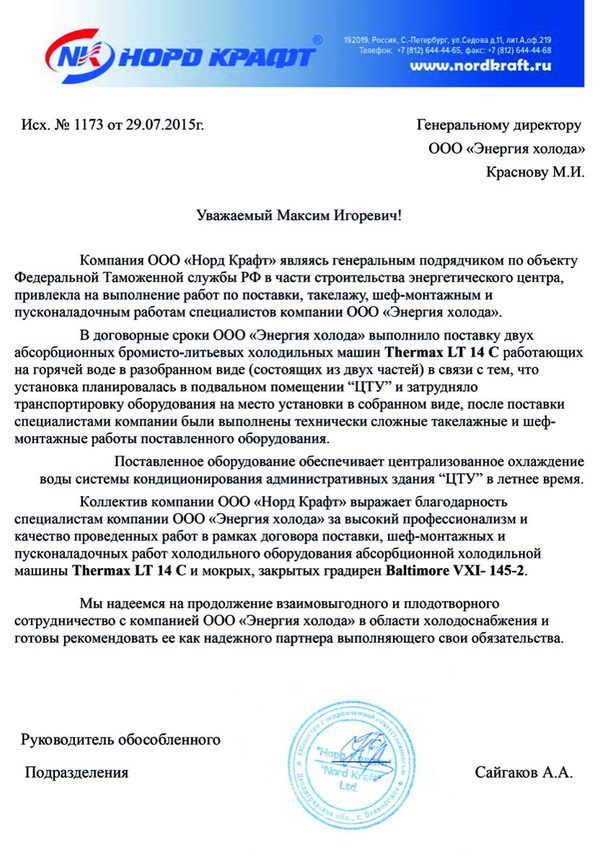
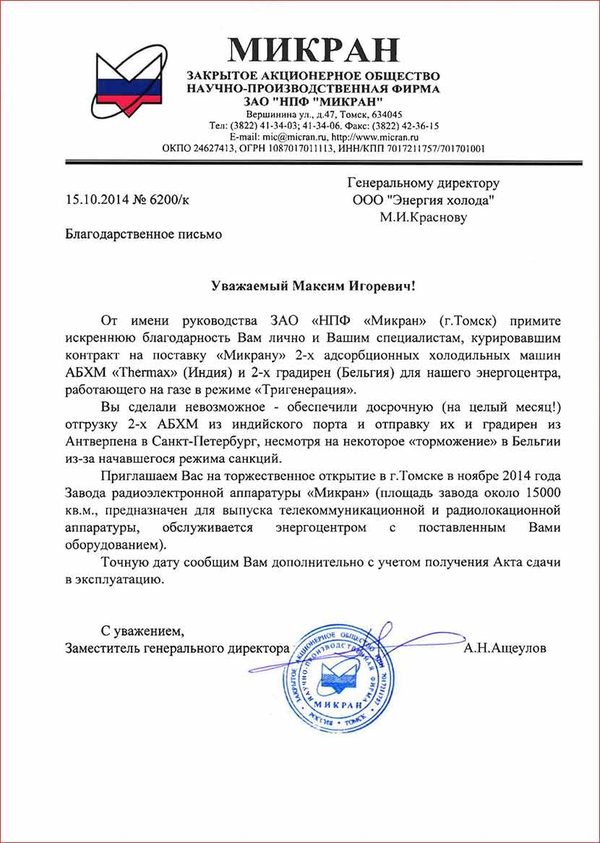
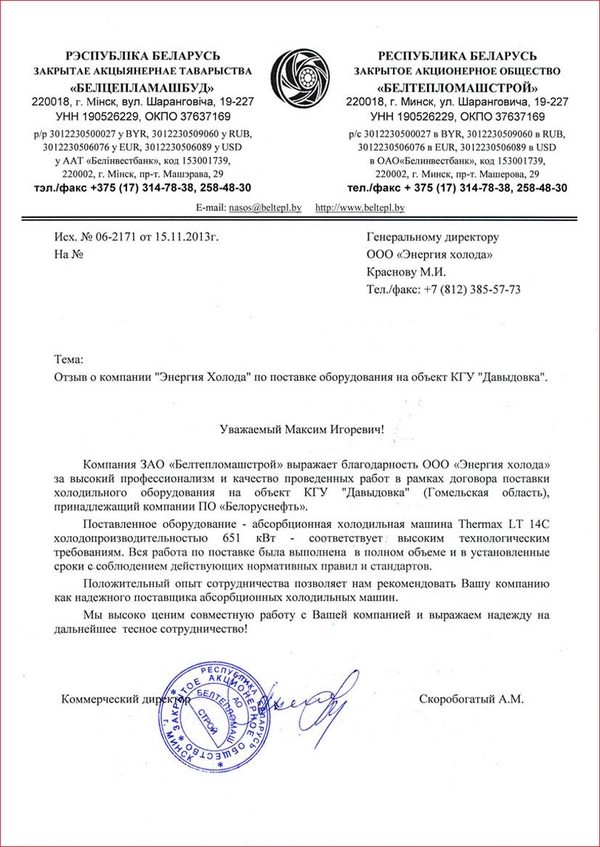
150 letters of thanks · 350+ major projects · 1,000+ customers · in business since 2011. These are real letters from customers; many others are on the references page.

Let us calculate trigeneration for your site
An engineer will put together the scheme and select the equipment, and you get a feasibility study. Free of charge, no obligation.