

Trigeneration and absorption chiller design: stages, input data, typical mistakes
In brief. A trigeneration project goes from a feasibility study and concept design to detailed design and field supervision. The key input data are the hourly load profile, engine exhaust at 100, 75 and 50%, a water analysis and the site climate.
A trigeneration (CCHP) project starts with the hourly load profile and the engine data. Cold Energy (NCT) designs the cooling circuit with Thermax absorption chillers and its interface with the engine: from the feasibility study and concept design to detailed design and field supervision. The gas engine generator sets themselves can be ordered from us too, together with the cooling.
What stages does design consist of?
-
Feasibility study: does the scheme pay off, what cooling is needed and for how many hours a year.
-
Technical and economic calculation (TER).
-
Concept design: scheme, equipment, space for it.
-
Design documentation.
-
Detailed design documentation.
-
Field supervision by the designer.
The detailed design sections for cooling with a lithium bromide absorption chiller are: mechanical (KhS), steel structures (KM), controls (AKhS) and electrical (EM). For a gas-fired machine, gas supply and flue gas removal are added; for a steam machine, steam and condensate piping with relief valve calculations.
What input data are needed for selection?
If even one item is empty, it is too early to send the selection. The minimum list:
| Block | What is needed | What happens if it is wrong |
|---|---|---|
| Cooling | capacity and profile by hour and month, temperatures 12/7 °C or others, hours per year, redundancy (N+1, 2N) | shortfall at peak or running at 20% |
| Engine | electrical output, mode (grid-parallel, island), exhaust and hot water at 100, 75 and 50% load, allowable back pressure | the engine loses power, the machine does not hold its operating point |
| Heat | supply and return temperatures, flow, year-round demand | capacity shortfall, wrong pump |
| Cooling tower | site climate (wet bulb), noise, 27/32 °C circuit | the cooling tower cannot keep up in summer |
| Water | laboratory analysis of make-up water, whether there is enough volume | scale and corrosion |
| Site | plant room, openings, rigging route, floor slab, heated room above +5 °C | the machine does not fit through or stands on an unsuitable slab |
Engine data for a single 100% load point are not enough: exhaust temperature rises as load falls. The full questionnaire is available on request.
Where do projects most often go wrong?
| Mistake | What it leads to |
|---|---|
| Cooling tower and pumps sized "as for a chiller" | the machine cannot hold its capacity in the first hot summer |
| No cooling tower bypass | crystallization in the shoulder seasons |
| Engine data only at 100% | the selection does not hold at 75 and 50% |
| No water analysis | scale: a 1 mm layer takes away about 14% of capacity |
| GOST flanges instead of ASME B16.5 Class 150 | it does not fit together at installation |
| Floor load based on operating weight | the slab is not designed for a machine filled with water |
| No backup power for the dilution cycle | crystallization on power loss |
Some of them are the same six interfaces described on the why trigeneration does not pay off page.
Jacket water circuit: the engine comes first
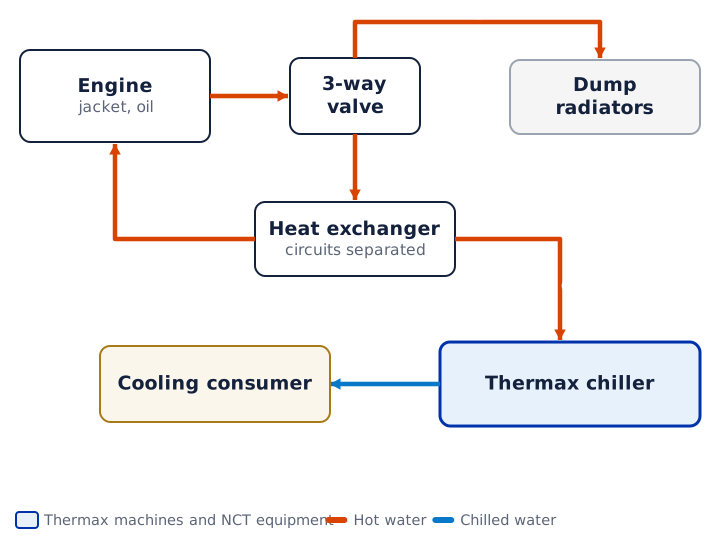
The return temperature to the engine is held by a three-way valve. The engine circuit is separated from the machine circuit by a heat exchanger. If the machine does not take the heat, the valve sends it to the emergency radiators, and the engine keeps running.
What does the project rely on?
On codes and standards: SP 60.13330 and SP 73.13330 (Russian building codes) for chilled and cooling water, SP 62.13330 and the Federal Norms and Rules (FNP) on gas consumption for a gas-fired machine, FNP ORPD for steam and hot water above 115 °C, PUE for electrical work, SP 131.13330 for climate data. FNP No. 531 and No. 536 are in force until 1 January 2027: at the time the project is issued, you need to check which act has replaced them.
Redundancy is set according to the customer's requirements. A layout example: four machines of 3,200 kW each and one standby machine in a chiller plant; with N+1, scheduled maintenance does not stop production. We calculate the cost of downtime together with you. A notional example: with downtime costing RUB 250,000 per hour and a standby machine at RUB 4 million, the redundancy pays off with two prevented 8-hour shutdowns over five years.
The cooling circuit is designed by one contractor, so the controls, pumps and cooling tower are calculated together. What exactly to install is described on the trigeneration plant page. At the estimate stage, see how to calculate a feasibility study.
If you want us to check your project or prepare a new one, submit a request for a feasibility study or run the numbers in the calculator. Thermax equipment: abxm-thermax.ru.
Frequently asked questions
Are storage tanks needed in the chilled and hot water circuits with an absorption chiller?
In the 7/12 °C chilled water circuit, in most cases no: the absorption chiller modulates smoothly from 10 to 100%, the system has a large water volume and the load is stable. Storage tanks are usually not used in the hot water circuit (not to be confused with expansion tanks). For year-round operation, an intermediate cooling water tank is installed after the cooling tower if there is no central cooling water system. The exception is a continuous load, where a chilled water tank is needed to cover the time the machine takes to reach its operating point, about 30 minutes.
Can you calculate gas engine emissions for the environmental section?
We do not: designers do this by the approved method in the environmental section. Take the NOx and CO limits from the engine datasheet, and add the noise limit in the installation zone (industrial or residential), the design (containerized or open) and the altitude above sea level.
What our customers say
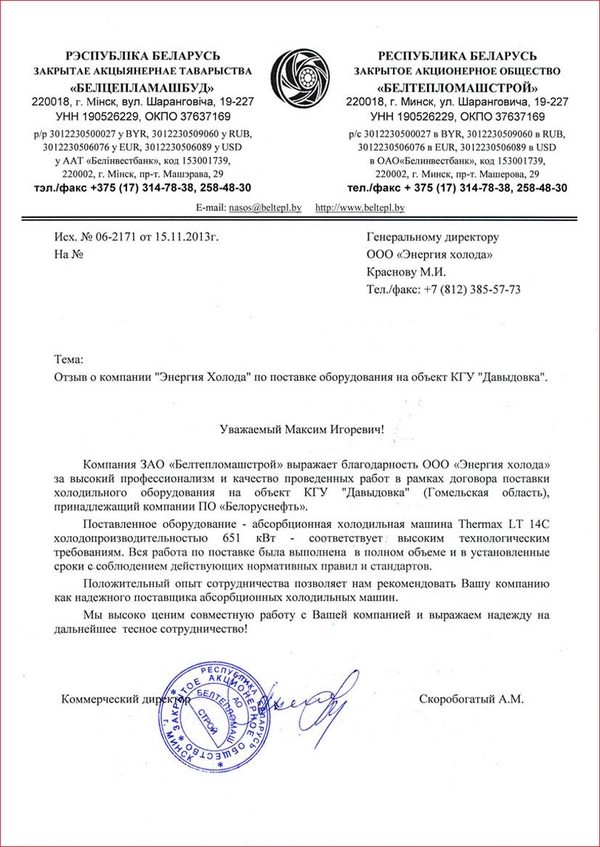
150 letters of thanks · 350+ major projects · 1,000+ customers · in business since 2011. These are real letters from customers; many others are on the references page.



Let us calculate trigeneration for your site
An engineer will put together the scheme and select the equipment, and you get a feasibility study. Free of charge, no obligation.