

Trigeneration for factories, electronics and power generation
In brief. The scheme suits an industrial site if the engine or turbine has heat above 80 °C all year round and cooling is needed for at least 3,000 hours a year. Process heat at 45 °C is too little for an absorption chiller. At a gas turbine station, inlet cooling gives the turbine more output in summer.
At an industrial plant, trigeneration (CCHP) works when the engine or turbine has hot exhaust or hot jacket water, and cooling is needed for a process or air conditioning almost all year round. For an electronics plant, a factory and a power station, the task is different. A factory needs cooling as part of the process. A station needs cooling so as not to lose output in summer. In both cases the main risk is the same: the engine or turbine stops, and the cooling stops with it.
How is industry different from other sectors?
Here the cooling goes to a process, and the requirements for it are stricter than in a shopping mall. The customer of the electronics production at Mikran in Tomsk set strict reliability requirements. The main difficulty of the project was coordinating the operation of the gas engine plant and the lithium bromide absorption chillers during the transition period and at low load.
Low load is a separate problem. According to the US Environmental Protection Agency (EPA), gas turbines have poor efficiency at part load, while reciprocating engines and microturbines have acceptable efficiency. That is why selection is based on the actual hourly load profile, not on averages.
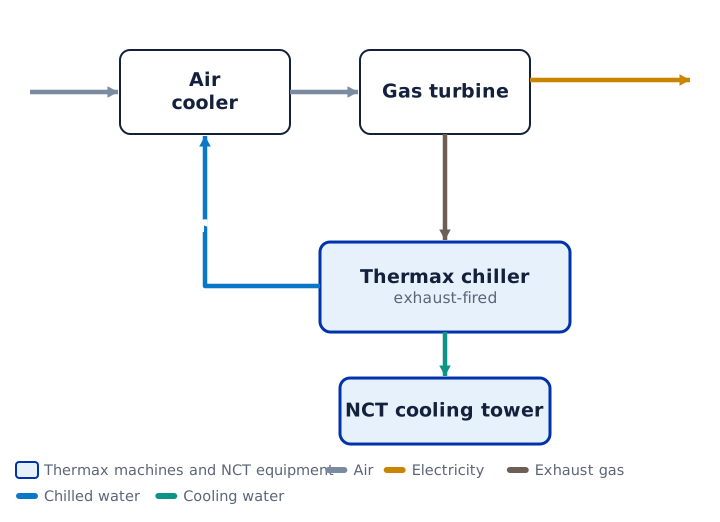
A gas turbine station is a special case. In summer the turbine loses output because of the heat. The exhaust drives an absorption chiller, and its chilled water cools the air at the compressor inlet. The turbine's own waste heat gives back its summer output.
Gas turbine and an exhaust-fired chiller
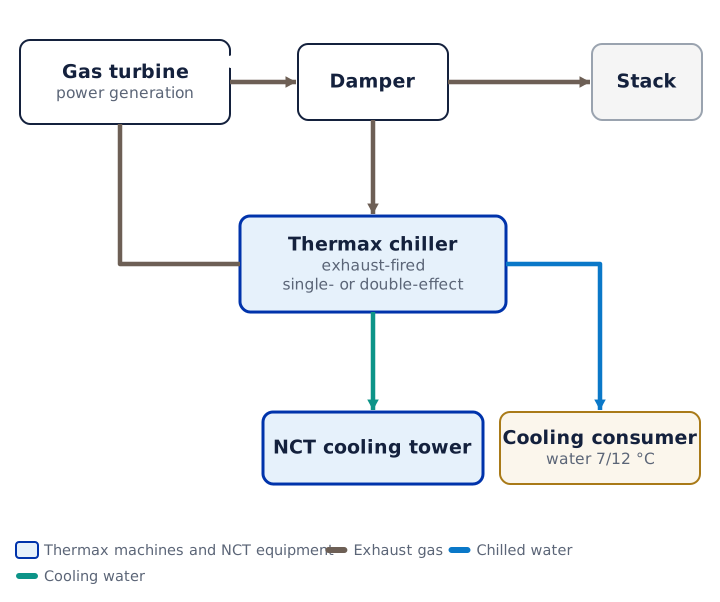
The gas turbine exhaust goes through a damper to an exhaust-fired Thermax chiller. When little cooling is needed, the gas goes to the bypass. A turbine gives a lot of heat at a high temperature.
Cooling at the turbine inlet
In hot weather a gas turbine loses output. Chilled water cools the air before the compressor, and electrical output in summer rises thanks to the turbine's own waste heat.
What are the limitations of the scheme?
-
You need heat at a high enough temperature. Hot water for the LT series can start from 70 °C, but the capacity is then noticeably below nominal; economically it makes sense from 80 °C.
-
Exhaust cannot "just be connected." An exhaust-fired chiller has a gas-side pressure drop of 200–250 mm H2O, and the engine or turbine must be able to handle it. That is why back pressure in the gas path is calculated and a bypass is installed.
-
If the engine stops, the cooling stops. A process needs a second heat source or a chiller, and the absorption chiller takes about 30 minutes to reach its operating mode.
-
Small capacities. Below 300 kW of cooling and below 2,000 hours a year, an absorption chiller does not pay back.
For industry we have no single standard feasibility study model: each process has its own cooling curve. You can make an estimate in the calculator and then refine it with your load profile.
What industrial sites do we have?
These are examples, and many others are in the projects section.
| Site | Generation | Cooling | What we did |
|---|---|---|---|
| Mikran plant, Tomsk | 1.7 MW gas engine | 2 × 5G 4L C, 1,100 kW each | Supply, installation supervision, commissioning |
| ZhGTES gas turbine power station, Aktobe | Gas turbines, 110 MW in total | 2D 5M C on exhaust, about 3.2 MW, 15/8 °C | Supply, installation supervision, commissioning |
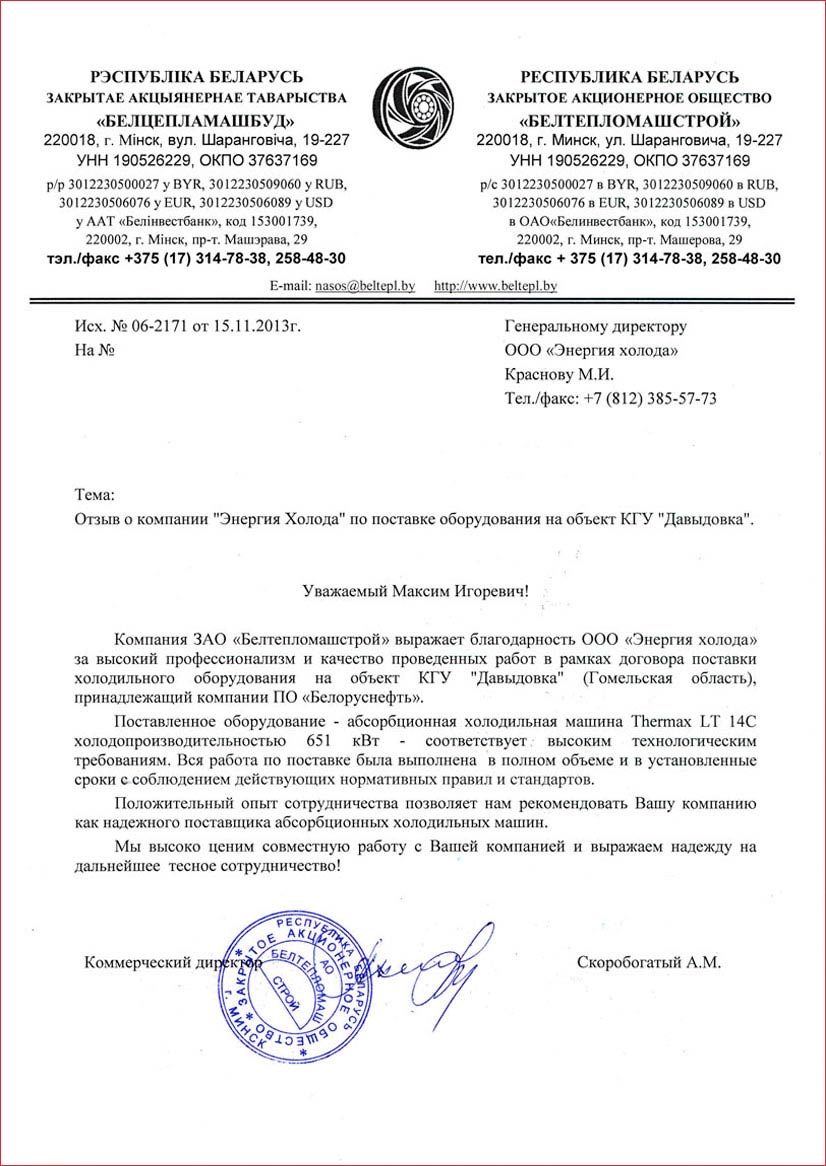
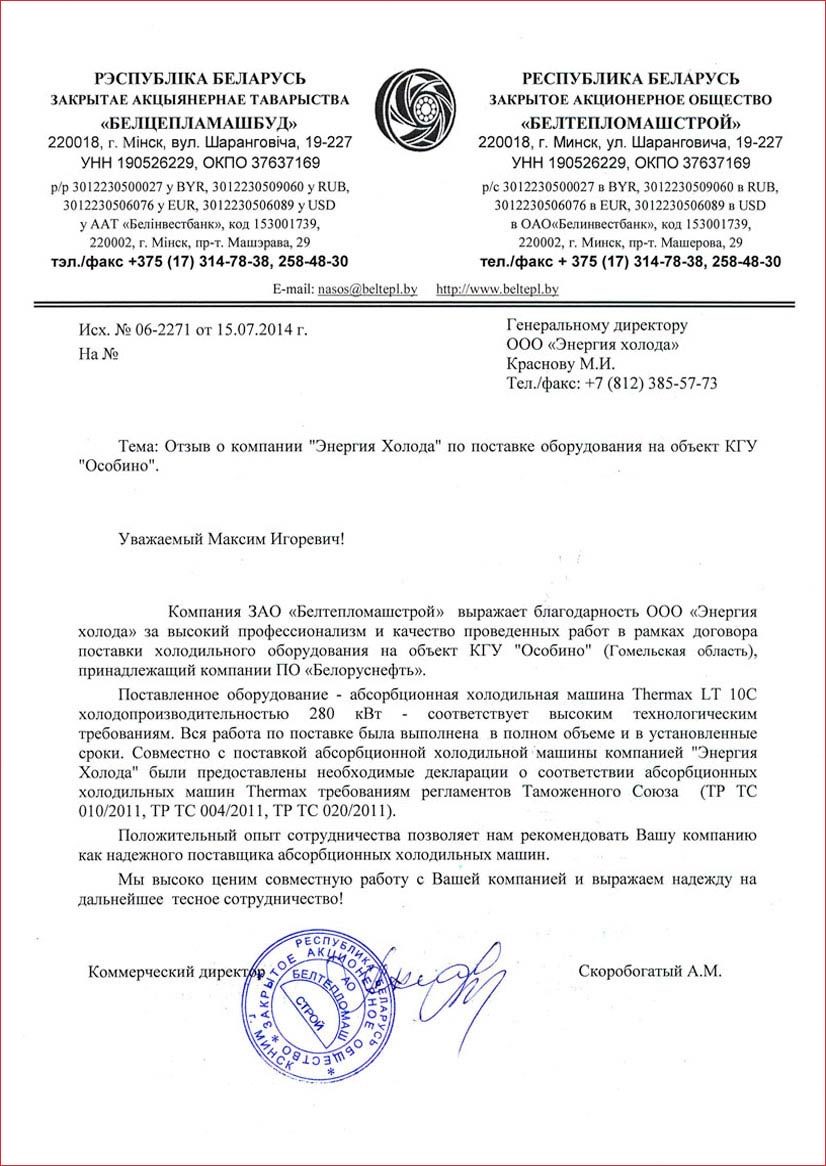
| Davydovka and Osobino cogeneration units, Belarus | 1.26 and 3.1 MW gas engines | LT 14C 651 kW and LT 10C 280 kW | Supply, installation supervision, commissioning, training |
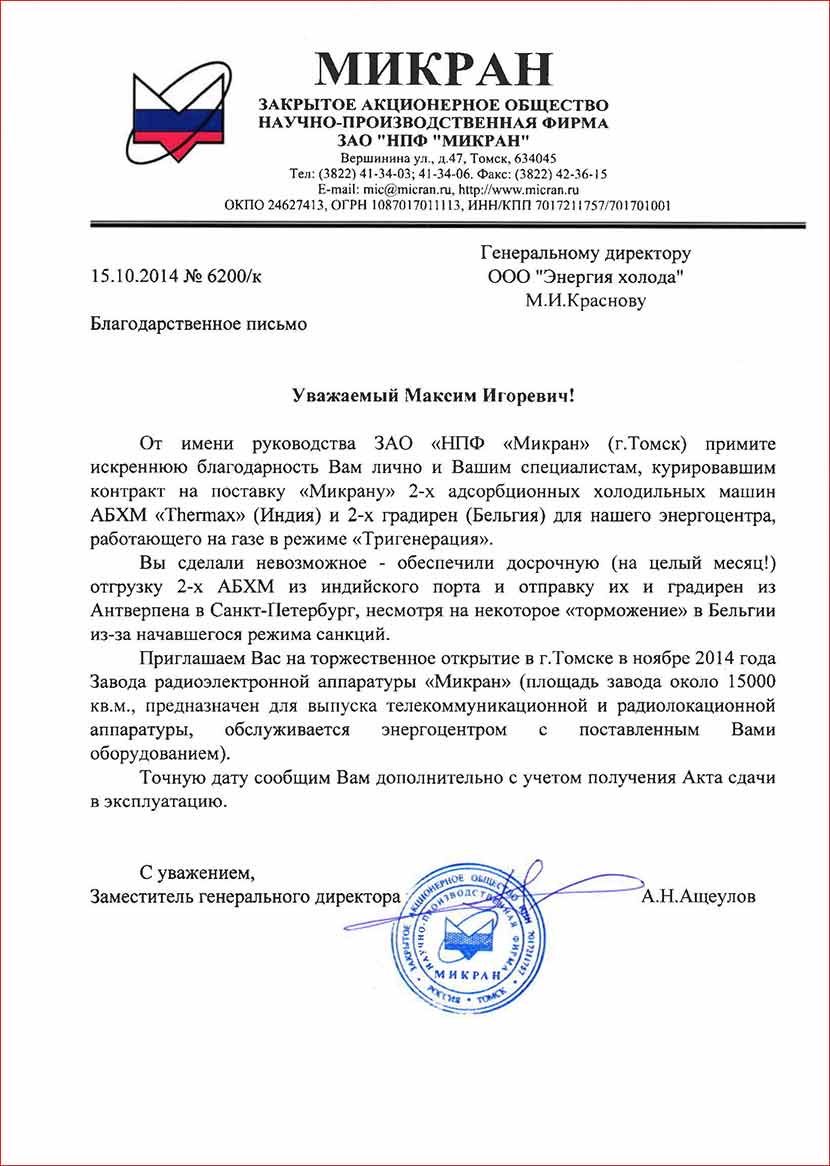
Mikran is a radio-electronic equipment plant of about 15,000 m². The letter from the owner of the energy center says that two Thermax absorption chillers and cooling towers were shipped a full month ahead of schedule, despite the cargo being held up in Belgium because of sanctions.
At ZhGTES the chiller cools the air at the gas turbine inlet, and output no longer depends on the outdoor air temperature. We do not give a figure for the output gain: we have no measurements.
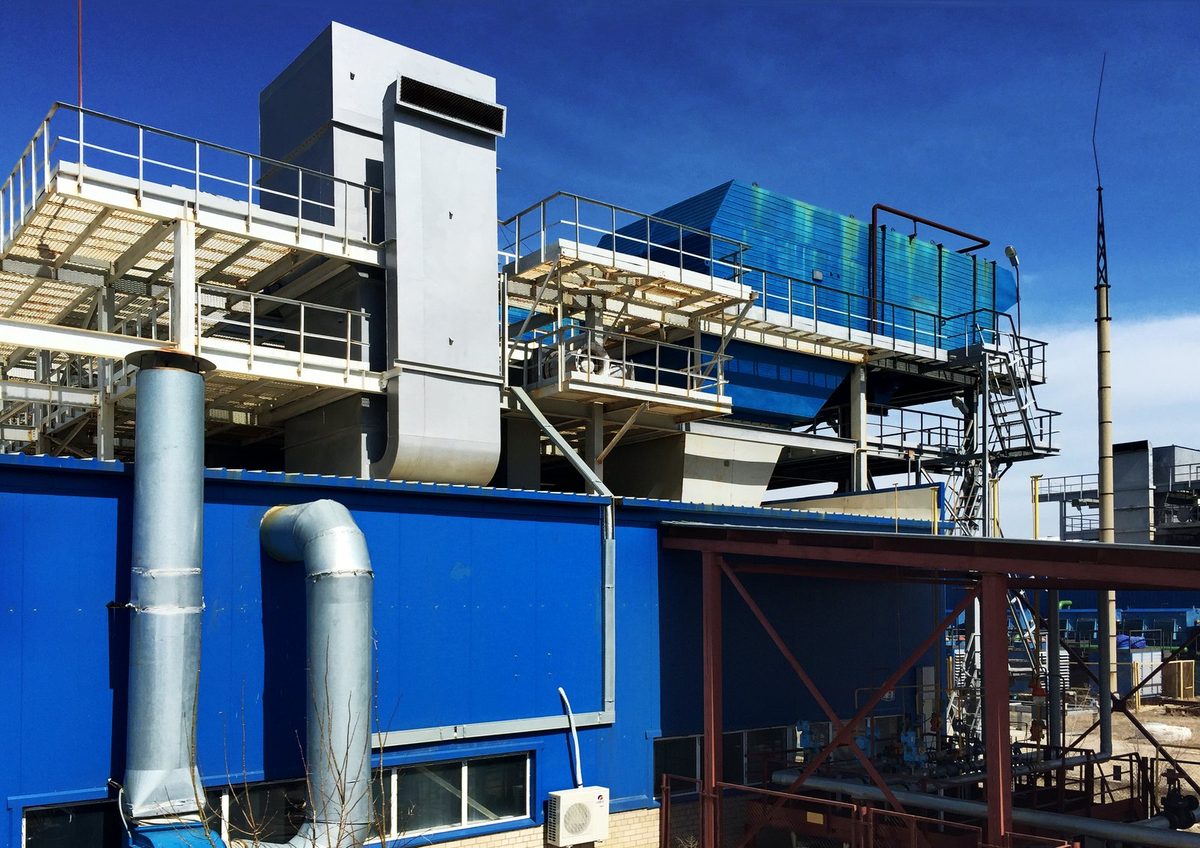
 Thermax absorption chillers at a gas turbine power station in Kazakhstan (in Russian)
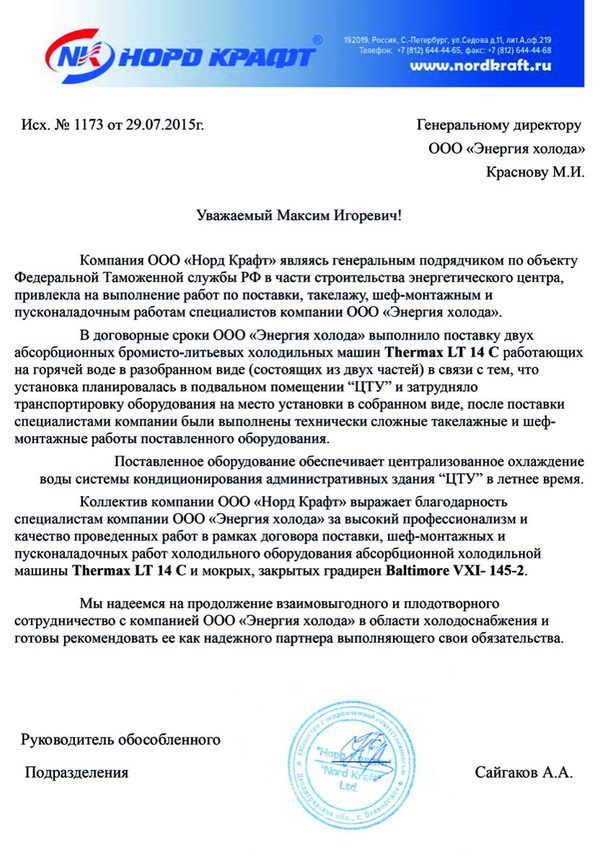
The Belorusneft sites, the Davydovka and Osobino cogeneration units, are gas engine cogeneration plants with cooling from waste heat. Both letters are signed by the contractor, not by the site owner: they were sent by Belteplomashstroy CJSC. The Davydovka reference is dated 15 November 2013, the Osobino one 15 July 2014. Both letters state that the work was completed in full and on time, and recommend the company as a reliable supplier.
What examples are there around the world?
Data from Thermax presentations, not independently verified.
| Site | Generation | Cooling from heat | Purpose |
|---|---|---|---|
| Moser Baer (India), optical discs | 5 Wartsila engines, 6 MW each | steam and jacket water chillers, about 21 MW | Process and comfort cooling |
| LEGO, Nyíregyháza (Hungary) | 3 GE Jenbacher JMS 620, 2.6 MW each | 3 absorption chillers on exhaust and jacket water | Cooling for plastic molding |
| AT&S, Shanghai (China), printed circuit boards | 1 gas engine, 1.1 MW | 1 absorption chiller, about 1,160 kW | Chilled water at 7 °C in summer, hot water at 80 °C in winter |
LEGO reports a reduction in emissions of 8,500 tonnes of CO2 per year. In Thermax materials, Moser Baer is named as one of the largest installations in India. The project in Austin (USA) from an ORNL report is also telling: a 4.5 MW gas turbine and a 2,500-ton double-effect chiller on the exhaust without a heat recovery steam generator. Total efficiency at full load is above 80 %, and the average, based on preliminary measurements, is 74 %. For such a scheme ORNL recommends a year-round base heat load of at least 4,500 hours a year.
Where the engine and the cooling get in each other's way is covered on the trigeneration mistakes page. If they are split between different contractors, the interface belongs to no one. At Cold Energy (NCT) you can order the engine and the cooling together.
Selection for your site starts with an hourly load profile and the heat temperature. Send them for a feasibility study or check the order of magnitude in the calculator. For engine and chiller piping, read the gas engines page, and for gas turbines, the gas turbines page.
Sources
- ORNL, Berry et al., Advanced absorption chiller converts turbine exhaust to air conditioning, ISHPC 2005: ornl.gov
- EPA, Catalog of CHP Technologies, 2017: epa.gov
- Moser Baer, LEGO, AT&S projects: Thermax materials
Frequently asked questions
Can we install an absorption chiller if all we have is 45 °C hot air from an extrusion line?
No, that is too little to drive it. Usually trigeneration with a gas engine generator set is considered, where the engine becomes the heat source. For selection we need the inlet and outlet temperatures of the chilled water, the makeup water source and the reserve of electrical capacity.
Can we get cooling for distillation column condensers from the heat of process vapors through an absorption chiller?
Technically this is justified if there is surplus heat. 1 MW of heat will give roughly 0.8–1.4 MW of cooling, depending on the heat transfer medium. The equipment is a self-contained unit that fits into the existing scheme.
We want to recover secondary heat from a process unit (hot water) through an absorption chiller. What data is needed?
Supply and return temperatures, available flow rate, hourly profile and whether it is available year-round. On the cooling side: the load profile, temperatures and medium. Then the electricity tariff, gas and water prices, a laboratory analysis of the makeup water, the plant room dimensions and the rigging route, and space for the cooling tower. While even one item is blank, it is too early to send a selection request.
What our customers say
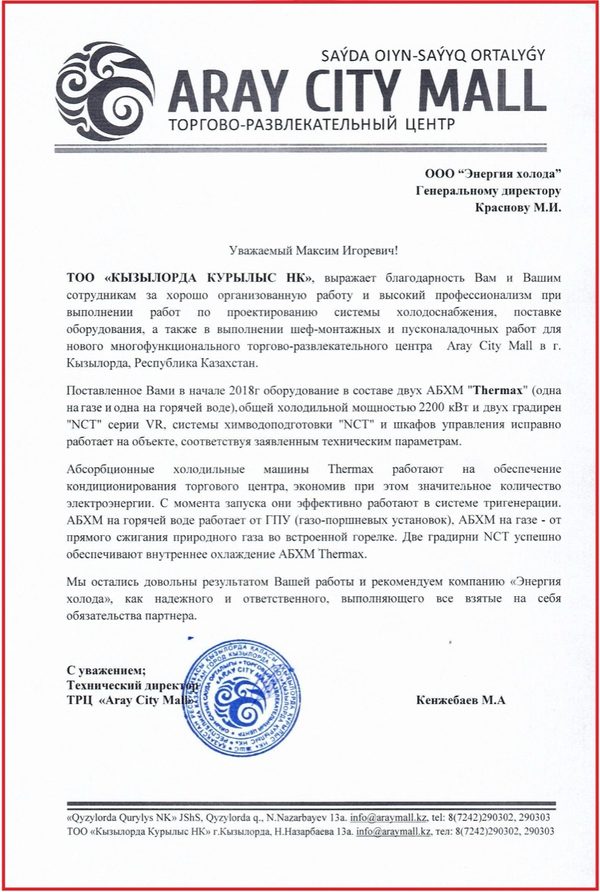
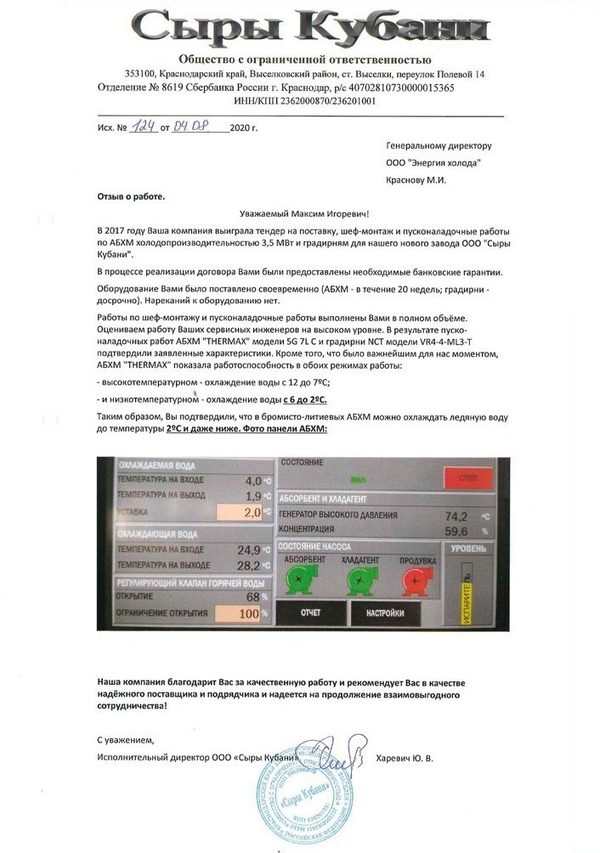
150 letters of thanks · 350+ major projects · 1,000+ customers · in business since 2011. These are real letters from customers; many others are on the references page.
Let us calculate trigeneration for your site
An engineer will put together the scheme and select the equipment, and you get a feasibility study. Free of charge, no obligation.