

Supply of trigeneration equipment: lead times, packing, oversized delivery
In brief. A Thermax absorption chiller reaches the site through a port in 14–25 weeks, and Thermax issues drawings 2–4 weeks after the order. The chiller is oversized cargo, so the rigging route into the building is planned in advance.
Supplying a trigeneration (CCHP) plant is more complicated than buying equipment from a catalog. The Thermax lithium bromide absorption chiller is made at the Thermax factory, NCT cooling towers and chillers at our plant, and the pumps and controls separately. Each component travels its own route and has to arrive at the right point on time. Cold Energy (NCT) supplies gas engine generator sets and the cooling circuit and is responsible for completeness of supply.
How long does supply take?
According to technical and commercial proposals for 2026: absorption chillers 14–25 weeks, cooling towers 10–15 weeks. Large packages can take longer: absorption chillers up to 28–30 weeks, cooling towers and pumps up to 16–18 weeks. Thermax issues drawings with exact dimensions and mounting details 2–4 weeks after the order: until then neither the foundation nor the openings are finalized.
Lead times depend on the series, capacity and factory workload, so the proposal states the lead time for your model. The figures above are a guide, not an offer.
How does the chiller get to the site?
The chiller leaves the factory in a protective crate, is loaded onto rail or road transport and goes to a seaport, where it is transferred into containers and shipped by sea to a Russian port, and from there by road or rail to the installation site. Absorption chillers and gas engine generator sets are almost always oversized: they do not fit into a standard container or onto a standard platform. That is why special protective factory packing is used.
The chiller arrives assembled, under nitrogen. On request it is shipped in three parts: the lower shell, the upper shell and the high-temperature generator.
How much does the chiller weigh and how do you get it into the building?
For example, dimensions and weight depend on the chiller. A 400 kW model: dry weight 4.8 t, operating weight 5.8 t, flooded weight 9.4 t. A 1,500 kW direct-fired chiller: 7.6 × 3.6 × 3.8 m, dry weight 30.5 t, operating weight 42.5 t. The largest in the 2B series: 10.8 × 3.6 × 4.4 m and an operating weight of 78.4–84.0 t. The floor slab is designed for the flooded weight, when the chiller is filled with water.
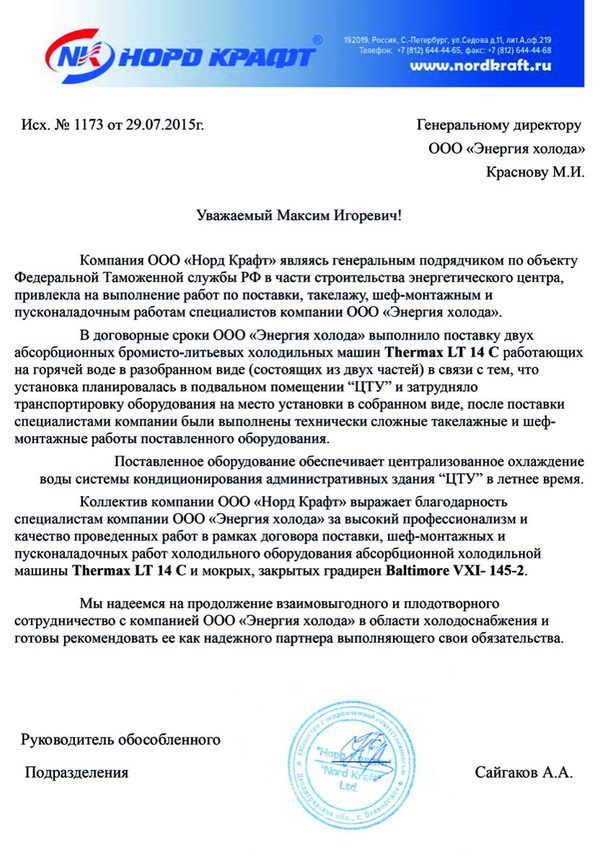
That is why the rigging route is designed in advance: plant room and opening dimensions, gates, lifting capacity. Sometimes chillers are delivered in parts and assembled on site: this was done for the TsTU site in Moscow, where two 500 kW LT-14 C chillers were brought in parts and assembled in the basement. For tall buildings a crane is selected: there is a known case of a lift to the 12th floor with a crane with a 60 m reach.
What is included in the supply?
Gas engines, Thermax absorption chillers, NCT cooling towers and dry coolers, chillers, pump skids, controls and water treatment. In Russia and the CIS, Thermax chillers are supplied only by Cold Energy. If the engine and the cooling are ordered from us together, dimensions and lead times are coordinated right away. Scope and equipment pages: trigeneration plant, Thermax absorption chillers, NCT cooling towers.
After delivery comes installation and commissioning. Why the whole cooling circuit should be handled by one company: services.
If you want to know the lead time for your project, submit a request for a feasibility study or try the calculator. NCT catalog: nc-t.ru.
What our customers say
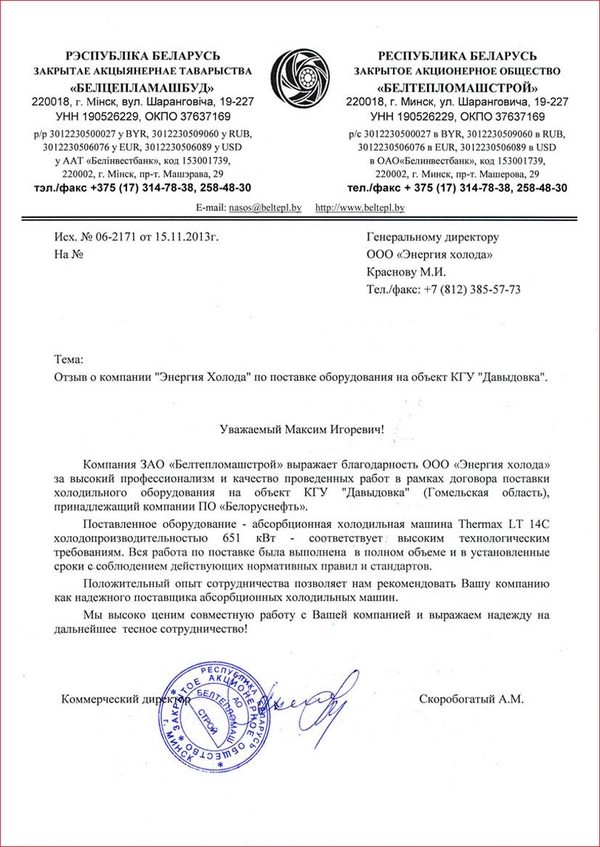
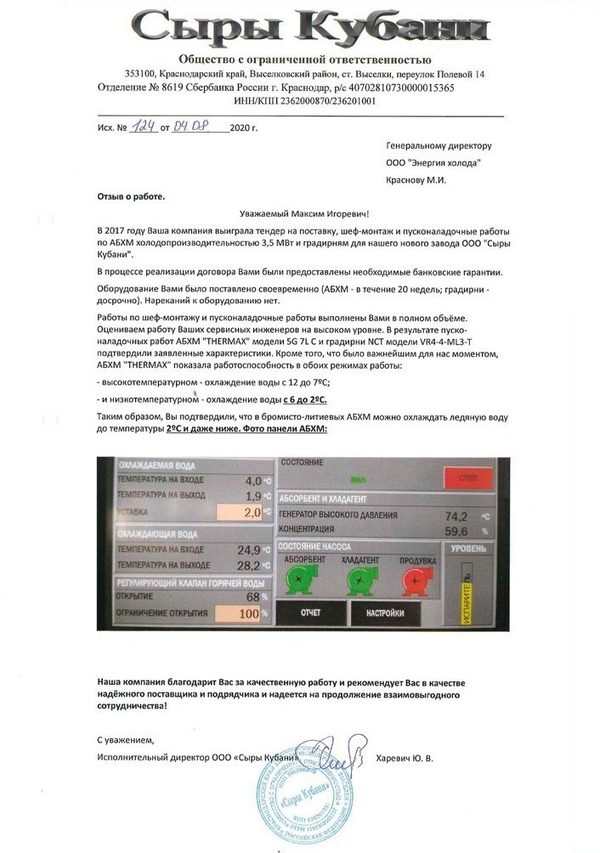
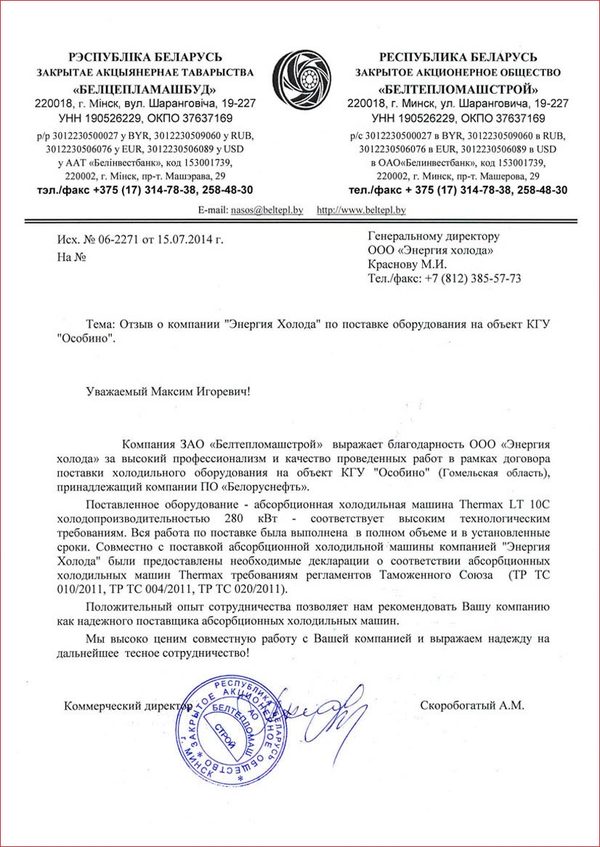
150 letters of thanks · 350+ major projects · 1,000+ customers · in business since 2011. These are real letters from customers; many others are on the references page.
Let us calculate trigeneration for your site
An engineer will put together the scheme and select the equipment, and you get a feasibility study. Free of charge, no obligation.